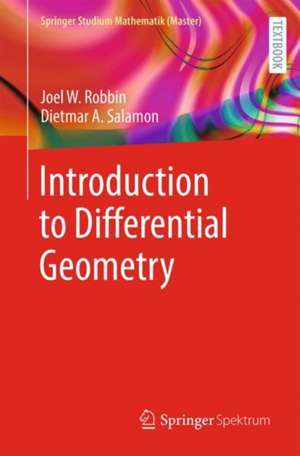
Introduction to Differential Geometry: Springer Studium Mathematik (Master)
Autor Joel W. Robbin, Dietmar A. Salamonen Limba Engleză Paperback – 13 ian 2022
Observăm în Introduction to Differential Geometry o lucrare riguroasă care prioritizează interdependența dintre analiza matematică, algebra liniară și topologia mulțimilor de puncte, oferind un fundament solid pentru disciplinele STEM. Autorii, Joel W. Robbin și Dietmar A. Salamon, propun o metodologie pedagogică echilibrată, abordând subiectul atât din perspectivă extrinsecă, cât și intrinsecă, o dualitate esențială pentru înțelegerea varietăților moderne.
Structura volumului reflectă o progresie logică, de la fundamentele istorice și definirea varietăților netede sau a grupurilor Lie (ajungând la teorema lui Frobenius), până la concepte de profunzime precum conexiunea Levi-Civita și geodezicele. Apreciem în mod deosebit includerea unor secțiuni dedicate varietăților cu curbură secțională nepozitivă și tensorului Weyl, elemente care pregătesc studentul pentru cercetare avansată. Comparativ cu Differential Geometry de Clifford Henry Taubes, care pune accent pe limbajul comun dintre geometrie și fizica teoretică, volumul de față se concentrează pe rigoarea demonstrațiilor matematice pure, precum cea pentru teorema Cartan-Ambrose-Hicks. Totodată, cititorii familiarizați cu Riemannian Manifolds de John M. Lee vor aprecia aici extinderea către abordarea geometric-diferențială a teoriei algebrelor Lie propusă de Donaldson.
Această lucrare se poziționează ca o continuare naturală a preocupărilor autorului Dietmar A. Salamon din The Moment-Weight Inequality and the Hilbert–Mumford Criterion. Dacă în lucrarea anterioară Salamon explora intersecția dintre teoria invariantă geometrică și geometria infinit-dimensională, prezentul manual consolidează baza teoretică necesară pentru a înțelege acele analogii complexe, rămânând fidel stilului clar și sistematic specific editurii Springer.
Preț: 499.32 lei
Carte tipărită la comandă
Livrare economică 03-17 decembrie
Specificații
ISBN-10: 3662643391
Pagini: 432
Ilustrații: XIII, 418 p. 45 illus. in color.
Dimensiuni: 155 x 235 x 24 mm
Greutate: 0.65 kg
Ediția:1st ed. 2022
Editura: Springer
Colecția Springer Studium Mathematik (Master)
Seria Springer Studium Mathematik (Master)
Locul publicării:Berlin, Heidelberg, Germany
De ce să citești această carte
Această ediție este ideală pentru studenții la masterat care doresc o introducere matematică precisă în geometria riemanniană. Dincolo de programa standard de un semestru, cititorul câștigă acces la subiecte avansate precum grupurile de izometrii și raza de injectivitate. Este o resursă excelentă pentru cei care urmăresc o carieră în cercetare, oferind instrumentele tehnice necesare pentru a naviga între topologie și geometria diferențială aplicată.
Despre autor
Joel W. Robbin este profesor emerit la Universitatea din Wisconsin-Madison, cunoscut pentru contribuțiile sale în sisteme dinamice și topologie. Dietmar A. Salamon este un matematician de prestigiu, profesor emerit la ETH Zürich, laureat al Premiului Moore și membru al Academiei Europene. Salamon este o figură centrală în topologia simplectică, fiind coautor al unor lucrări fundamentale care au definit standardele moderne în geometria diferențială. Expertiza lor combinată transformă acest manual într-o referință academică de înalt nivel pentru comunitatea matematică internațională.
Cuprins
Notă biografică
Dietmar Salamon was born in Bremen in 1953 and completed his PhD at the University of Bremen in 1982 under the direction of Diederich Hinrichsen. After postdoctoral positions in Madison and Zurich, hetook up a position at the University Warwick in 1986, and moved to ETH Zurich in 1998, where he has been emeritus since 2018. His field of research is symplectic topology and related subjects.
He was an invited speaker at the ECM 1992 in Paris, at the ICM 1994 in Zurich, and at the ECM 2000 in Barcelona. He delivered the Andrejewski Lectures in Goettingen (1998) and at the Humboldt Unversity Berlin (2005), and the Xth Lisbon Summer Lectures in Geometry (2009).
He is the author of several textbooks and research momgraphs including two joint books with Dusa McDuff entitled "Introduction to Sympectic Topology" and "J-holomorphic Curves and Symplectic Topology" for which they were jointly awarded the 2017 Leroy P Steele Prize for Mathematical Exposition. He is a Fellow of the American Mathematical Society and a member of the Academia Europaea.
Textul de pe ultima copertă
The first chapters give a historical overview of the field and contain an introduction to basic concepts such as manifolds and smooth maps, vector fields and flows, and Lie groups, leading up to the theorem of Frobenius. Subsequent chapters deal with the Levi-Civita connection, geodesics, the Riemann curvature tensor, a proof of the Cartan-Ambrose-Hicks theorem, as well as applications to flat spaces, symmetric spaces, and constant curvature manifolds. Also included are sections about manifolds with nonpositive sectional curvature, the Ricci tensor, the scalar curvature, and the Weyl tensor.
An additional chapter goes beyond the scope of a one semester lecture course and deals with subjects such as conjugate points and the Morse index, the injectivity radius, the group of isometries and the Myers-Steenrod theorem, and Donaldson's differential geometric approach to Lie algebra theory.