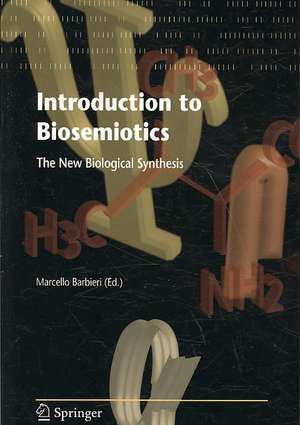
Introduction to Biosemiotics
Editat de Marcello Barbierien Limba Engleză Paperback – 20 mar 2008
Găsim în această lucrare, coordonată de Marcello Barbieri, o analiză riguroasă a modului în care viața poate fi înțeleasă prin prisma semiozei — procesul de transformare a semnalelor obiective în semne cu semnificație. Notăm cu interes abordarea practică a capitolului dedicat codurilor de corectare a erorilor în genetică și studiile de caz privind comunicarea interspecifică, elemente care ancorează teoriile abstracte în date biologice concrete. Structura volumului urmărește o progresie logică, pornind de la fundamentele biofizice și evoluția istorică a domeniului, până la aplicații complexe în epigenetică și imunologie celulară. Cercetătorii familiarizați cu Essential Readings in Biosemiotics de Donald Favareau vor aprecia în acest volum Introduction to Biosemiotics o focalizare mai accentuată pe modelul codurilor organice și pe mecanismele moleculare ale interpretării semnelor. Spre deosebire de sintezele istorice, această ediție din 2007 pune accent pe „schelele semiotice” ale sistemelor vii, oferind o perspectivă tehnică asupra modului în care celulele procesează informația. În contextul operei sale, Marcello Barbieri extinde aici conceptele din The Organic Codes și The Semantic Theory of Evolution, rafinând distincția dintre selecția naturală și convențiile naturale. Cartea reușește să demonstreze că viața nu este doar interacțiune moleculară, ci un sistem complex de codificare și interpretare, esențial pentru înțelegerea evoluției moderne.
Preț: 1267.33 lei
Preț vechi: 1545.53 lei
-18%
Carte tipărită la comandă
Livrare economică 21 noiembrie-05 decembrie
Specificații
ISBN-10: 1402083440
Pagini: 530
Ilustrații: XII, 530 p.
Dimensiuni: 160 x 235 x 31 mm
Greutate: 0.78 kg
Ediția:2007 edition
Editura: Springer
Locul publicării:Dordrecht, Netherlands
V-ar putea interesa
-
 The Reason WhyJohn GribbinPreț: 112.72 lei
 -
 Applied Evolutionary PsychologyS. Craig Roberts-31%Preț: 748.82 lei1081.24 lei
 -
 Preț: 112.19 lei
 -
 Mathematical Population Genetics 1Warren J. Ewens-18%Preț: 1161.93 lei1416.98 lei
 -
 Moral OriginsChristopher BoehmPreț: 235.00 lei
 -
 The Organic CodesMarcello Barbieri-11%Preț: 427.74 lei480.61 lei
 -
 Evolution of the Human HeadDaniel E. LiebermanPreț: 533.97 lei
 -
 Darwin's NotebookJonathan ClementsPreț: 109.82 lei
 -
 Evolution since Darwin: The First 150 YearsMichael A. Bell-20%Preț: 542.16 lei678.71 lei
 -
 SuperCooperatorsMartin NowakPreț: 105.32 lei
 -
 Introducing DarwinJonathan MillerPreț: 56.62 lei
 -
 Creation: The True Story of Charles DarwinRandal Keynes-6%Preț: 67.48 lei71.46 lei
 -
 MetamorphosisFrank RyanPreț: 77.21 lei
 -
 Preț: 426.40 lei
Public țintă
ResearchDe ce să citești această carte
Această resursă este esențială pentru cercetătorii care doresc să depășească modelul pur mecanicist al biologiei. Cititorul câștigă o înțelegere profundă a modului în care procesele de semnalizare celulară și codurile genetice funcționează ca sisteme de limbaj. Este o lectură fundamentală pentru cei care studiază biologia evoluționistă, oferind un cadru teoretic solid pentru a interpreta complexitatea vieții dincolo de genetica tradițională.
Despre autor
Professorul Marcello Barbieri activează în cadrul Departamentului de Morfologie și Embriologie de la Universitatea din Ferrara, Italia. Este o figură centrală în biosemiotica contemporană, fiind recunoscut pentru dezvoltarea teoriei semantice a evoluției și a conceptului de coduri organice. Prin activitatea sa editorială și lucrările de referință precum Code Biology, Barbieri a contribuit decisiv la recunoașterea biosemioticii ca disciplină științifică, propunând o viziune în care viața este definită prin prezența codurilor și a proceselor de interpretare.
Cuprins
Recenzii
“Biosemiotics is the study of semiotic phenomena in animals, and eventually in all living creatures. … Each chapter is self-contained; however, the editor has done a remarkable job of maintaining continuity and flow. … Each contains its own extensive collection of references. The fine index will assist many readers in locating related material from the individually written chapters. Summing Up: Recommended. Graduate students and above.” (J. Beidler, CHOICE, Vol. 44 (10), June, 2007)
Notă biografică
He has published books on embryology and evolution, and has taught biophysics, molecular embryology and theoretical biology respectively at the Universities of Bologna, Sassari and Turin. His research interests include embryology, evolution and biosemiotics.
He is president of the Italian Association for Theoretical Biology and Editor-in-Chief of the Journal of Biosemiotics. His major books include The Semantic Theory of Evolution (1985), Harwood Academic Publishers, New York, and The Organic Codes. An Introduction to Semantic Biology (2003), Cambridge University Press, Cambridge UK.
Web page: www.cambridge.org/uk/catalogue/catalogue.asp?isbn=0521531004
Web site: http://www.biologiateorica.it
Textul de pe ultima copertă
Combining research approaches from biology, philosophy and linguistics, the field of Biosemiotics proposes that animals, plants and single cells all engage in semiosis – the conversion of objective signals into conventional signs. This has important implications and applications for issues ranging from natural selection to animal behavior and human psychology, leaving biosemiotics at the cutting edge of the research on the fundamentals of life.
Drawing on an international expertise, the book details the history and study of biosemiotics, and provides a state-of-the-art summary of the current work in this new field. And, with relevance to a wide range of disciplines – from linguistics and semiotics to evolutionary phenomena and the philosophy of biology – the book provides an important text for both students and established researchers, while marking a vital step in the evolution of a new biological paradigm.
Marcello Barbieri is University Professor of Embryology at the University of Ferrara, Italy, President of the Italian Association for Theoretical Biology and Editor-in-Chief of the Journal of Biosemiotics.