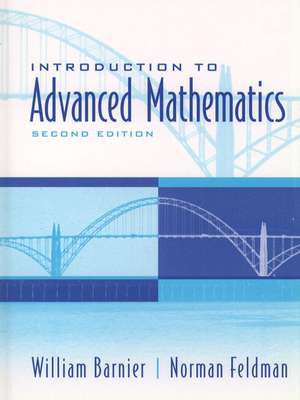
Introduction to Advanced Mathematics
Autor William Barnier, Norman Feldmanen Limba Engleză Paperback – 30 noi 1999
Focused on "What Every Mathematician Needs to Know," this book focuses on the analytical tools necessary for thinking like a mathematician. It anticipates many of the questions readers might have, and develops the subject slowly and carefully, with each chapter containing a full exposition of topics, many examples, and practice problems to reinforce the concepts as they are introduced. "Find the Flaw" problems help readers learn to read proofs critically. Contains five core chapters on elementary logic, methods of proof, set theory, functions, and relations; and four chapters of examples, theorems, and projects. For those interested in abstract algebra or real analysis.
Preț: 920.86 lei
Preț vechi: 1195.91 lei
-23%
Carte tipărită la comandă
Livrare economică 27 noiembrie-11 decembrie
Specificații
ISBN-10: 0130167509
Pagini: 300
Dimensiuni: 173 x 238 x 19 mm
Greutate: 0.57 kg
Ediția:Nouă
Editura: Pearson
Locul publicării:Upper Saddle River, United States
V-ar putea interesa
-
 Testing ExogeneityNeil R. Ericsson-22%Preț: 418.41 lei536.45 lei
 -
 -18%Preț: 210.78 lei255.82 lei
 -
 Introduction to Graph TheoryRobin J. WilsonPreț: 372.11 lei
 -
 Think Like A Maths Genius: The Art of Calculating in Your HeadMichael Shermer-20%Preț: 74.69 lei92.91 lei
 -
 Just-in-Time Algebra and Trigonometry for CalculusGuntram Müller-19%Preț: 472.06 lei582.79 lei
 -
 Revise Mathematics to Further Level GCSEChristine Graham-23%Preț: 296.01 lei384.86 lei
 -
 Preț: 288.10 lei
 -
 Topology and Its ApplicationsWilliam F Basener-9%Preț: 892.51 lei980.77 lei
 -
 MathematicsA. D. AleksandrovPreț: 413.95 lei
 -
 The Math Behind the MusicLeon HarkleroadPreț: 203.53 lei
 -
 The Pleasures of CountingT. W. Körner-8%Preț: 418.37 lei454.76 lei
Descriere
Focused on “What Every Mathematician Needs to Know,” this text provides material necessary for students to succeed in upper-division mathematics courses, and more importantly, the analytical tools necessary for thinking like a mathematician. It begins with a natural progression from elementary logic, methods of proof, and set theory, to relations and functions; then provides application examples, theorems, and student projects.
Cuprins
1. Introduction to Logic.
2. Methods of Proof.
3. Set Theory.
4. Cartesian Products and Functions.
5. Relations.
6. Cardinality.
7. Number Theory.
8. Rings and Integral Domains.
9. Limits and the Real Numbers.
Caracteristici
- NEW - Streamlined Ch. 1—Gets more quickly to proofs involving topics more commonly encountered in mathematics courses.
- NEW - Functions are now covered before relations (Chs. 4 and 5).
- NEW - New chapter on rings and integral domains (Ch. 8).
- NEW - Extensively revised chapter on number theory and algebra. (Chs. 6, 7, and 9).
- The flow from cardinality to rings is now very smooth. Ex.___
- The flow from cardinality to rings is now very smooth. Ex.___
- NEW - “Find the Flaw” problems—At the beginning of exercise sets in Chs. 1-5.
- Help students learn to read proofs critically. Ex.___
- Help students learn to read proofs critically. Ex.___
- NEW - A collection of True/False questions—Begins each set of review exercises in Chs. 2-5.
- NEW - Many new exercises of all kinds—More than in any other textbook of its kind.
- Five core chapters (Chs. 1-5)—In a natural progression: elementary logic, methods of proof, set theory, functions, and relations. Each chapter contains a full exposition of topics with many examples and practice problems to reinforce the concepts as they are introduced.
- Anticipates many of the questions students might have and develops the subject slowly and carefully. Students are then able to work more independently—and with much greater understanding of the material. Ex.___
- Anticipates many of the questions students might have and develops the subject slowly and carefully. Students are then able to work more independently—and with much greater understanding of the material. Ex.___
- Four chapters of examples, theorems, and projects (Chs. 6-9)—Many theorems have no proof or only a hint or outline for the proof. Likewise, the examples may have no solutions or just a hint for the solution.
- The intent is that the material be used as a basis for students to construct their own proofs or solutions and perhaps present them to the class. Ex.___
- The intent is that the material be used as a basis for students to construct their own proofs or solutions and perhaps present them to the class. Ex.___
- Clearly written examples and practice problems— Provides solutions to practice problems, odd-numbered exercises, and review problems.
- Supplementary exercises—Extend or relate to some of the concepts discussed in the text but are not necessary for the continuity of the subject matter.