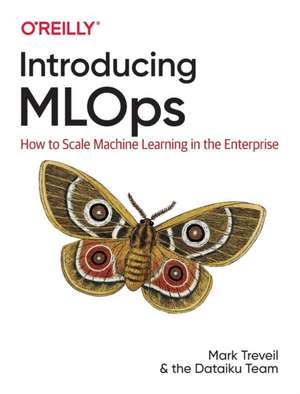
Introducing MLOps
Autor Mark Treveil, Nicolas Omont, Clément Stenac, Kenji Lefevre, Du Phan, Joachim Zentici, Adrien Lavoillotte, Makoto Miyazaki, Lynn Heidmannen Limba Engleză Paperback – 5 ian 2021
Notăm cu interes faptul că Introducing MLOps abordează direct marea problemă a departamentelor de date moderne: faptul că majoritatea modelelor de învățare automată rămân la stadiul de prototip. Metodologia propusă de cei nouă autori de la O'Reilly se concentrează pe arhitectură și guvernanță, transformând un proces adesea haotic într-o disciplină inginerească riguroasă. Structura cărții urmărește cele cinci etape critice ale ciclului de viață ML — de la construcție și preproducție până la monitorizare și mentenanță pe termen lung. Găsim în această carte un echilibru necesar între soluțiile tehnice și strategiile organizaționale. Autorii, printre care se numără Mark Treveil și Nicolas Omont, explică modul în care procesele de MLOps pot reduce riscurile prin modele explicabile și corecte, asigurând în același timp o automatizare fluidă a pipeline-urilor. Abordarea diferă de Practical MLOps de Noah Gift prin faptul că este mai puțin concentrată pe un set specific de tool-uri cloud (cum ar fi AWS sau Azure) și mai mult axată pe principiile aplicabile universal pentru operaționalizarea modelelor în sisteme de business complexe. Credem că valoarea adăugată a acestui volum constă în perspectiva sa pragmatică asupra mentenanței. Nu este suficient să lansezi un model; acesta trebuie recalibrat și monitorizat constant pentru a-și păstra acuratețea. Tonul tehnic și orientat spre specificații concrete face din această lucrare un ghid esențial pentru echipele care doresc să treacă de la experimente izolate la un impact real în afaceri, oferind soluții pentru eliminarea barierelor dintre data scientists și inginerii de aplicații.
Preț: 313.76 lei
Preț vechi: 392.21 lei
-20%
Carte disponibilă
Livrare economică 06-20 noiembrie
Livrare express 22-28 octombrie pentru 57.58 lei
Specificații
ISBN-10: 1492083291
Pagini: 183
Dimensiuni: 177 x 228 x 12 mm
Greutate: 0.35 kg
Ediția:1
Editura: O'Reilly
V-ar putea interesa
-
 Using Artificial Intelligence Absolute Beginner's GuideMichael Miller-20%Preț: 201.24 lei251.56 lei
 -
 Just Enough Data Science and Machine LearningMark LevenePreț: 342.01 lei
 -
 The AI PlaybookEric Siegel-16%Preț: 184.62 lei219.54 lei
 -
 Machine Learning in ProductionChristian Kastner-20%Preț: 572.46 lei715.57 lei
 -
 -39%Preț: 394.79 lei646.62 lei
 -
 -29%Preț: 92.46 lei129.41 lei
 -
 Preț: 228.40 lei
 -
 Preț: 204.99 lei
 -
 Operating AIUlrika Jagare-20%Preț: 196.93 lei246.15 lei
 -
 Preț: 103.34 lei
 -
 Machine Learning For DummiesLuca Massaron-20%Preț: 149.88 lei187.36 lei
 -
 The Essential Book of AIAnne Rooney-20%Preț: 76.61 lei95.77 lei
 -
 Practical FairnessAileen Nielsen-20%Preț: 280.45 lei350.56 lei
 -
 -20%Preț: 335.74 lei419.68 lei
 -
 Preț: 400.73 lei
 -
 Programming Machine LearningPaolo Perrotta-20%Preț: 293.77 lei367.22 lei
 -
 -20%Preț: 249.08 lei311.36 lei
 -
 How to Make AI UsefulMagnus Reiner-11%Preț: 84.37 lei94.27 lei
 -
 Preț: 433.14 lei
De ce să citești această carte
Recomandăm această carte inginerilor de machine learning și specialiștilor în data science care vor să asigure succesul modelelor lor în producție. Veți câștiga o metodologie clară pentru a gestiona întregul ciclu de viață ML, reducând riscurile organizaționale și tehnice. Este un ghid practic pentru oricine dorește să transforme algoritmii complecși în instrumente de business fiabile și scalabile.