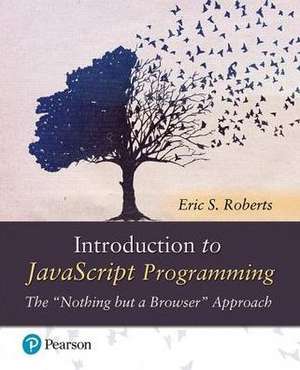
INTRO TO JAVASCRIPT PROGRAMMIN
Autor Eric Robertsen Limba Engleză Paperback – 31 ian 2019
Abordarea practică a acestui curs publicat de Pearson se bazează pe un raport echilibrat între rigoarea teoretică și execuția imediată, fiind conceput special pentru cei aflați la primul contact cu programarea. Apreciem în mod deosebit utilizarea micromediului imersiv 'Karel the Robot', o metodă pedagogică consacrată care permite vizualizarea algoritmilor înainte de a trece la sintaxa complexă a limbajului. Găsim în această carte o progresie logică: se începe cu rezolvarea de probleme prin instrucțiuni de control simple, continuând cu date numerice, funcții și gestionarea șirurilor de caractere în contextul browserului.
Merită menționat că structura este riguros organizată pentru a facilita învățarea autodidactă. După introducerea în JavaScript, autorul alocă secțiuni extinse pentru grafică simplă și obiecte grafice, oferind cititorului satisfacția de a construi aplicații web interactive care funcționează în timp real. Cititorul care a aplicat ideile din Introduction to JavaScript Programming with XML and PHP de Elizabeth Drake va găsi aici o fundamentare mult mai profundă a conceptelor de informatică pură, dincolo de simpla integrare a scripturilor în pagini web. Spre deosebire de abordările axate strict pe dezvoltarea web, lucrarea de față pune accent pe bunele practici de inginerie, precum testarea, depanarea și mentenanța software.
Deși autorul Eric Roberts este cunoscut în spațiul public și pentru scrieri cu caracter biografic, precum Runaway Train, expertiza sa academică de la Stanford își spune cuvântul în Intro to Javascript Programmin. Această lucrare distilează decenii de experiență pedagogică într-un format accesibil, transformând concepte abstracte precum 'stepwise refinement' în instrumente practice pentru orice viitor programator.
Preț: 916.55 lei
Preț vechi: 1078.29 lei
-15%
Carte disponibilă
Livrare economică 20 mai-03 iunie
Livrare express 06-12 mai pentru 235.07 lei
Specificații
ISBN-10: 0135245850
Pagini: 480
Dimensiuni: 187 x 231 x 20 mm
Greutate: 6.24 kg
Editura: Pearson
V-ar putea interesa
-
 JavaScript Absolute Beginner's GuideKirupa Chinnathambi-20%Preț: 206.13 lei257.65 lei
 -
 Begin to Code with JavaScriptRob Miles-20%Preț: 234.10 lei292.63 lei
 -
 -20%Preț: 228.69 lei285.87 lei
 -
 Javascript Absolute Beginner's Guide, Third EditionKirupa Chinnathambi-20%Preț: 205.07 lei256.34 lei
 -
 Deitel, H: Internet & World Wide Web: How to ProgramAbbey Deitel-13%Preț: 583.92 lei671.17 lei
 -
 -20%Preț: 196.48 lei245.60 lei
 -
 JavaScript and jQueryJon Duckett-20%Preț: 201.80 lei252.25 lei
 -
 JavaScript for Kids for DummiesChris Minnick-20%Preț: 109.30 lei136.63 lei
 -
 Coding All-in-One For DummiesChris Minnick-20%Preț: 161.89 lei202.36 lei
 -
 -20%Preț: 551.20 lei689.01 lei
 -
 JavaScript Essentials for DummiesPaul McFedries-20%Preț: 63.25 lei79.05 lei
 -
 JavaScriptPhilip Ackermann-20%Preț: 318.09 lei397.61 lei
 -
 Getting Started with JavaScriptThomas Theis-20%Preț: 196.27 lei245.34 lei
 -
 JavaScript for KidsNick Morgan-39%Preț: 160.81 lei263.20 lei
 -
 -37%Preț: 191.32 lei302.89 lei
 -
 -37%Preț: 237.90 lei374.95 lei
 -
 Data Structures and Algorithms in JavaScriptFederico Kereki-36%Preț: 286.66 lei447.97 lei
 -
 -36%Preț: 240.89 lei377.21 lei
 -
 JavaScript in easy stepsMike Mcgrath-20%Preț: 77.17 lei96.46 lei
 -
 Murachs JavaScriptMary Delamater-29%Preț: 340.93 lei477.24 lei
De ce să citești această carte
Recomandăm această carte studenților și autodidacților care doresc o bază solidă în programare, nu doar o introducere în sintaxa JavaScript. Prin utilizarea metodei 'Karel the Robot' și a exercițiilor de grafică interactivă, cititorul câștigă abilități analitice transferabile către orice alt limbaj. Este un instrument esențial pentru a trece de la simplul copy-paste de cod la înțelegerea logică a modului în care funcționează algoritmii.
Despre autor
Eric Roberts este profesor de informatică și 'John and Cynthia Gunn University Fellow' la Universitatea Stanford. Recunoscut la nivel internațional ca un pedagog de excepție, a primit numeroase distincții pentru calitatea predării, inclusiv premiul ACM-SIGCSE în 2003 pentru contribuții remarcabile în educația informatică. A jucat un rol esențial în definirea standardelor educaționale globale, fiind autorul principal al raportului ACM/IEEE-CS privind curricula de calcul din 2001. Experiența sa academică vastă se reflectă în claritatea și rigoarea cu care abordează conceptele de programare în lucrările sale tehnice.
Notă biografică
Cuprins
1.1 Introducing Karel
1.2 Teaching Karel to solve problems
1.3 Control statements
1.4 Stepwise refinement
1.5 Algorithms in Karel's world
Summary
Review questions
Exercises
2. Introducing JavaScript
2.1 Data and types
2.2 Numeric data
2.3 Variables
2.4 Functions
2.5 String data
2.6 Running JavaScript in the browser
2.7 Testing and debugging
2.8 Software maintenance
Summary
Review questions
Exercises
3. Control Statements
3.1 Boolean Data
3.2 The if statement
3.3 The switch statement
3.4 The while statement
3.5 The for statement
3.6 Algorithmic programming
3.7 Avoiding fuzzy standards of truth
Summary
Review questions
Exercises
4. Simple Graphics
4.1 A graphical version of "Hello World"
4.2 Classes, objects, and methods
4.3 Graphical objects
4.4 The graphics window
4.5 Creating graphical applications
Summary
Review questions
Exercises
5. Functions
5.1 A quick review of functions
5.2 Libraries
5.3 A library to support randomness
5.4 The mechanics of function calls
5.5 Recursive functions
Summary
Review questions
Exercises
6. Writing Interactive Programs
6.1 First-class functions
6.2 A simple interactive example
6.3 Controlling properties of objects
6.4 Responding to mouse events
6.5 Timer-based animation
6.6 Expanding the graphics library
Summary
Review questions
Exercises
7. Strings
7.1 Binary representation
7.2 String operations
7.3 Classifying characters
7.4 Common string patterns
7.5 String applications
7.6 Reading from the console
Summary
Review questions
Exercises
8. Arrays
8.1 Introduction to arrays
8.2 Array operations
8.3 Using arrays for tabulation
8.4 Reading text from files
8.5 Multidimensional arrays
8.6 Image processing
Summary
Review questions
Exercises
9. Objects
9.1 Objects in JavaScript
9.2 Using objects as maps
9.3 Representing points
9.4 Rational numbers
9.5 Linking objects together
Summary
Review questions
Exercises
10. Designing Data Structures
10.1 Abstract data types
10.2 Implementing a token scanner
10.3 Efficiency and representation
10.4 Representing real-world data
Summary
Review questions
Exercises
11. Inheritance
11.1 Class hierarchies
11.2 Defining an employee hierarchy
11.3 Extending graphical classes
11.4 Decomposition and inheritance
11.5 Alternatives to inheritance
Summary
Review questions
Exercises
12. JavaScript and the Web
12.1 A simple interactive example
12.2 An expanded look at HTML
12.3 Controlling style using CSS
12.4 Connecting JavaScript and HTML
12.5 Storing data in the index.html file
Summary
Review questions
Exercises
Descriere scurtă
Introducing the fundamental concepts of programming with JavaScript
A brand new textbook by Eric Roberts, Understanding Programming through JavaScript, focuses on the fundamental concepts of programming, and is written for students with no prior knowledge or experience. It draws on a rich pedagogical heritage-including the immersive Karel the Robot microworld, time-testing programming guidelines, and a logical, step-by-step organization-to give them the foundational skills needed to pursue other coding languages, or a career in computer programming. Using the text, students will build their skills and develop live, interactive web applications that really work on web browsers, providing both instant feedback and gratification. This new text includes chapter openers that humanize computing, review questions for student self-testing, and many other valuable features.