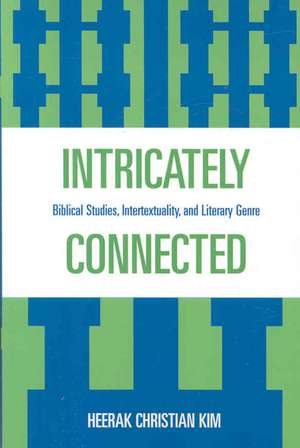
Intricately Connected: Biblical Studies, Intertextuality, and Literary Genre
Autor Heerak Christian Kimen Limba Engleză Paperback – 29 aug 2008
Preț: 250.59 lei
Preț vechi: 349.11 lei
-28%
Puncte Express: 376
Carte tipărită la comandă
Livrare economică 03-17 decembrie
Livrare prin curier în România Termenul estimat este afișat lângă disponibilitate.
Transport gratuit de la 400.00 lei Plată online sau ramburs, în funcție de opțiunile comenzii.
Retur gratuit în 14 zile Comandă securizată și suport în română.
Specificații
ISBN-13: 9780761841494
ISBN-10: 0761841490
Pagini: 102
Dimensiuni: 153 x 231 x 8 mm
Greutate: 0.18 kg
Editura: Bloomsbury Publishing
Colecția University Press of America
Locul publicării:New York, United States
ISBN-10: 0761841490
Pagini: 102
Dimensiuni: 153 x 231 x 8 mm
Greutate: 0.18 kg
Editura: Bloomsbury Publishing
Colecția University Press of America
Locul publicării:New York, United States
V-ar putea interesa
-
 My Very First BibleJuliet DavidPreț: 48.53 lei
 -
 Bible Stories Gone Crazy!Josh EdwardsPreț: 60.15 lei
 -
 A Little Bird Told MeTimothy CrossPreț: 64.47 lei
Cuprins
Chapter 1 1: The Lord's Supper as the Key Signifier in The Da Vinci Code (2006)
Chapter 2 2: Jeremiah 11:1-17 and Deuteronomy 29 Compared: A Study in Structure, Language, and Ideas to Elucidate Their Relationship
Chapter 3 3: Luke 4:14-30 and its Socio-Historical Context of Galilee for Understanding Jesus of Nazareth and the Jesus Movement
Chapter 4 4: The Psalms of Solomon as a Proz-Zadokite Document: A Content-Thematic Examination of Chapter 17
Chapter 5 5: Prohibition Imperative in Septuagint Greek
Chapter 6 6: Beloved as the Source of Redemption: Toni Morrison's Contribution to the Phenomenon of Scripturalization
Chapter 2 2: Jeremiah 11:1-17 and Deuteronomy 29 Compared: A Study in Structure, Language, and Ideas to Elucidate Their Relationship
Chapter 3 3: Luke 4:14-30 and its Socio-Historical Context of Galilee for Understanding Jesus of Nazareth and the Jesus Movement
Chapter 4 4: The Psalms of Solomon as a Proz-Zadokite Document: A Content-Thematic Examination of Chapter 17
Chapter 5 5: Prohibition Imperative in Septuagint Greek
Chapter 6 6: Beloved as the Source of Redemption: Toni Morrison's Contribution to the Phenomenon of Scripturalization