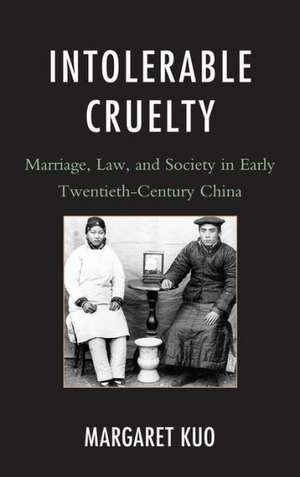
Intolerable Cruelty: Marriage, Law, and Society in Early Twentieth-Century China
Autor Margaret Kuoen Limba Engleză Hardback – 15 noi 2012
Intolerable Cruelty thoughtfully explores key issues in modern Chinese history, including state-society relations, social transformation, and gender relations in the context of the Republican Chinese experiment with liberal modernity. Investigating both the codification process and the subsequent implementation of the Code, Margaret Kuo deftly challenges arguments that discount Republican law as an elite pursuit that failed to exert much influence beyond modernized urban households. She reconsiders the dominant narratives of the 1930s and 1940s as "dark years" for Chinese women. Instead, she convincingly recasts the history of these years from the perspective of women who actively and successfully engaged the law to improve their lives.
Preț: 602.02 lei
Preț vechi: 910.16 lei
-34%
Puncte Express: 903
Preț estimativ în valută:
106.61€ • 124.51$ • 92.62£
106.61€ • 124.51$ • 92.62£
Carte tipărită la comandă
Livrare economică 21 februarie-07 martie
Preluare comenzi: 021 569.72.76
Specificații
ISBN-13: 9781442218406
ISBN-10: 1442218401
Pagini: 235
Dimensiuni: 159 x 236 x 24 mm
Greutate: 0.52 kg
Editura: Bloomsbury Publishing
Colecția Rowman & Littlefield Publishers
Locul publicării:New York, United States
ISBN-10: 1442218401
Pagini: 235
Dimensiuni: 159 x 236 x 24 mm
Greutate: 0.52 kg
Editura: Bloomsbury Publishing
Colecția Rowman & Littlefield Publishers
Locul publicării:New York, United States
Cuprins
Part I: Law and the State
Chapter 1: Introduction
Chapter 2: GMD Legal Exceptionalism: Conceptual Underpinnings of the Republican Civil Code
Chapter 3: The Rise of Public Opinion: The Case of GMD Surname Legislation
Chapter 4: The Process of Civil Adjudication: Marital Justice and the Republican Civil Court System
Part II: Law and Society
Chapter 5: Spousal Abuse: Divorce Litigation and the Emergence of Rights Consciousness
Chapter 6: Running Away: Cohabitation Litigation and the Reconfiguration of Husband Patriarchy
Chapter 7: Bourgeois Affairs: Separation and Support Litigation and Injury to Reputation
Chapter 8: Natural Eunuchs: Husband Impotence Annulment Litigation and Legal Opportunism
Chapter 9: Conclusion
Chapter 1: Introduction
Chapter 2: GMD Legal Exceptionalism: Conceptual Underpinnings of the Republican Civil Code
Chapter 3: The Rise of Public Opinion: The Case of GMD Surname Legislation
Chapter 4: The Process of Civil Adjudication: Marital Justice and the Republican Civil Court System
Part II: Law and Society
Chapter 5: Spousal Abuse: Divorce Litigation and the Emergence of Rights Consciousness
Chapter 6: Running Away: Cohabitation Litigation and the Reconfiguration of Husband Patriarchy
Chapter 7: Bourgeois Affairs: Separation and Support Litigation and Injury to Reputation
Chapter 8: Natural Eunuchs: Husband Impotence Annulment Litigation and Legal Opportunism
Chapter 9: Conclusion
Recenzii
Kuo's book challenges us to recognize the 'liberal triumph' of the Republican Civil Code as it established 'a socially progressive agenda in the context of an indisputably authoritarian regime,' created a functional judiciary, and reshaped individual lives and world views at all social levels (199). Through expert organization, incisive and nuanced reading of the sources, tight focus, and the resulting depth, Kuo has written a persuasive and thought-provoking history of the role of the law in women's lives, and of the role of women and the law in the transformation of late Republican government and society. In the process she has also given us an exemplary model of how to answer the double question.
Intolerable Cruelty is accessible, innovative, and relevant, not only to students studying Chinese history but also to students studying comparative women's history, women's and gender studies, legal history, and the rule of law.
Provides an important reconsideration of the social changes that took place as the Guomindang consolidated power in the Republican period and, moreover, exemplifies how historians might best use legal cases to write effective social history. In extensively mining the archives for vivid examples of how the law worked for the litigants involved, Margaret Kuo has provided an excellent model of how to construct empirically based and methodologically rigorous historical arguments.
Intolerable Cruelty is accessible, innovative, and relevant, not only to students studying Chinese history but also to students studying comparative women's history, women's and gender studies, legal history, and the rule of law.
Provides an important reconsideration of the social changes that took place as the Guomindang consolidated power in the Republican period and, moreover, exemplifies how historians might best use legal cases to write effective social history. In extensively mining the archives for vivid examples of how the law worked for the litigants involved, Margaret Kuo has provided an excellent model of how to construct empirically based and methodologically rigorous historical arguments.