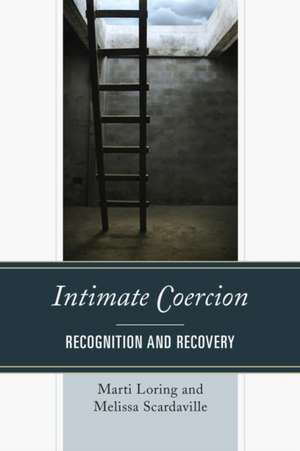
Intimate Coercion: Recognition and Recovery
Autor Marti Loring, Melissa Scardavilleen Limba Engleză Hardback – 21 aug 2015
Preț: 453.20 lei
Preț vechi: 597.14 lei
-24%
Puncte Express: 680
Carte tipărită la comandă
Livrare economică 28 noiembrie-12 decembrie
Livrare prin curier în România Termenul estimat este afișat lângă disponibilitate.
Transport gratuit pentru acest produs Plată online sau ramburs, în funcție de opțiunile comenzii.
Retur gratuit în 14 zile Comandă securizată și suport în română.
Specificații
ISBN-13: 9781442254329
ISBN-10: 1442254327
Pagini: 168
Dimensiuni: 161 x 236 x 18 mm
Greutate: 0.41 kg
Editura: Bloomsbury Publishing
Colecția Rowman & Littlefield
Locul publicării:New York, United States
ISBN-10: 1442254327
Pagini: 168
Dimensiuni: 161 x 236 x 18 mm
Greutate: 0.41 kg
Editura: Bloomsbury Publishing
Colecția Rowman & Littlefield
Locul publicării:New York, United States
V-ar putea interesa
-
 Rape and the Legal ProcessJennifer Temkin-28%Preț: 448.46 lei623.85 lei
 -
 Scars Across HumanityElaine StorkeyPreț: 93.33 lei
 -
 Preț: 132.48 lei
 -
 Resolving Sexual AbuseYvonne M. DolanPreț: 279.83 lei
 -
 Even from a Broken WebBob BertolinoPreț: 218.99 lei
 -
 Healing the Incest WoundChristine A. CourtoisPreț: 442.68 lei
 -
 Preț: 480.37 lei
 -
 -18%Preț: 1248.18 lei1522.18 lei
 -
 How Long Does It Hurt?Cynthia L MatherPreț: 128.59 lei
 -
 -23%Preț: 39.24 lei51.22 lei
 -
 Crimes UnspokenMiriam Gebhardt-8%Preț: 379.72 lei412.74 lei
 -
 Sexual Harassment Around the GlobeKatherine C Wong-26%Preț: 535.63 lei727.86 lei
 -
 -27%Preț: 1026.55 lei1397.76 lei
Cuprins
Chapter 1: Research Review
Chapter 2: Therapy with the Traumatized and Abused
Chapter 3: Recognizing Intimate Coercion
Chapter 4: The Foundation of Intimate Coercion
Chapter 5: A Closer Look at the Coerced
Chapter 6: Understanding Coercers in Relationships
Chapter 7: The Coercive Process: Overt and Covert Emotional Abuse
Chapter 8: Evaluation of Coercion
Chapter 9: Coercion in Other Groups: Immigrants, People with Disabilities, Gay Couples, Church Partners, Children, Adolescents, and Elders
Chapter 10: Transformation of the Coerced
Chapter 11: Therapeutic Intervention with the Coerced
Chapter 2: Therapy with the Traumatized and Abused
Chapter 3: Recognizing Intimate Coercion
Chapter 4: The Foundation of Intimate Coercion
Chapter 5: A Closer Look at the Coerced
Chapter 6: Understanding Coercers in Relationships
Chapter 7: The Coercive Process: Overt and Covert Emotional Abuse
Chapter 8: Evaluation of Coercion
Chapter 9: Coercion in Other Groups: Immigrants, People with Disabilities, Gay Couples, Church Partners, Children, Adolescents, and Elders
Chapter 10: Transformation of the Coerced
Chapter 11: Therapeutic Intervention with the Coerced
Recenzii
As the publisher's website states, this volume 'explores the foundation and causes of intimate coercion, focusing specifically on the identification of the issue and subsequent healing process.' Sociologists Loring and Scardaville shine a light on intimate coercion and how devastating it can be for the victims and their families. In the book's 11 chapters, they provide information on what intimate coercion entails; how to evaluate subjects to determine if coercion is occurring; how coercion happens, and reasons why it continues, in a relationship; and what therapies work with coercion. The book details the types of abuse-physical, sexual, and emotional-common to coercive relationships. Case studies scattered throughout the book are invaluable in helping the reader understand the nature of intimate coercion-on the parts of the coerced and the coercer. A chapter on special populations highlights some of the distinct problems (deportation, making sexual orientation public, and so on) the groups might face. The chapter on the transformation of coerced subjects using therapy and transformative tools is particularly interesting. This readable volume will be valuable to anyone seeking to understand domestic violence, mental health problems, or criminal justice. Summing Up: Recommended. Upper-division undergraduates through faculty; professionals.
This extraordinarily well-written book needs to be read by anyone who works in the criminal justice system; it fills a void in the literature. The authors have achieved their stated aim of 'making the lives of the coerced come alive' and offer practical pathways for lawyers, therapists, and others.
Intimate Coercion is a brilliant exploration of the cathartic power of connection in relationships. Loring and Scardaville's analysis of the dynamics of coercion help us understand how love mutates into abuse. A must read for anyone who wants to understand and improve their intimate relationships.
Through the use of personal accounts, Loring and Scardaville show us how a history of trauma from abuse plays a pivotal role in present and future choices, and how that history, for those coerced into breaking the law, may leave them questioning their own belief-systems, morals, boundaries, and even their sanity. These stories are so compelling, I can't help but stop to think that they could be about any woman I know. I asked myself, 'How many women in prison are there because of this type of coercion?'
This extraordinarily well-written book needs to be read by anyone who works in the criminal justice system; it fills a void in the literature. The authors have achieved their stated aim of 'making the lives of the coerced come alive' and offer practical pathways for lawyers, therapists, and others.
Intimate Coercion is a brilliant exploration of the cathartic power of connection in relationships. Loring and Scardaville's analysis of the dynamics of coercion help us understand how love mutates into abuse. A must read for anyone who wants to understand and improve their intimate relationships.
Through the use of personal accounts, Loring and Scardaville show us how a history of trauma from abuse plays a pivotal role in present and future choices, and how that history, for those coerced into breaking the law, may leave them questioning their own belief-systems, morals, boundaries, and even their sanity. These stories are so compelling, I can't help but stop to think that they could be about any woman I know. I asked myself, 'How many women in prison are there because of this type of coercion?'