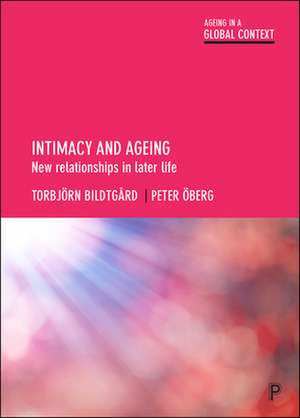
Intimacy and Ageing: New Relationships in Later Life: Ageing in a Global Context
Autor Torbjörn Bildtgård, Peter Öbergen Limba Engleză Paperback – 2019
As people live longer around the world, remaining healthy into old age, the phenomenon of new intimate relationships in later life is rapidly growing. This book, part of the Ageing in a Global Context series, looks closely at how these relationships have developed within the current cohort of elderly, with particular attention to the ways in which new relationships at older ages are simultaneously rooted in older cultures of intimacy and partake in changes in social relations and behavior that have emerged more recently. What do new intimate relationships offer older men and women, and what do they expect or hope for from them?


Preț: 297.97 lei
Puncte Express: 447
Preț estimativ în valută:
52.70€ • 61.61$ • 45.82£
52.70€ • 61.61$ • 45.82£
Carte tipărită la comandă
Livrare economică 07-21 martie
Specificații
ISBN-13: 9781447326502
ISBN-10: 1447326504
Pagini: 224
Dimensiuni: 159 x 235 x 15 mm
Greutate: 0.41 kg
Editura: Bristol University Press
Colecția Policy Press
Seria Ageing in a Global Context
ISBN-10: 1447326504
Pagini: 224
Dimensiuni: 159 x 235 x 15 mm
Greutate: 0.41 kg
Editura: Bristol University Press
Colecția Policy Press
Seria Ageing in a Global Context
Notă biografică
Torbjörn Bildtgård is associate professor of sociology at Stockholm University, Sweden. Peter Öberg is associate professor of sociology in the Faculty of Health and Occupational Studies at the University of Gävle, Sweden.
Cuprins
List of figures and tables
Acknowledgements
Series editors’ preface
One Introduction
Setting the scene
Outline of the book
Two Intimacy and ageing in late modernity
The changing landscape of later life
The transformation of intimacy
Intimacy and cultural context
The importance of life phase: a developmental perspective
Conclusion
Three The changing landscape of intimacy in later life
The impact of the prolonged lifespan for envisioning new intimate futures
A culture of divorce
From ‘society of widows’ to ‘society of divorcees’
The grey divorce revolution
The gendered structure of the partner market
Changing venues for dating in later life
Conclusion
Four From marriage to alternative union forms
A smorgasbord of union forms
Are older people carriers of the ideals of marriage culture?
Are older people following the ideals of their times?
Are some union forms more adapted to later life?
A question of age, period or cohort?
Cohort
Historical time
Life phase
Conclusion
Five A life of relationships
Relationship careers among older Swedes
Consequences of prior relationship dissolutions for late-life intimacy
Gendered experiences: continuity and change in repartnering
Conclusion
Six Attitudes towards new romantic relationships
Attitudes to what?
Whose attitudes?
The Swedish case
Conclusion
Seven Initiation and development of new romantic relationships
Unveiling negotiation and change in new late-life relationships
Relationship ideals in singlehood: Single Sally
From singlehood to LAT and beyond: LAT Lisa and Lars
From singlehood to cohabitation and beyond: Cohabiting Carl and Caroline
From singlehood to marriage and beyond: Married Mike and Martha
Conclusion
Eight A new partner as a resource for social support
The gains of repartnering
Companionate support
Emotional support
Practical support
Conclusion
Nine Consequences for social network and support structures
The impact of life transitions on linked lives
Integration of social and filial networks
The partner as a key to autonomy
Restructuring the chain of interdependent lives
A hierarchy of dependencies
The social support network
Conclusion
Ten Sex in an ideology
From an ideology of marriage to an ideology of love
The ideal of consummate relationship
Sex in new late-life relationships
Conclusion
Eleven Time as a structuring condition for the new intimate relationships in later life
An existential theory of time
Post-(re)productive free time
Remaining time
Conclusion
Twelve Discussion
Historical change
Phase of life
The Swedish case
Methodological appendix
The qualitative interview study
The quantitative questionnaire
References
Notes
Index
Acknowledgements
Series editors’ preface
One Introduction
Setting the scene
Outline of the book
Two Intimacy and ageing in late modernity
The changing landscape of later life
The transformation of intimacy
Intimacy and cultural context
The importance of life phase: a developmental perspective
Conclusion
Three The changing landscape of intimacy in later life
The impact of the prolonged lifespan for envisioning new intimate futures
A culture of divorce
From ‘society of widows’ to ‘society of divorcees’
The grey divorce revolution
The gendered structure of the partner market
Changing venues for dating in later life
Conclusion
Four From marriage to alternative union forms
A smorgasbord of union forms
Are older people carriers of the ideals of marriage culture?
Are older people following the ideals of their times?
Are some union forms more adapted to later life?
A question of age, period or cohort?
Cohort
Historical time
Life phase
Conclusion
Five A life of relationships
Relationship careers among older Swedes
Consequences of prior relationship dissolutions for late-life intimacy
Gendered experiences: continuity and change in repartnering
Conclusion
Six Attitudes towards new romantic relationships
Attitudes to what?
Whose attitudes?
The Swedish case
Conclusion
Seven Initiation and development of new romantic relationships
Unveiling negotiation and change in new late-life relationships
Relationship ideals in singlehood: Single Sally
From singlehood to LAT and beyond: LAT Lisa and Lars
From singlehood to cohabitation and beyond: Cohabiting Carl and Caroline
From singlehood to marriage and beyond: Married Mike and Martha
Conclusion
Eight A new partner as a resource for social support
The gains of repartnering
Companionate support
Emotional support
Practical support
Conclusion
Nine Consequences for social network and support structures
The impact of life transitions on linked lives
Integration of social and filial networks
The partner as a key to autonomy
Restructuring the chain of interdependent lives
A hierarchy of dependencies
The social support network
Conclusion
Ten Sex in an ideology
From an ideology of marriage to an ideology of love
The ideal of consummate relationship
Sex in new late-life relationships
Conclusion
Eleven Time as a structuring condition for the new intimate relationships in later life
An existential theory of time
Post-(re)productive free time
Remaining time
Conclusion
Twelve Discussion
Historical change
Phase of life
The Swedish case
Methodological appendix
The qualitative interview study
The quantitative questionnaire
References
Notes
Index
Recenzii
"At last, an account of aging intimacy that blows away stereotypes to engage with the complexities. A must-read for academics and those working with older people."