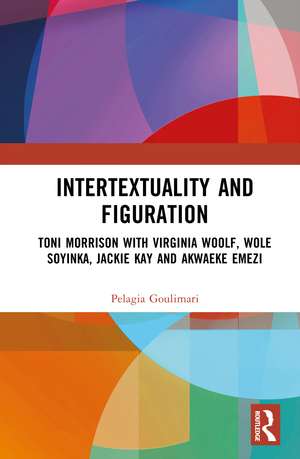
Intertextuality and Figuration: Toni Morrison with Virginia Woolf, Wole Soyinka, Jackie Kay and Akwaeke Emezi
Autor Pelagia Goulimarien Limba Engleză Hardback – 12 feb 2027
In Part One, Goulimari reveals how Toni Morrison is in intertextual dialogue with Woolf and Soyinka by adopting and adapting figures in their texts. In Part Two, Goulimari turns to Kay and Emezi and their intertextual dialogue with figures in Morrison’s texts. These are figures of modernity, subjectivity and (inter)textuality. These figures are diagnostic, critical, reconstructive. Figures include: “falling,” “burning,” “shredding” and “tunnelling”; “crossing” over to “the other side,” “the Clearing” and “flesh that weeps, laughs, dances”; “spinning” “round and round,” “the bottomless ground” and “the bottomless gift”; “holding” and “shedding.” In their polysemy, ambiguity and plasticity, figures undergo continuous variation, as they encounter, blend or clash with other figures.
This innovative book crosses established canons, their divisions and boundaries to bring together authors who have not previously been studied in dialogue. It is an invaluable resource for students and scholars interested in global and transnational women’s writing, comparative literature, and literary theory.
Preț: 1099.22 lei
Preț vechi: 1458.37 lei
-25% Precomandă
Puncte Express: 1649
Carte nepublicată încă
Livrare prin curier în România Precomanda se expediază când titlul devine disponibil.
Transport gratuit pentru acest produs Plată online sau ramburs, în funcție de opțiunile comenzii.
Retur gratuit în 14 zile Comandă securizată și suport în română.
Doresc să fiu notificat când acest titlu va fi disponibil:
Se trimite...
Specificații
ISBN-13: 9781032789415
ISBN-10: 1032789417
Pagini: 196
Dimensiuni: 156 x 234 mm
Ediția:1
Editura: Taylor & Francis
Colecția Routledge
Locul publicării:Oxford, United Kingdom
ISBN-10: 1032789417
Pagini: 196
Dimensiuni: 156 x 234 mm
Ediția:1
Editura: Taylor & Francis
Colecția Routledge
Locul publicării:Oxford, United Kingdom
Public țintă
Academic and PostgraduateCuprins
Acknowledgements; Introduction. Opening Intertextuality and Figuration: Toni Morrison with Virginia Woolf, Wole Soyinka, Jackie Kay and Akwaeke Emezi; A Schematic Representation of the Relations Between Authors and Figures; Part I. Toni Morrison with Virginia Woolf and Wole Soyinka; 1. Falling, Burning, Shredding, Tunnelling: Modernity, Virginia Woolf’s Mrs. Dalloway, Toni Morrison’s Sula, and my Grandparents circa 1922; 2. The Clearing and “flesh that weeps, laughs; … dances”: Toni Morrison’s Beloved, Wole Soyinka’s Death and the King’s Horseman, Funmilayo Ransome-Kuti and the Abeokuta Women’s Revolt circa 1947; Part II. Jackie Kay and Akwaeke Emezi with Toni Morrison; 3. “Where are you (really) from?” “Spinning” “round and round” and “the bottomless ground”: Jackie Kay’s Trumpet and Toni Morrison’s Jazz circa 2016; 4. Holding – Shedding: Akwaeke Emezi’s Freshwater, Toni Morrison’s Beloved and Love, and Celestine Chukwuemeka Mbaegbu’s Igbo Metaphysics; Index
Notă biografică
Pelagia Goulimari is Senior Fellow in Feminist Studies at the University of Oxford, and Senior Research Fellow at Somerville College, Oxford, UK. Her books include: After Modernism: Women, Gender, Race (2022), The Oxford Encyclopedia of Literary Theory (2022), Love and Vulnerability: Thinking with Pamela Sue Anderson (2020), Women Writing Across Cultures: Present, Past, Future (2017), Literary Criticism and Theory: From Plato to Postcolonialism (2015), Toni Morrison (2009), and Postmodernism: What Moment? (2007). She is the Editor-in-Chief of Angelaki: Journal of the Theoretical Humanities.
Recenzii
'Invoking and describing a set of shapeshifting textual figures, Pelagia Goulimari traces the intertextual affinities that knit together Toni Morrison’s “ancestors” and “descendants” (and Goulimari’s own family history) in a nonlinear play of influence and dialogue across literary generations. With its concentrated close readings of a number of interrelated texts, this is provocatively insightful thinking about and through the literary and the modernities with which it engages.'
John Frow, Professor Emeritus of English, University of Sydney
'Pelagia Goulimari writes in that intimate and critical embrace we call close reading. In this book, we are given figures that are holding, tunnelling, falling, sh(r)edding, ado/apting, and spinning through pages of English, Nigerian, Scottish, and American novels. These figures are in an intertextual dialogue, they speak in tongues that Goulimari can hear. Hold on and you will see how Toni Morrison influences Akwaeke Emezi, and how Emezi revitalizes Morrison: Or how literary studies adapts queer theory, and how African queer theory sheds old skin through literature.'
Tadiwa Madenga, Assistant Professor of English and Comparative Literature, UC Berkeley
'This is a capacious study that expertly reformulates the very concept of intertextuality to display the full artistry and influence of a literary giant. Intertextuality and Figuration is as audacious and expert in its treatment of contemporary theorists—Kristeva, Foucault, Deleuze—as it is pioneering and timely in its analysis of luminaries of the past—Woolf, Achebe—and stars of the present—Kay, Emezi. Goulimari unveils new depth and nuance in bodies of literature and critical theory that, through influence of Morrison’s writings, bring renewed insight into pressing matters of our past and present lives: from slavery and race to immigration and trans identity.'
Sheldon George, Professor of Africana Studies, University of Massachusetts, Boston
'Pelagia Goulimari’s groundbreaking exploration of intertextuality traces repeated “figures” linking contemporary novels with their predecessors. Contemporary novelists repeat, but also reinvent, figures – such as burning, shedding, holding, tunneling – that together create an intertext , a literary chain of dynamic verbal forms connecting the contemporary author with the work of those who came before.
Consideration of “figures” allows Goulimari to observe stunning affinities between ancestral belief systems —Yoruba and Igbo—and contemporary writing practices. For example, she shows how Toni Morrison in Beloved and Akwaeki Emezi in Freshwater borrow from each other and from Igbo metaphyics to create the elusive and plural figure of Beloved in Morrison’s Beloved and the multiple, ever-expanding character of Ada in Emezi’s Freshwater'
Jean Wyatt, Professor Emerita of English, Occidental College
John Frow, Professor Emeritus of English, University of Sydney
'Pelagia Goulimari writes in that intimate and critical embrace we call close reading. In this book, we are given figures that are holding, tunnelling, falling, sh(r)edding, ado/apting, and spinning through pages of English, Nigerian, Scottish, and American novels. These figures are in an intertextual dialogue, they speak in tongues that Goulimari can hear. Hold on and you will see how Toni Morrison influences Akwaeke Emezi, and how Emezi revitalizes Morrison: Or how literary studies adapts queer theory, and how African queer theory sheds old skin through literature.'
Tadiwa Madenga, Assistant Professor of English and Comparative Literature, UC Berkeley
'This is a capacious study that expertly reformulates the very concept of intertextuality to display the full artistry and influence of a literary giant. Intertextuality and Figuration is as audacious and expert in its treatment of contemporary theorists—Kristeva, Foucault, Deleuze—as it is pioneering and timely in its analysis of luminaries of the past—Woolf, Achebe—and stars of the present—Kay, Emezi. Goulimari unveils new depth and nuance in bodies of literature and critical theory that, through influence of Morrison’s writings, bring renewed insight into pressing matters of our past and present lives: from slavery and race to immigration and trans identity.'
Sheldon George, Professor of Africana Studies, University of Massachusetts, Boston
'Pelagia Goulimari’s groundbreaking exploration of intertextuality traces repeated “figures” linking contemporary novels with their predecessors. Contemporary novelists repeat, but also reinvent, figures – such as burning, shedding, holding, tunneling – that together create an intertext , a literary chain of dynamic verbal forms connecting the contemporary author with the work of those who came before.
Consideration of “figures” allows Goulimari to observe stunning affinities between ancestral belief systems —Yoruba and Igbo—and contemporary writing practices. For example, she shows how Toni Morrison in Beloved and Akwaeki Emezi in Freshwater borrow from each other and from Igbo metaphyics to create the elusive and plural figure of Beloved in Morrison’s Beloved and the multiple, ever-expanding character of Ada in Emezi’s Freshwater'
Jean Wyatt, Professor Emerita of English, Occidental College
Descriere
Intertextuality and Figuration offers a theory of intertextuality that revolves around figuration, the process of making and remaking figures. Centering on Toni Morrison, the study examines how five major authors engage in complex intertextual dialogues that challenge understandings of literary influence and genealogy.