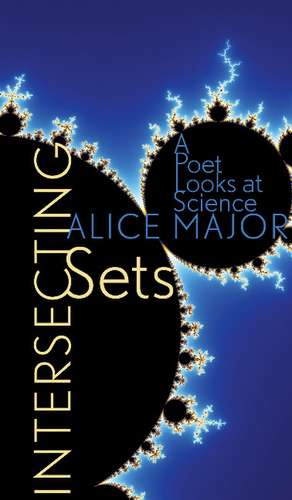
Intersecting Sets: A Poet Looks at Science
Autor Alice Majoren Limba Engleză Paperback – 15 oct 2011
Preț: 177.89 lei
Preț vechi: 228.18 lei
-22%
Puncte Express: 267
Carte disponibilă
Livrare economică 16-30 noiembrie
Livrare prin curier în România Termenul estimat este afișat lângă disponibilitate.
Transport gratuit de la 400.00 lei Plată online sau ramburs, în funcție de opțiunile comenzii.
Retur gratuit în 14 zile Comandă securizată și suport în română.
Specificații
ISBN-13: 9780888645951
ISBN-10: 0888645953
Pagini: 272
Dimensiuni: 133 x 229 x 19 mm
Greutate: 0.4 kg
Editura: University of Alberta Press
Colecția University of Alberta Press
Locul publicării:Edmonton, Canada
ISBN-10: 0888645953
Pagini: 272
Dimensiuni: 133 x 229 x 19 mm
Greutate: 0.4 kg
Editura: University of Alberta Press
Colecția University of Alberta Press
Locul publicării:Edmonton, Canada
Recenzii
Interesting things happen at edges. We are living in one of the most exciting ages of science, shifting from the mechanistic universe that made science seem so cold a century ago to a world shaped by unfolding complexity and fractal wiggles. The probing of brains and the sifting of DNA are helping humans to truly understand how we are related to the natural world in which we evolved. As a poet, Alice Major practices an art that humans have been sharing since the dawn of language, from the campfires of the OMO people to today's rappers. All this time, poetry has been used to understand and respond to the world's patterns and to explore our central questions - who are we? How did all this begin? What is change? What is time? (And what time is it, anyway?) These are the two sets - the work of poets and the work of scientists - that she allows to intersect in this book, like spots of coloured light overlapping to form new shades of illumination for every reader who is engaged with the world. We always exist at the edge, the circumference, a perimeter. It's like the edge of the Mandelbrot set, a region in which self-similar patterns emerge as we zoom in closer and closer to its mathematical country-sprinkled curves and arabesques, small lakes of belonging and the broken coastline of longing. But fortunately, we live in a world where the fractals come to a limit. The plane bumps down and we are home. Alice Major has published nine collections of poetry, including many poems inspired by sciences from cosmology to chemistry to botany. Three of her collections have been shortlisted for the prestigious Pat Lowther Award, which she won for The Office Tower Tales. Her most recent collection, Memory's Daughter, also received the Stephan G. Stephansson Prize from the Writers Guild of Alberta. She has served as president of the League of Canadian Poets and chair of the Edmonton Arts Council, and from 2005 to 2007 served as her city's first poet laureate.
# 5 on the Edmonton Journal's Bestsellers list for the week on January 08, 2012
Rattle Magazine published an excerpt from Intersecting Sets in their summer, 2011 issue, #35. http://rattle.com/blog/2012/01/poetry-and-scale-by-alice-major/
"Canadian poet Alice Major considers confluences between science and poetry in this lyrical and insightful meditation on perception, language, and creativity. Her motivation, she says, was to bridge the artificial divide between literature and science--the so-called 'two cultures'--that has dominated intellectual life since the Romantics... Drawing on a broad range of scientific inquiry, including neuroscience, mathematics, physics, biochemistry, astronomy, psychology, and botany, Major argues that emotion is central to both poetry and science, and that the cognitive processes of scientists and poets are fundamentally aligned.... Recommended. Lower-division undergraduates through faculty; general readers." L. Simon, Skidmore College, Choice Magazine, March 1, 2012
"Novelist Lynn Coady and poets Tim Bowling, Michael Penny and Alice Major are among a strong field of local finalists who will be vying for this year's Alberta Literary Awards.... Major is a finalist for the top non-fiction prize for Intersecting Sets: A Poet Looks at Science, her latest release through University of Alberta Press." Richard Helm, Edmonton Journal, April 12, 2012
"Until recently, the University of Alberta Press, whose books are beautifully designed by Alan Brownoff, has published mostly Alberta poets such as Alice Major, whose work often takes its inspiration from science. In fact, her most recent book with U of A is a prose work called Intersecting Sects: A Poet Looks at Science ($29.95). Last year the press launched the "Robert Kroetsch Series of creative works," named for the Alberta poet-novelist killed in a road accident last June. This series is broader than its antecedent in that it also includes "creative non-fiction" and publishes some geographical outsiders." George Fetherling, Vancouver Sun, April 5, 2012 [Full article at http://bit.ly/HY2jsC]
"For the elegance and precision of its language, the encyclopedic reach of its knowledge, and the daring of its thought, this book is a winner. Every page offers fresh insight and challenging intellectual vistas, yet the text never loses itself in a fog of abstraction. There's always someone or something - a cat named Pushkin, a bird on a credit card, an old man walking, walking, reciting his poems-to ground the conceptual universe in the sensory world. Measured against the writer's intentions and the pleasure it offers to readers, this book is practically perfect." Jury comments, Wilfrid Eggleston Award, WGA.
"I have not done justice to the delight I felt in reading these essays-it was a joy to take in their looping, fractal structure. Major offers us the pleasure of watching another writer's mind in motion at every scale, from conversation with her cat to theories in cosmology, from the personal questions of why we write or practice science to the evolutionary questions of what makes us human and where language comes from. As a scientist, I wanted to research and debate one question after another. As a poet, I encountered the questions I ask myself, along with wise advice about writing." Robin Chapman, American Scientist.
"The essays do not form a rigorous argument as to any one "side" but rather range widely and expose the reader to new ideas as they arise in many contexts. I liked this approach, as it provided room for the reader to graze and discover things that they might not even realize they were interested in." The Indextrious Reader.
"[Alice Major] dissects the principles of science, spreading them on the page alongside elements of poetry. She effectively uses literature as a language for making scientific ideas clearer. And the skill with which she integrates the two points of view demonstrates such careful precision it's hard not to think of her as the smart girl you'd have wanted for your lab partner. Inversely, she also uses the language of science to define poetic concepts.. Anyone who enjoys juxtaposing ideas, or who thinks it might be possible to toss thoughts back and forth from one hemisphere of the brain to the other, probably needs this book. It could well lead to a change in the way you see the world." Heidi Greco, Prairie Fire, July 2012 [Full review at http://bit.ly/MndzG0]
"This book isn't a scientific explanation of poetry, but rather, an examination of various concepts in science-from quantum physics to the development of language in the human brain-from the point of view of someone who's deeply fascinated by metaphor, language, and the possibilities that exist. If poets can read this book and have their minds altered by new scientific understanding, a scientist may read this book and gain a deeper appreciation for the nuances of poetry, perhaps even gain an understanding of how the expressiveness of language, and the emotionally laden potential of poetry, can provide a new way of expressing scientific concepts." Alisa Gordaneer, The Malahat Review, Spring 2012
Alice Major, an accomplished poet, takes readers through several quasi-technical though thoroughly accessible explorations of topics in popular science. She expresses an ardent distaste for how science and poetry, as perspectives if not practices, are set in opposition to each other. In eleven chapters on everything from scale and symmetry, brain-chemistry, phase changes, black holes, motion, holographic universes, and more, Major makes a compelling case for a renewed rapport between poets and scientists. Distributed by Wayne State U. Press. (Annotation ©2012 Book News Inc. Portland, OR)
"... reading the essays inside feels like visiting with a curious, thoughtful friend-one who has always just read something interesting and leaves you with lots of new ideas to consider, a friend who also has her feet on the ground, plenty of experience, and an easy playfulness that makes her company a pleasure.... [G]uided by Major, we readers populate our minds with seemingly disparate elements, energize that space with reason, imagination, and emotion, and listen to the reverberations of whatever collisions ensue. This book is an obvious fit for courses in science writing or creative science writing.... It would make an excellent gift book, too..." SueEllen Campbell, Interdisciplinary Studies in Literature and Environment (2012) [Full article at doi:10.1093/isle/iss093]
"There is a myth that scientists and artists live on different planets, which is rubbish.... Alice Major, a Canadian poet, has brought the two worlds together very nicely.... Major's writing is both clear and lyrical. Readers who, perhaps, have never heard of either Mandelbrot sets or dactylic meter will find those and other concepts explained in ways that are entertaining and related to every day life. Running beneath the poetry/science conjunctions is the thread of her father's Alzheimer's disease and his eventual death. The poetry, the science, and the loss of her father come together in one powerful, positive message: this is a beautiful world." Sharon Wildwind, Story Circle Network, December 22, 2012 [Full review at http://www.storycirclebookreviews.org/reviews/intersecting.shtml]
".poetry and science go on a date in Intersecting Sets: A Poet Looks at Science by Alice Major." Off the Shelf, Geist, Summer 2012
“Intersecting Sets is Major’s completely beguiling exploration of what science and poetry might have to say to one another…. I genuinely found this a breathtaking read, sharing everything that makes Major’s poetry such a pleasure to read: rigorously thoughtful, inventive, freewheeling, full of genuine surprises and showing a complete delight in the strangenesses and wonders both of the physical world, and the world of language….” [Full post at http://bit.ly/25SHtqn]
# 5 on the Edmonton Journal's Bestsellers list for the week on January 08, 2012
Rattle Magazine published an excerpt from Intersecting Sets in their summer, 2011 issue, #35. http://rattle.com/blog/2012/01/poetry-and-scale-by-alice-major/
"Canadian poet Alice Major considers confluences between science and poetry in this lyrical and insightful meditation on perception, language, and creativity. Her motivation, she says, was to bridge the artificial divide between literature and science--the so-called 'two cultures'--that has dominated intellectual life since the Romantics... Drawing on a broad range of scientific inquiry, including neuroscience, mathematics, physics, biochemistry, astronomy, psychology, and botany, Major argues that emotion is central to both poetry and science, and that the cognitive processes of scientists and poets are fundamentally aligned.... Recommended. Lower-division undergraduates through faculty; general readers." L. Simon, Skidmore College, Choice Magazine, March 1, 2012
"Novelist Lynn Coady and poets Tim Bowling, Michael Penny and Alice Major are among a strong field of local finalists who will be vying for this year's Alberta Literary Awards.... Major is a finalist for the top non-fiction prize for Intersecting Sets: A Poet Looks at Science, her latest release through University of Alberta Press." Richard Helm, Edmonton Journal, April 12, 2012
"Until recently, the University of Alberta Press, whose books are beautifully designed by Alan Brownoff, has published mostly Alberta poets such as Alice Major, whose work often takes its inspiration from science. In fact, her most recent book with U of A is a prose work called Intersecting Sects: A Poet Looks at Science ($29.95). Last year the press launched the "Robert Kroetsch Series of creative works," named for the Alberta poet-novelist killed in a road accident last June. This series is broader than its antecedent in that it also includes "creative non-fiction" and publishes some geographical outsiders." George Fetherling, Vancouver Sun, April 5, 2012 [Full article at http://bit.ly/HY2jsC]
"For the elegance and precision of its language, the encyclopedic reach of its knowledge, and the daring of its thought, this book is a winner. Every page offers fresh insight and challenging intellectual vistas, yet the text never loses itself in a fog of abstraction. There's always someone or something - a cat named Pushkin, a bird on a credit card, an old man walking, walking, reciting his poems-to ground the conceptual universe in the sensory world. Measured against the writer's intentions and the pleasure it offers to readers, this book is practically perfect." Jury comments, Wilfrid Eggleston Award, WGA.
"I have not done justice to the delight I felt in reading these essays-it was a joy to take in their looping, fractal structure. Major offers us the pleasure of watching another writer's mind in motion at every scale, from conversation with her cat to theories in cosmology, from the personal questions of why we write or practice science to the evolutionary questions of what makes us human and where language comes from. As a scientist, I wanted to research and debate one question after another. As a poet, I encountered the questions I ask myself, along with wise advice about writing." Robin Chapman, American Scientist.
"The essays do not form a rigorous argument as to any one "side" but rather range widely and expose the reader to new ideas as they arise in many contexts. I liked this approach, as it provided room for the reader to graze and discover things that they might not even realize they were interested in." The Indextrious Reader.
"[Alice Major] dissects the principles of science, spreading them on the page alongside elements of poetry. She effectively uses literature as a language for making scientific ideas clearer. And the skill with which she integrates the two points of view demonstrates such careful precision it's hard not to think of her as the smart girl you'd have wanted for your lab partner. Inversely, she also uses the language of science to define poetic concepts.. Anyone who enjoys juxtaposing ideas, or who thinks it might be possible to toss thoughts back and forth from one hemisphere of the brain to the other, probably needs this book. It could well lead to a change in the way you see the world." Heidi Greco, Prairie Fire, July 2012 [Full review at http://bit.ly/MndzG0]
"This book isn't a scientific explanation of poetry, but rather, an examination of various concepts in science-from quantum physics to the development of language in the human brain-from the point of view of someone who's deeply fascinated by metaphor, language, and the possibilities that exist. If poets can read this book and have their minds altered by new scientific understanding, a scientist may read this book and gain a deeper appreciation for the nuances of poetry, perhaps even gain an understanding of how the expressiveness of language, and the emotionally laden potential of poetry, can provide a new way of expressing scientific concepts." Alisa Gordaneer, The Malahat Review, Spring 2012
Alice Major, an accomplished poet, takes readers through several quasi-technical though thoroughly accessible explorations of topics in popular science. She expresses an ardent distaste for how science and poetry, as perspectives if not practices, are set in opposition to each other. In eleven chapters on everything from scale and symmetry, brain-chemistry, phase changes, black holes, motion, holographic universes, and more, Major makes a compelling case for a renewed rapport between poets and scientists. Distributed by Wayne State U. Press. (Annotation ©2012 Book News Inc. Portland, OR)
"... reading the essays inside feels like visiting with a curious, thoughtful friend-one who has always just read something interesting and leaves you with lots of new ideas to consider, a friend who also has her feet on the ground, plenty of experience, and an easy playfulness that makes her company a pleasure.... [G]uided by Major, we readers populate our minds with seemingly disparate elements, energize that space with reason, imagination, and emotion, and listen to the reverberations of whatever collisions ensue. This book is an obvious fit for courses in science writing or creative science writing.... It would make an excellent gift book, too..." SueEllen Campbell, Interdisciplinary Studies in Literature and Environment (2012) [Full article at doi:10.1093/isle/iss093]
"There is a myth that scientists and artists live on different planets, which is rubbish.... Alice Major, a Canadian poet, has brought the two worlds together very nicely.... Major's writing is both clear and lyrical. Readers who, perhaps, have never heard of either Mandelbrot sets or dactylic meter will find those and other concepts explained in ways that are entertaining and related to every day life. Running beneath the poetry/science conjunctions is the thread of her father's Alzheimer's disease and his eventual death. The poetry, the science, and the loss of her father come together in one powerful, positive message: this is a beautiful world." Sharon Wildwind, Story Circle Network, December 22, 2012 [Full review at http://www.storycirclebookreviews.org/reviews/intersecting.shtml]
".poetry and science go on a date in Intersecting Sets: A Poet Looks at Science by Alice Major." Off the Shelf, Geist, Summer 2012
“Intersecting Sets is Major’s completely beguiling exploration of what science and poetry might have to say to one another…. I genuinely found this a breathtaking read, sharing everything that makes Major’s poetry such a pleasure to read: rigorously thoughtful, inventive, freewheeling, full of genuine surprises and showing a complete delight in the strangenesses and wonders both of the physical world, and the world of language….” [Full post at http://bit.ly/25SHtqn]