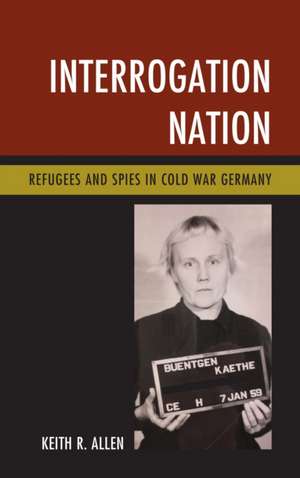
Interrogation Nation: Refugees and Spies in Cold War Germany
Autor Keith R. Allenen Limba Engleză Hardback – 25 mai 2017
Allen's study illuminates the places, personalities, and practices of refugee interrogation in one of Europe's most successful postwar states. As calls for intense scrutiny of refugees have grown dramatically, Allen illustrates how decisions to shortchange the rights of migrants in periods of heightened ideological and military tension may contribute to long-term threats to personal liberties and the rule of law.
Preț: 641.84 lei
Preț vechi: 959.78 lei
-33%
Puncte Express: 963
Carte tipărită la comandă
Livrare economică 03-17 decembrie
Livrare prin curier în România Termenul estimat este afișat lângă disponibilitate.
Transport gratuit pentru acest produs Plată online sau ramburs, în funcție de opțiunile comenzii.
Retur gratuit în 14 zile Comandă securizată și suport în română.
Specificații
ISBN-13: 9781538101513
ISBN-10: 1538101513
Pagini: 312
Ilustrații: 14 b/w photos
Dimensiuni: 159 x 237 x 24 mm
Greutate: 0.61 kg
Editura: Bloomsbury Publishing
Colecția Rowman & Littlefield
Locul publicării:New York, United States
ISBN-10: 1538101513
Pagini: 312
Ilustrații: 14 b/w photos
Dimensiuni: 159 x 237 x 24 mm
Greutate: 0.61 kg
Editura: Bloomsbury Publishing
Colecția Rowman & Littlefield
Locul publicării:New York, United States
V-ar putea interesa
-
 Slate Mining in the Lake DistrictAlastair CameronPreț: 112.60 lei
 -
 ParasRoger PaynePreț: 157.10 lei
 -
 Richmond ParkPaul RabbittsPreț: 77.62 lei
 -
 Angel MeadowDean KirbyPreț: 109.02 lei
Cuprins
Abbreviations
Acknowledgments
Introduction: Migrants, Spies, and Security in Cold War Germany
Part I: Places
1 The Allied Enclave of West Berlin
2 Debriefing in West Germany
Part II: Personalities
3 British Initiators: Scientific and Technical Intelligence Branch
(STIB)
4 American Liberators: The Counter Intelligence Corps (CIC)
5 West German Administrators: The Federal Intelligence Service
(BND)
Part III: Practices
6 Westward Migration and East Germany's Stasi
7 Shared Approaches to Security Questioning
8 Conclusion: Refugee Screening-the Past as Prologue
Appendix: The Changing State of Archival Access
References
Index
Acknowledgments
Introduction: Migrants, Spies, and Security in Cold War Germany
Part I: Places
1 The Allied Enclave of West Berlin
2 Debriefing in West Germany
Part II: Personalities
3 British Initiators: Scientific and Technical Intelligence Branch
(STIB)
4 American Liberators: The Counter Intelligence Corps (CIC)
5 West German Administrators: The Federal Intelligence Service
(BND)
Part III: Practices
6 Westward Migration and East Germany's Stasi
7 Shared Approaches to Security Questioning
8 Conclusion: Refugee Screening-the Past as Prologue
Appendix: The Changing State of Archival Access
References
Index
Recenzii
Rich in information. . . .[An] important pioneering work. The book tells us a great deal about the interrogation practice of Western intelligence services in Cold War Germany, but as Allen emphasizes, much remains to be discovered and discussed.
The revelations provided by Edward Snowden regarding electronic surveillance, the growth of lone wolf terrorist attacks, and the recent influx of migrants into Europe from the Middle East have all prompted a reconsideration of how intelligence agencies gather information vital to national security. Allen reminds readers that these debates, especially in Central Europe, have a long history. In an impressively researched work based on archival materials from several countries, Allen argues that the vetting procedures for screening refugees in Germany after WW II 'laid the foundation' for those used for interrogation to this day. His book aptly demonstrates the competition that existed among various nations (most notably the US, the UK, and France) to collect sensitive information after 1945, as well as the ways that these actions routinely infringed on the sovereignty of West Germany. Divided into sections that focus on the places of interrogation, the personalities responsible for these encounters, and the practices used to acquire information, this study shines a penetrating light into a very dark and mysterious chapter of postwar history.
Summing Up: Highly recommended. Upper-division undergraduates and above.
This book, which links relevant institutions, practices, and biographies in one presentation, offers a reading that is as exciting as it is enlightening.
Interrogation Nation presents a compelling analysis of the Western screening of refugees and asylum seekers in the Federal Republic of Germany during the Cold War and beyond. It will remain a standard reference work for the plethora of programs and places associated with such screening, not only for historians, but also for genealogists retracing the path of family members making their way from East to West through a divided Germany during the Cold War. It also represents an important contribution to the history of refugee screening, the activities of Western intelligence agencies, and the Bonn Republic's relationship to the Western powers during the Cold War.
A fascinating read.
It takes painstaking work to compile and cross-reference records across multiple agencies, as Allen has done, relying mainly on declassified documents from the British, American, and German national archives in Kew, College Park, and Koblenz, along with the German state archives in Berlin, Hesse, and North Rhine-Westphalia. He also delves into Stasi records to see just what the East German side was able to piece together aboutWestern methods. The most engaging passages of this study involve brief case studies highlighting the cross-border networks that could "push" or "pull" desired informants intoWestern hands. A particularly vivid case takes Allen to the Archive of the Security Services in Prague. The source material illuminates all manner of ColdWar fates, pointing the way toward a social history of border-crossers.
By setting out how intelligence agencies used institutional mechanisms embedded in the escalating fortification of the border between West Germany and East Germany, Allen's extensive research provides useful insights in the emergence of systems used to interrogate and process information from refugees that often remain today. . . . Through an examination of specific individuals involved in developing interrogation programs and the refugees drawn into them, Allen provides a fascinating picture of how the management of refugees and border regimes became a focus for conflicts between British, US, and West German intelligence agencies. Moreover, the divergent ways in which information was managed and processed outlined in the final section demonstrate how differences in political culture, institutional tradition, and ideological outlook fueled such disputes in ways that continued long after Germany's reunification. . . . [F]or researchers interested in Cold War history, European security, and migration, this book is a treasure trove of information.
This is a brilliantly researched and fascinating study of Cold War espionage and interrogation. It could not be more timely: many of the Cold War issues Keith Allen exposes are being resurrected all around us today.
Keith Allen opens a vital window to the history of interrogations and intelligence through his careful, nuanced, and fascinating exploration of refugee screening in western Germany. Particularly gripping and informative are the many individual personalities of shadowy 'sources' culled from American, British, Czech, and German archives. Interrogation and refugees are not a brand-new concern of our present day. Allen illuminates the roots of our current system, reaching back into the rubble-strewn soil of the postwar moment.
Keith Allen's meticulously crafted book is a research masterpiece on the topic of post-World War II interrogation procedures. Drawing together a stupendous trove of documents, many recently declassified, from American, East and West German, British and French agencies, Allen resurrects a complex network of sites, technologies, and personnel-including the galvanizing stories of spies, refugees, and scientists, among others. Together they constituted a significant part of the mass migrations of the second half of the twentieth century. While focusing on those who crossed from East to West Germany, especially in the 1940s and 1950s, Allen's research does not simply resurrect a Cold War bygone. Rather, Interrogation Nation directly sheds light on two of the key unresolved issues of our time: procedures of vetting Syrian and other fleeing refugees within Europe, as well as ongoing debates over increasingly penetrating, increasingly networked, electronic surveillance.
The revelations provided by Edward Snowden regarding electronic surveillance, the growth of lone wolf terrorist attacks, and the recent influx of migrants into Europe from the Middle East have all prompted a reconsideration of how intelligence agencies gather information vital to national security. Allen reminds readers that these debates, especially in Central Europe, have a long history. In an impressively researched work based on archival materials from several countries, Allen argues that the vetting procedures for screening refugees in Germany after WW II 'laid the foundation' for those used for interrogation to this day. His book aptly demonstrates the competition that existed among various nations (most notably the US, the UK, and France) to collect sensitive information after 1945, as well as the ways that these actions routinely infringed on the sovereignty of West Germany. Divided into sections that focus on the places of interrogation, the personalities responsible for these encounters, and the practices used to acquire information, this study shines a penetrating light into a very dark and mysterious chapter of postwar history.
Summing Up: Highly recommended. Upper-division undergraduates and above.
This book, which links relevant institutions, practices, and biographies in one presentation, offers a reading that is as exciting as it is enlightening.
Interrogation Nation presents a compelling analysis of the Western screening of refugees and asylum seekers in the Federal Republic of Germany during the Cold War and beyond. It will remain a standard reference work for the plethora of programs and places associated with such screening, not only for historians, but also for genealogists retracing the path of family members making their way from East to West through a divided Germany during the Cold War. It also represents an important contribution to the history of refugee screening, the activities of Western intelligence agencies, and the Bonn Republic's relationship to the Western powers during the Cold War.
A fascinating read.
It takes painstaking work to compile and cross-reference records across multiple agencies, as Allen has done, relying mainly on declassified documents from the British, American, and German national archives in Kew, College Park, and Koblenz, along with the German state archives in Berlin, Hesse, and North Rhine-Westphalia. He also delves into Stasi records to see just what the East German side was able to piece together aboutWestern methods. The most engaging passages of this study involve brief case studies highlighting the cross-border networks that could "push" or "pull" desired informants intoWestern hands. A particularly vivid case takes Allen to the Archive of the Security Services in Prague. The source material illuminates all manner of ColdWar fates, pointing the way toward a social history of border-crossers.
By setting out how intelligence agencies used institutional mechanisms embedded in the escalating fortification of the border between West Germany and East Germany, Allen's extensive research provides useful insights in the emergence of systems used to interrogate and process information from refugees that often remain today. . . . Through an examination of specific individuals involved in developing interrogation programs and the refugees drawn into them, Allen provides a fascinating picture of how the management of refugees and border regimes became a focus for conflicts between British, US, and West German intelligence agencies. Moreover, the divergent ways in which information was managed and processed outlined in the final section demonstrate how differences in political culture, institutional tradition, and ideological outlook fueled such disputes in ways that continued long after Germany's reunification. . . . [F]or researchers interested in Cold War history, European security, and migration, this book is a treasure trove of information.
This is a brilliantly researched and fascinating study of Cold War espionage and interrogation. It could not be more timely: many of the Cold War issues Keith Allen exposes are being resurrected all around us today.
Keith Allen opens a vital window to the history of interrogations and intelligence through his careful, nuanced, and fascinating exploration of refugee screening in western Germany. Particularly gripping and informative are the many individual personalities of shadowy 'sources' culled from American, British, Czech, and German archives. Interrogation and refugees are not a brand-new concern of our present day. Allen illuminates the roots of our current system, reaching back into the rubble-strewn soil of the postwar moment.
Keith Allen's meticulously crafted book is a research masterpiece on the topic of post-World War II interrogation procedures. Drawing together a stupendous trove of documents, many recently declassified, from American, East and West German, British and French agencies, Allen resurrects a complex network of sites, technologies, and personnel-including the galvanizing stories of spies, refugees, and scientists, among others. Together they constituted a significant part of the mass migrations of the second half of the twentieth century. While focusing on those who crossed from East to West Germany, especially in the 1940s and 1950s, Allen's research does not simply resurrect a Cold War bygone. Rather, Interrogation Nation directly sheds light on two of the key unresolved issues of our time: procedures of vetting Syrian and other fleeing refugees within Europe, as well as ongoing debates over increasingly penetrating, increasingly networked, electronic surveillance.