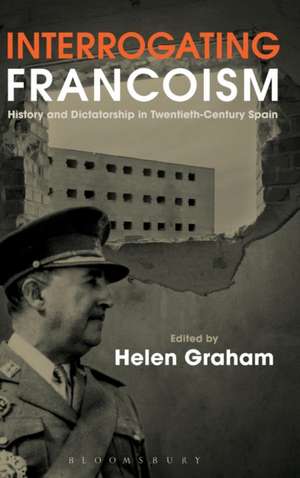
Interrogating Francoism: History and Dictatorship in Twentieth-Century Spain
Editat de Professor Helen Grahamen Limba Engleză Hardback – 25 aug 2016
Interrogating Francoism uses a three-part structure to look at the old regime, the civil war and the forging of Francoism; the nature of Franco's dictatorship; and the 'history wars' that have since taken place over his legacy. Social, political, economic and cultural historical approaches are integrated throughout and 'top down' political analysis is incorporated along with 'bottom up' social perspectives. The book places Spain and Francoism in comparative European context and explores the relationship between the historical debates and present-day political and ideological controversies in Spain.
In part a tribute to Paul Preston, the foremost historian of contemporary Spain today, Interrogating Francoism includes an interview with Professor Preston and a comprehensive bibliography of his work, as well as extensive further readings in English. It is a crucial volume for all students of 20th-century Spain.
| Toate formatele și edițiile | Preț | Express |
|---|---|---|
| Paperback (1) | 185.86 lei 6-8 săpt. | |
| Bloomsbury Publishing – 25 aug 2016 | 185.86 lei 6-8 săpt. | |
| Hardback (1) | 739.63 lei 6-8 săpt. | |
| Bloomsbury Publishing – 25 aug 2016 | 739.63 lei 6-8 săpt. |
Preț: 739.63 lei
Preț vechi: 860.03 lei
-14%
Puncte Express: 1109
Preț estimativ în valută:
130.68€ • 149.86$ • 113.42£
130.68€ • 149.86$ • 113.42£
Carte tipărită la comandă
Livrare economică 14-28 mai
Specificații
ISBN-13: 9781472576347
ISBN-10: 1472576349
Pagini: 288
Dimensiuni: 156 x 234 mm
Greutate: 0.7 kg
Editura: Bloomsbury Publishing
Colecția Bloomsbury Academic
Locul publicării:London, United Kingdom
ISBN-10: 1472576349
Pagini: 288
Dimensiuni: 156 x 234 mm
Greutate: 0.7 kg
Editura: Bloomsbury Publishing
Colecția Bloomsbury Academic
Locul publicării:London, United Kingdom
V-ar putea interesa
-
 The Kings and Queens of BritainJohn Cannon-21%Preț: 81.50 lei102.62 lei
 -
 Trautmann's JourneyCatrine Clay-20%Preț: 71.00 lei89.16 lei
 -
 1536Suzannah LipscombPreț: 89.87 lei
 -
 Food and Identity in England, 1540-1640: Eating to ImpressDr Paul S. Lloyd-26%Preț: 265.18 lei358.42 lei
 -
 A History of RomeDavid CherryPreț: 298.38 lei
 -
 -28%Preț: 84.33 lei116.62 lei
 -
 Colonial Food in Interwar Paris: The Taste of EmpireDr Lauren Janes-34%Preț: 800.17 lei1204.25 lei
 -
 Russian History through the Senses: From 1700 to the PresentProfessor Matthew P. Romaniello-20%Preț: 186.67 lei234.60 lei
 -
 WRNS: The Women’s Royal Naval ServiceNeil R. Storey-28%Preț: 44.27 lei61.42 lei
 -
 Canals in BritainTony Conder-27%Preț: 45.15 lei61.96 lei
Cuprins
Introduction: Writing Spain's Twentieth Century in(to) Europe (Helen Graham, Royal Holloway, University of London, UK)
Part I - The Endurance of the Old Regime: Structures, Mentalities and Everyday Life
1. Twentieth-Century Catholicisms: Religion as Prison, as Haven, as 'Clamp' (Maria A. Thomas, University of Exeter, UK)
2. Building Alliances against the New? Monarchy and the Military in Industrialising Spain (Francisco Romero Salvadó, University of Bristol, UK)
3. Reform as Promise and Threat: Political Progressives and Blueprints for Change in 1930s Spain (Helen Graham)
Part II - Making Dictatorship: Discourse, Policy and Practice
4. 'Productive Hatreds': Radical Segregationist Discourses and the Making of Francoism (Isabelle Rohr, Independent Scholar, UK)
5. A Coup against Change: Repression in Seville and the Assault against Civilian Society (Rúben Serém, University of Nottingham, UK, and the New University of Lisbon, Portugal)
6. Natural Alliances: The Impact of Nazism and Fascism on Franco's Domestic Policies (Angel Viñas, Universidad Complutense, Madrid, Spain)
7. States of War: 'Being Civilian' in 1940s Spain (Jorge Marco, Universidad Complutense, Madrid, Spain/University of Bath, UK)
Part III - Making Memory: History and the Future of Dictatorship
8. Stories for After a War: Social Memory and the making of Urban and Industrial Transition in 1960s Spain (Michael Richards, University of the West of England, UK)
9. Disremembering Francoism: What is at Stake in Spain's Memory Wars? (Julián Casanova, University of Zaragoza, Spain, and CEU, Hungary)
Part IV - Bibliographies
Biographies for a Caudillo after a War: A Bibliography of Franco Biographies (Enrique Moradiellos, University of Extremadura, Cáceres, Spain)
Cumulative Bibliography of the Work of Paul Preston (Maria A. Thomas)
Part V - CODA
Ten Questions for Paul Preston
PhDs supervised by Paul Preston
Glossary
Bibliography
Index
Part I - The Endurance of the Old Regime: Structures, Mentalities and Everyday Life
1. Twentieth-Century Catholicisms: Religion as Prison, as Haven, as 'Clamp' (Maria A. Thomas, University of Exeter, UK)
2. Building Alliances against the New? Monarchy and the Military in Industrialising Spain (Francisco Romero Salvadó, University of Bristol, UK)
3. Reform as Promise and Threat: Political Progressives and Blueprints for Change in 1930s Spain (Helen Graham)
Part II - Making Dictatorship: Discourse, Policy and Practice
4. 'Productive Hatreds': Radical Segregationist Discourses and the Making of Francoism (Isabelle Rohr, Independent Scholar, UK)
5. A Coup against Change: Repression in Seville and the Assault against Civilian Society (Rúben Serém, University of Nottingham, UK, and the New University of Lisbon, Portugal)
6. Natural Alliances: The Impact of Nazism and Fascism on Franco's Domestic Policies (Angel Viñas, Universidad Complutense, Madrid, Spain)
7. States of War: 'Being Civilian' in 1940s Spain (Jorge Marco, Universidad Complutense, Madrid, Spain/University of Bath, UK)
Part III - Making Memory: History and the Future of Dictatorship
8. Stories for After a War: Social Memory and the making of Urban and Industrial Transition in 1960s Spain (Michael Richards, University of the West of England, UK)
9. Disremembering Francoism: What is at Stake in Spain's Memory Wars? (Julián Casanova, University of Zaragoza, Spain, and CEU, Hungary)
Part IV - Bibliographies
Biographies for a Caudillo after a War: A Bibliography of Franco Biographies (Enrique Moradiellos, University of Extremadura, Cáceres, Spain)
Cumulative Bibliography of the Work of Paul Preston (Maria A. Thomas)
Part V - CODA
Ten Questions for Paul Preston
PhDs supervised by Paul Preston
Glossary
Bibliography
Index
Recenzii
A first-rate collection of wide-ranging yet coherently integrated essays ... The volume covers much of 20th century Spanish history, coherently inserts Spain's past into the European framework and engages with current historiographical debates. It will be useful not only to undergraduate and postgraduate students but also to all those interested in Spain's difficult past and convulsive present. It certainly deserves a wide readership.
Offers a fresh critique of the historiography of the Franco regime ... authoritative and incisive, the arguments posited in this volume could not be more propitious. A volume to pore over and return to over time has resoundingly achieved its original premise, to debunk myths through nuanced reflection and rigorous assessment. And to encourage future historians to take up the challenge to participate in this 'live dialogue with the present'.
An impressive team of contributors, with exceptional offerings from representatives of the new generation of historians of contemporary Spain. The book offers fresh insights into Spain's first democracy and the civil war that destroyed it. In the face of attempts, both in Spain and abroad, to sanitise Franco's subsequent dictatorship, this volume highlights once again the regime's brutality and its enduring cultural and political legacies for twenty-first century Spain. This is a fitting tribute to the most recognised historian of contemporary Spain.
Interrogating Francoism is a fine, authoritative collection of essays that shed light on what the excellent editor, Helen Graham, calls 'Europe's most successful and adaptive dictatorial culture'. Wide-ranging yet coherent, the book spans the crisis of modernisation out of which the dictatorship and its repressed alternative emerged, and the resurgent contemporary nationalism that continues to justify the crimes of the dictatorship, or at least to invalidate the Republic. This volume deserves a much wider readership than Spanish specialists alone because it tells us so very much about Europe entire, and the story is not a pretty one.
Over the past forty years Professor Paul Preston, through his own impressive body of publications and those of his Anglo-Spanish army of former doctoral students, has become the focus of a veritable 'Preston school' of historical scholarship on twentieth-century Spain. This distinguished collective volume, ably edited by Professor Helen Graham, is an altogether fitting tribute to an outstanding career , offering as it does work of range, rigour and 'Prestonian' conviction. As an analysis of Francoism's roots, nature and baleful legacy it constitutes a devastating corrective to the currently fashionable effusions of Spanish 'revisionists'. Its dedicatee could not have asked for more.
This compelling volume is worthy of Paul Preston's four decades of groundbreaking historical research on twentieth-century Spain. The contributors' essays present significant new work on topics as wide-ranging as the role of the Catholic Church and the persistence of Francoist patterns of thought and behavior long after the dictator's death. More important, this book underscores--as Preston has for forty years--three important insights: that Spain's history cannot be understood separate from its European context; that, conversely, historians of Europe cannot relegate Spain to the margins of their narrative; and, finally, that a proper understanding of the way in which the political and cultural tensions of the 1930s played out in Spain during the Civil War and the Franco dictatorship continues to have great relevance as Europe is facing one of its most challenging moments in recent history.
Offers a fresh critique of the historiography of the Franco regime ... authoritative and incisive, the arguments posited in this volume could not be more propitious. A volume to pore over and return to over time has resoundingly achieved its original premise, to debunk myths through nuanced reflection and rigorous assessment. And to encourage future historians to take up the challenge to participate in this 'live dialogue with the present'.
An impressive team of contributors, with exceptional offerings from representatives of the new generation of historians of contemporary Spain. The book offers fresh insights into Spain's first democracy and the civil war that destroyed it. In the face of attempts, both in Spain and abroad, to sanitise Franco's subsequent dictatorship, this volume highlights once again the regime's brutality and its enduring cultural and political legacies for twenty-first century Spain. This is a fitting tribute to the most recognised historian of contemporary Spain.
Interrogating Francoism is a fine, authoritative collection of essays that shed light on what the excellent editor, Helen Graham, calls 'Europe's most successful and adaptive dictatorial culture'. Wide-ranging yet coherent, the book spans the crisis of modernisation out of which the dictatorship and its repressed alternative emerged, and the resurgent contemporary nationalism that continues to justify the crimes of the dictatorship, or at least to invalidate the Republic. This volume deserves a much wider readership than Spanish specialists alone because it tells us so very much about Europe entire, and the story is not a pretty one.
Over the past forty years Professor Paul Preston, through his own impressive body of publications and those of his Anglo-Spanish army of former doctoral students, has become the focus of a veritable 'Preston school' of historical scholarship on twentieth-century Spain. This distinguished collective volume, ably edited by Professor Helen Graham, is an altogether fitting tribute to an outstanding career , offering as it does work of range, rigour and 'Prestonian' conviction. As an analysis of Francoism's roots, nature and baleful legacy it constitutes a devastating corrective to the currently fashionable effusions of Spanish 'revisionists'. Its dedicatee could not have asked for more.
This compelling volume is worthy of Paul Preston's four decades of groundbreaking historical research on twentieth-century Spain. The contributors' essays present significant new work on topics as wide-ranging as the role of the Catholic Church and the persistence of Francoist patterns of thought and behavior long after the dictator's death. More important, this book underscores--as Preston has for forty years--three important insights: that Spain's history cannot be understood separate from its European context; that, conversely, historians of Europe cannot relegate Spain to the margins of their narrative; and, finally, that a proper understanding of the way in which the political and cultural tensions of the 1930s played out in Spain during the Civil War and the Franco dictatorship continues to have great relevance as Europe is facing one of its most challenging moments in recent history.