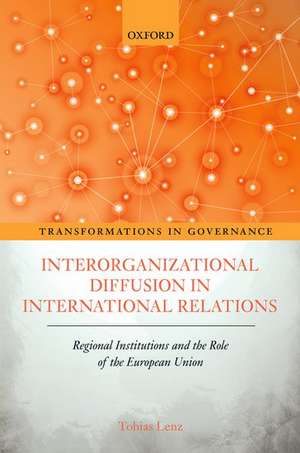
Interorganizational Diffusion in International Relations: Regional Institutions and the Role of the European Union: Transformations in Governance
Autor Tobias Lenzen Limba Engleză Hardback – 2 iul 2021
Din seria Transformations in Governance
- 32%
 Preț: 642.56 lei
 - 32%
 Preț: 642.71 lei
 - 19%
 Preț: 590.06 lei
 - 32%
 Preț: 618.08 lei
 - 32%
 Preț: 617.46 lei
 - 33%
 Preț: 575.79 lei
 - 33%
 Preț: 577.19 lei
 - 32%
 Preț: 643.16 lei
 - 32%
 Preț: 656.13 lei
 - 31%
 Preț: 695.02 lei
 - 30%
 Preț: 744.32 lei
 - 27%
 Preț: 421.20 lei
 - 19%
 Preț: 361.32 lei
 - 31%
 Preț: 621.56 lei
 - 19%
 Preț: 248.93 lei
 - 29%
 Preț: 870.33 lei
 - 29%
 Preț: 552.76 lei
 - nou
 Preț: 612.33 lei
Preț: 678.64 lei
Preț vechi: 837.83 lei
-19%
Puncte Express: 1018
Carte disponibilă
Livrare economică 12-26 noiembrie
Livrare prin curier în România Termenul estimat este afișat lângă disponibilitate.
Transport gratuit pentru acest produs Plată online sau ramburs, în funcție de opțiunile comenzii.
Retur gratuit în 14 zile Comandă securizată și suport în română.
Specificații
ISBN-13: 9780198823827
ISBN-10: 0198823827
Pagini: 288
Dimensiuni: 163 x 241 x 21 mm
Greutate: 0.56 kg
Editura: OUP OXFORD
Colecția OUP Oxford
Seria Transformations in Governance
Locul publicării:Oxford, United Kingdom
ISBN-10: 0198823827
Pagini: 288
Dimensiuni: 163 x 241 x 21 mm
Greutate: 0.56 kg
Editura: OUP OXFORD
Colecția OUP Oxford
Seria Transformations in Governance
Locul publicării:Oxford, United Kingdom
Recenzii
A fascinating and timely examination of the influence of EU institutions on other regional organizations. Lenz breaks new ground in his conceptualization of transnational diffusion and puts it to work to explain heterogeneity in regional institutionalization. The EU may influence institutional preferences and strategies in other regional contexts but regional institutions around the world do not merely emulate the EU. Empirical tests spanning large-N study, process-tracing, and a paired comparison suggest that other regional institutions might have indeed been less institutionalized in the absence of interaction with the EU. The book is a must read for scholars of regional institutions and transnational diffusion alike.
For more than 60 years, international relations scholars have tried in vain to understand the relationship between Europe and regional organizations in the rest of the world. Look no further – here is the answer that will shape the debate for decades to come! In this ground-breaking book, Tobias Lenz covers all relevant regional organizations since 1950 and explains if, why and in what ways the European Union shapes their process of institution building. No serious scholar concerned with international and regional organizations, the EU's role in the world, and diffusion can afford to miss what he has to say.
This brilliant book is unique in shedding a radically new light on why and how regions around the world evolve over time in the shadow of the European Union (EU). Tobias Lenz convincingly argues that we live in a relational world, and that in such a world, the EU has been an organizational pioneer, affecting other regional organizations by shaping the way their national governments think and act. This book is destined to constitute THE main reference in the story of diffusion of Europe's approach to regional integration. No scholar or policy makers can afford to ignore it.
This book tackles an empirical conundrum in a very theoretically grounded way: On the one hand, the number of organizations that group together regional sub-sets of pre-existing national states has proliferated across the entire planet in recent decades; On the other, one of these – the European Union – is almost universally regarded as "unique" in its supra-national competences. Exploiting a comprehensive and original dataset with the formal characteristics of no less than 36 regional organizations, Lenz finds part of the answer in the process of institutional diffusion, both explicit thanks to the EU's efforts to clone itself and implicit in the efforts of others to imitate its success. No one attempting to develop a universally applicable theory of regional integration can afford to neglect Lenz's findings.
This is a phantastic book! It demonstrates that the European Union (EU) is indeed the dominant model of institutional diffusion to regional organizations in the rest of the world. However, diffusion does not lead to institutional convergence, but regional organizations across the world exhibit distinct features. National governments are no dummies simply downloading "EU software". They craft and filter EU features through their own preferences and strategies leading to the selective adaption of institutional models. Lenz develops his argument through a carefully designed mix of quantitative analyses complemented by detailed case studies. This book will have a lasting impact on both comparative regionalism and diffusion studies in general.
For more than 60 years, international relations scholars have tried in vain to understand the relationship between Europe and regional organizations in the rest of the world. Look no further – here is the answer that will shape the debate for decades to come! In this ground-breaking book, Tobias Lenz covers all relevant regional organizations since 1950 and explains if, why and in what ways the European Union shapes their process of institution building. No serious scholar concerned with international and regional organizations, the EU's role in the world, and diffusion can afford to miss what he has to say.
This brilliant book is unique in shedding a radically new light on why and how regions around the world evolve over time in the shadow of the European Union (EU). Tobias Lenz convincingly argues that we live in a relational world, and that in such a world, the EU has been an organizational pioneer, affecting other regional organizations by shaping the way their national governments think and act. This book is destined to constitute THE main reference in the story of diffusion of Europe's approach to regional integration. No scholar or policy makers can afford to ignore it.
This book tackles an empirical conundrum in a very theoretically grounded way: On the one hand, the number of organizations that group together regional sub-sets of pre-existing national states has proliferated across the entire planet in recent decades; On the other, one of these – the European Union – is almost universally regarded as "unique" in its supra-national competences. Exploiting a comprehensive and original dataset with the formal characteristics of no less than 36 regional organizations, Lenz finds part of the answer in the process of institutional diffusion, both explicit thanks to the EU's efforts to clone itself and implicit in the efforts of others to imitate its success. No one attempting to develop a universally applicable theory of regional integration can afford to neglect Lenz's findings.
This is a phantastic book! It demonstrates that the European Union (EU) is indeed the dominant model of institutional diffusion to regional organizations in the rest of the world. However, diffusion does not lead to institutional convergence, but regional organizations across the world exhibit distinct features. National governments are no dummies simply downloading "EU software". They craft and filter EU features through their own preferences and strategies leading to the selective adaption of institutional models. Lenz develops his argument through a carefully designed mix of quantitative analyses complemented by detailed case studies. This book will have a lasting impact on both comparative regionalism and diffusion studies in general.
Notă biografică
Tobias Lenz is Professor of International Relations, Leuphana University Lüneburg, and leader of a Leibniz Junior Research Group on the legitimation strategies of regional organizations at the German Institute for Global and Area Studies (GIGA). His research focuses on the design and evolution of international organizations, their legitimacy and legitimation, and on the role of the European Union in global regionalism. Previous and forthcoming publications include A Theory of International Organization (with Liesbet Hooghe and Gary Marks, OUP, 2019) and The Rise of International Parliaments: Strategic Legitimation in International Organizations (with Frank Schimmelfennig, Thomas Winzen, Jofre Rocabert, Loriana Crasnic, Cristina Gherasimov, Jana Lipps, and Densua Mumford, OUP, 2020).