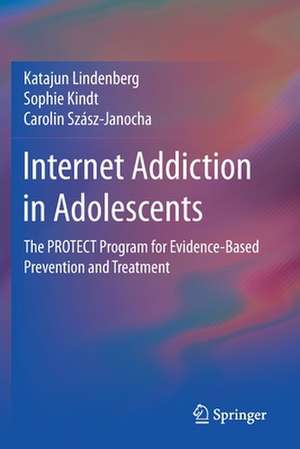
Internet Addiction in Adolescents
Autor Katajun Lindenberg, Sophie Kindt, Carolin Szász-Janochaen Limba Engleză Paperback – 2 iun 2021
Topics featured in this book include:
- Adolescence and development-specific features of Internet addiction.
- An overview of modifiable risk factors and maintenance factors of Internet addiction.
- Environmental factors that affect the development of Internet addiction.
- Online and offline video gaming addiction.
- Social network addiction.
- Strategies that work in prevention and treatment.
Internet Addiction in Adolescents is a must-have resource for researchers, professors, clinicians and related professionals as well as graduate students in clinical child, school, and developmental psychology, educational policy and politics, and socialwork as well as related disciplines.
Preț: 751.45 lei
Preț vechi: 916.40 lei
-18%
Puncte Express: 1127
Carte tipărită la comandă
Livrare economică 03-17 decembrie
Livrare prin curier în România Termenul estimat este afișat lângă disponibilitate.
Transport gratuit pentru acest produs Plată online sau ramburs, în funcție de opțiunile comenzii.
Retur gratuit în 14 zile Comandă securizată și suport în română.
Specificații
ISBN-13: 9783030437862
ISBN-10: 3030437868
Pagini: 224
Ilustrații: XVII, 206 p. 8 illus.
Dimensiuni: 155 x 235 x 13 mm
Greutate: 0.35 kg
Ediția:1st ed. 2020
Editura: Springer
Locul publicării:Cham, Switzerland
ISBN-10: 3030437868
Pagini: 224
Ilustrații: XVII, 206 p. 8 illus.
Dimensiuni: 155 x 235 x 13 mm
Greutate: 0.35 kg
Ediția:1st ed. 2020
Editura: Springer
Locul publicării:Cham, Switzerland
Cuprins
Part I: Internet Use Disorders in Adolescents.- Chapter 1. Definition and Diagnostics of Internet Use Disorders.- Chapter 2. Characteristics and Conditions Associated with Internet Use Disorders.- Chapter 3. Etiology of Internet Use Disorders.- Chapter 4. Treatment and Prevention for Adolescents with Internet Use Disorders.- Chapter 5. The PROTECT Intervention.- Part II: The PROTECT Program for Evidence-Based Prevention and Treatment.- Chapter 6. Module 1 – Boredom and Motivational Problems.- Chapter 7. Module 2 – Performance Anxiety and Procrastination.- Chapter 8. Module 3 – Social Anxiety.- Chapter 9. Module 4 – Emotion Regulation.
Notă biografică
Prof. Katajun Lindenberg, Ph.D., research scientist and clinical psychologist Associate professor for developmental psychology at the University of Education Heidelberg, Germany; Professor for clinical child psychology and psychotherapy at the Goethe University Frankfurt, Germany
Sophie Kindt, M.Sc., research associate and clinical psychologist. Her research focuses on Internet Use Disorders, prevention and risk factors.
Carolin Szász-Janocha, M.Sc., research associate and clinical psychologist. Her research focuses on Internet Use Disorders, treatment and risk factors.
Sophie Kindt, M.Sc., research associate and clinical psychologist. Her research focuses on Internet Use Disorders, prevention and risk factors.
Carolin Szász-Janocha, M.Sc., research associate and clinical psychologist. Her research focuses on Internet Use Disorders, treatment and risk factors.
Textul de pe ultima copertă
This book presents a new, evidence-based cognitive behavioral intervention for the prevention and treatment of Internet addiction in adolescents. It provides a comprehensive overview of the current state of research regarding phenomenology, diagnostics, epidemiology, etiology, and treatment and prevention of Internet addiction as a new behavioral addiction. The book is divided into two sections. The first part of the book explores various bio-psycho-social factors that contribute to the development and maintenance of symptoms in young individuals. Chapters in the second part of the book discuss the PROTECT intervention to reduce Internet addiction in adolescents. PROTECT aims to modify risk factors and maintenance factors, specifically, boredom and motivational problems, procrastination and performance anxiety, social anxiety and maladaptive emotion regulation. The PROTECT intervention is a low-intensity approach which uses comprehensive case examples in order to increase cognitive dissonance and treatment motivation. In addition, PROTECT contains cognitive behavioral intervention techniques such as psychoeducation, behavior activation, cognitive restructuring, problem solving and emotion regulation.
Topics featured in this book include:
Internet Addiction in Adolescents is a must-have resource for researchers, professors, clinicians and related professionals as well as graduate students in clinical child, school, and developmental psychology, educational policy and politics, and social work as well as related disciplines.
Topics featured in this book include:
- Adolescence and development-specific features of Internet addiction.
- An overview of modifiable risk factors and maintenance factors of Internet addiction.
- Environmental factors that affect the development of Internet addiction.
- Online and offline video gaming addiction.
- Social network addiction.
- Strategies that work in prevention and treatment.
Internet Addiction in Adolescents is a must-have resource for researchers, professors, clinicians and related professionals as well as graduate students in clinical child, school, and developmental psychology, educational policy and politics, and social work as well as related disciplines.
Caracteristici
Describes a cost-effective, low-intensity, stepped-care CBT intervention (PROTECT) to treat internet addiction in youth Synthesizes findings on risk factors and cognitive-behavioral and neurophysical causes and mechanisms Addresses comorbid symptoms of youth Internet addiction (e.g., anxiety, ADHD) Discusses Internet addiction treatment techniques for teens, such as cognitive restructuring and behavior modification