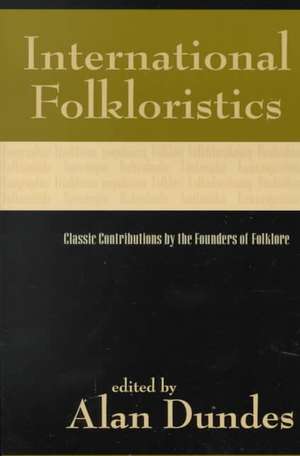
International Folkloristics: Classic Contributions by the Founders of Folklore
Editat de Alan Dundes Contribuţii de Béla Bartók, Séamus Ó Duilearga, James George Frazer, Sigmund Freud, Kenneth S. Goldstein, Antonio Gramsci, Jacob Grimm, Reinhold Köhler, Kaarle Krohn, Wilhelm Mannhardt, Max Müller, Axel Olrik, Giuseppe Pitrè, Vladimir Propp, Géza Róheim, Boris Sokolov, Yuri Sokolov, William Thoms, Arnold van Gennep, Carl Wilhelm von Sydow, W. B. Yeatsen Limba Engleză Paperback – aug 1999
Preț: 308.26 lei
Preț vechi: 386.70 lei
-20%
Puncte Express: 462
Carte tipărită la comandă
Livrare economică 08-22 iunie
Specificații
ISBN-13: 9780847695157
ISBN-10: 0847695158
Pagini: 270
Dimensiuni: 155 x 232 x 16 mm
Greutate: 0.4 kg
Ediția:0272
Editura: Bloomsbury Publishing
Colecția Rowman & Littlefield
Locul publicării:New York, United States
ISBN-10: 0847695158
Pagini: 270
Dimensiuni: 155 x 232 x 16 mm
Greutate: 0.4 kg
Ediția:0272
Editura: Bloomsbury Publishing
Colecția Rowman & Littlefield
Locul publicării:New York, United States
V-ar putea interesa
-
 -9%Preț: 302.52 lei331.12 lei
 -
 Love in a Dark TimeColm Tòibìn-43%Preț: 45.18 lei79.32 lei
 -
 Emily Bronte: Wuthering HeightsNicholas MarshPreț: 172.03 lei
 -
 Mastering the Novels of Jane AustenRichard GillPreț: 241.75 lei
 -
 Witness against the Beast: William Blake and the Moral LawE. P. ThompsonPreț: 161.25 lei
 -
 The Roots of RomanticismIsaiah Berlin-21%Preț: 101.52 lei128.74 lei
 -
 Introductions and Notes from the Magnum OpusWalter Scott-25%Preț: 640.30 lei850.17 lei
 -
 Victorian LiteratureDavid Amigoni-14%Preț: 144.23 lei166.90 lei
 -
 Victorian Literature and CultureMaureen Moran-22%Preț: 148.86 lei191.22 lei
 -
 Preț: 63.97 lei
 -
 Preț: 64.24 lei
 -
 Preț: 375.04 lei
 -
 Selected Poems of Christina RossettiChristina RossettiPreț: 36.55 lei
Cuprins
Chapter 1 Circular Concerning the Collecting of Folk Poetry
Chapter 2 Folk-Lore and the Origin of the Word
Chapter 3 Request
Chapter 4 An Angel Flew Through the Room
Chapter 5 The Study of Folk-Lore
Chapter 6 The Method of Julius Krohn
Chapter 7 The Message of the Folk-Lorist
Chapter 8 On the Need for a Bibliography of Folklore
Chapter 9 A Dialogue in Gyergyó-Kilényfalva
Chapter 10 In Search of Folktales and Songs
Chapter 11 Epic Laws of Folk Narrative
Chapter 12 The Rites of Passage
Chapter 13 The Principles of Sympathetic Magic
Chapter 14 The Structure of Russian Fairy Tales
Chapter 15 Observations on Folklore
Chapter 16 Geography and Folk-Tale Oicotypes
Chapter 17 Irish Tales and Story-Tellers
Chapter 18 Symbolism in Dreams
Chapter 19 Wedding Ceremonies in European Folklore
Chapter 20 Strategy in Counting Out: An Ethnographic Folklore Field Study
Chapter 21 Suggestions for Further Reading in the History of Folkloristics.
Chapter 2 Folk-Lore and the Origin of the Word
Chapter 3 Request
Chapter 4 An Angel Flew Through the Room
Chapter 5 The Study of Folk-Lore
Chapter 6 The Method of Julius Krohn
Chapter 7 The Message of the Folk-Lorist
Chapter 8 On the Need for a Bibliography of Folklore
Chapter 9 A Dialogue in Gyergyó-Kilényfalva
Chapter 10 In Search of Folktales and Songs
Chapter 11 Epic Laws of Folk Narrative
Chapter 12 The Rites of Passage
Chapter 13 The Principles of Sympathetic Magic
Chapter 14 The Structure of Russian Fairy Tales
Chapter 15 Observations on Folklore
Chapter 16 Geography and Folk-Tale Oicotypes
Chapter 17 Irish Tales and Story-Tellers
Chapter 18 Symbolism in Dreams
Chapter 19 Wedding Ceremonies in European Folklore
Chapter 20 Strategy in Counting Out: An Ethnographic Folklore Field Study
Chapter 21 Suggestions for Further Reading in the History of Folkloristics.
Recenzii
Alan Dundes, one of the world's leading folklorists, extracts the ground-breaking work of scholars from folklore's earliest days. This collection is recommended.
Alan Dundes' superb source book provides material evidence for the long standing and deeply committed scholarly interest in the vernacular expressions commonly referred to as folklore. The often unusual selections range from letters to seminal early articles by scholars in philology, literature, music and psychology-all of whom shared a commitment to folk expressions. The work is of immediate relevance to students of folklore and will serve as a wonderful teaching tool. Anthropologists, historians of science, and scholars within the cultural studies field in general will be equally interested in this work as it offers an instructive view of disciplinary emergence. Dundes' headnotes to each selection are a tour de force coupling individual biographies and disciplinary history.
In this brilliant volume Alan Dundes . . . has taken stock of folkloristic scholarship . . . . Most choices are undisputed, some may be surprising, others are true discoveries and revelations; but in each case Dundes offers deep insights into the workings of folklore and folkloristics and at the same time contributes to 19th and 20th century European and North American intellectual history in the best sense. The volume convincingly portrays and extends folkloristics and will certainly become one of its standard books.
When the discipline of folklore was achieving its first maturity in the United States, Alan Dundes edited an anthology that gave the profession momentum and purposes. Now in its moment of midlife crisis, Alan Dundes again provides order and direction for the folklorists' craft. His new anthology, a collection of key texts, brilliantly introduced, will become the basic historical textbook for the folklorist. It is a generous gift, a welcome and necessary foundation for thought and action.
Dundes provides an outstanding source book that highlights major thoeries, methods and concepts in the history of folklore, founded upon as he writes 'filedwork in the library'. The twenty chapters highlight work and personae of the most important folklorists.
Alan Dundes highlights major theories, methods, and concepts in the history of folklore. These essays, some recovered treasures making their first appearance in English, others already established classics, are intellectual milestones in a disciplinary attempt to put some of the central ideas that shaped our history in the past two hundred years to a scientific and systematic test. Dundes' biographical, bibliographical, and theoretical introductory comments make this anthology an essential text in any introductory course in folklore and more specifically in a course on the history of folklore studies.
Alan Dundes has edited an important book, which will solidly confirm the significance of international folkloristics as an independent, worldwide, scholarly academic discipline. Alan Dundes's collection is a delight in its variety and yet is well held together by the erudition and skilled commentaries of the editor. It is an excellent introduction to folklore and folkloristics and their history. It is truly a work of international folkloristics.
International Folkloristics belongs on every folklorist's shelf and every M.A. reading list.
Dundes's anthology is a great reference source, especially for folklorists in countries such as Vietnam. This anthology is also a good source for people who intend to write books on international folklore in their own languages. Anyone planning such a project will find suggestions for further reading in the history of folkloristics at the end of Dundes's book. A book that can be used as a practical reference for the teaching and studying of theories, fields, and genres of folklore.
A number of the pieces in this volume are by authors better known for the books--or volumes of books--they published, such as James Frazer. In addition, the international scope of folklore studies is highlighted with selections by such European heavy-weights as Guiseppe Pitre, one of the most prolific scholars in the field. This makes the volume a one-stop destination for an easily digestible overview of a number of the big figures and big ideas in folklore studies into the 1960s-and, conveniently enough, the work is all in English. Prefacing each piece in the volume is an intensive introduction with accompanying suggested further readings. The editor's introductions provide ample contextualization for each piece, while the suggested readings offer a springboard for more in-depth consideration. The introductions accomplish three things: they provide a brief biography and historical background of the scholar; present the historical and current significance of the scholar's ideas; and provide related bibliographical references, past and present. The introductions in conjunction with the selections provide a richly condensed overview of the forces that led to the formation and solidification of the field of folklore studies: a complex amalgamation of intellectual insights,dedicated fieldwork, personality traits, and historical circumstances.
Alan Dundes' superb source book provides material evidence for the long standing and deeply committed scholarly interest in the vernacular expressions commonly referred to as folklore. The often unusual selections range from letters to seminal early articles by scholars in philology, literature, music and psychology-all of whom shared a commitment to folk expressions. The work is of immediate relevance to students of folklore and will serve as a wonderful teaching tool. Anthropologists, historians of science, and scholars within the cultural studies field in general will be equally interested in this work as it offers an instructive view of disciplinary emergence. Dundes' headnotes to each selection are a tour de force coupling individual biographies and disciplinary history.
In this brilliant volume Alan Dundes . . . has taken stock of folkloristic scholarship . . . . Most choices are undisputed, some may be surprising, others are true discoveries and revelations; but in each case Dundes offers deep insights into the workings of folklore and folkloristics and at the same time contributes to 19th and 20th century European and North American intellectual history in the best sense. The volume convincingly portrays and extends folkloristics and will certainly become one of its standard books.
When the discipline of folklore was achieving its first maturity in the United States, Alan Dundes edited an anthology that gave the profession momentum and purposes. Now in its moment of midlife crisis, Alan Dundes again provides order and direction for the folklorists' craft. His new anthology, a collection of key texts, brilliantly introduced, will become the basic historical textbook for the folklorist. It is a generous gift, a welcome and necessary foundation for thought and action.
Dundes provides an outstanding source book that highlights major thoeries, methods and concepts in the history of folklore, founded upon as he writes 'filedwork in the library'. The twenty chapters highlight work and personae of the most important folklorists.
Alan Dundes highlights major theories, methods, and concepts in the history of folklore. These essays, some recovered treasures making their first appearance in English, others already established classics, are intellectual milestones in a disciplinary attempt to put some of the central ideas that shaped our history in the past two hundred years to a scientific and systematic test. Dundes' biographical, bibliographical, and theoretical introductory comments make this anthology an essential text in any introductory course in folklore and more specifically in a course on the history of folklore studies.
Alan Dundes has edited an important book, which will solidly confirm the significance of international folkloristics as an independent, worldwide, scholarly academic discipline. Alan Dundes's collection is a delight in its variety and yet is well held together by the erudition and skilled commentaries of the editor. It is an excellent introduction to folklore and folkloristics and their history. It is truly a work of international folkloristics.
International Folkloristics belongs on every folklorist's shelf and every M.A. reading list.
Dundes's anthology is a great reference source, especially for folklorists in countries such as Vietnam. This anthology is also a good source for people who intend to write books on international folklore in their own languages. Anyone planning such a project will find suggestions for further reading in the history of folkloristics at the end of Dundes's book. A book that can be used as a practical reference for the teaching and studying of theories, fields, and genres of folklore.
A number of the pieces in this volume are by authors better known for the books--or volumes of books--they published, such as James Frazer. In addition, the international scope of folklore studies is highlighted with selections by such European heavy-weights as Guiseppe Pitre, one of the most prolific scholars in the field. This makes the volume a one-stop destination for an easily digestible overview of a number of the big figures and big ideas in folklore studies into the 1960s-and, conveniently enough, the work is all in English. Prefacing each piece in the volume is an intensive introduction with accompanying suggested further readings. The editor's introductions provide ample contextualization for each piece, while the suggested readings offer a springboard for more in-depth consideration. The introductions accomplish three things: they provide a brief biography and historical background of the scholar; present the historical and current significance of the scholar's ideas; and provide related bibliographical references, past and present. The introductions in conjunction with the selections provide a richly condensed overview of the forces that led to the formation and solidification of the field of folklore studies: a complex amalgamation of intellectual insights,dedicated fieldwork, personality traits, and historical circumstances.