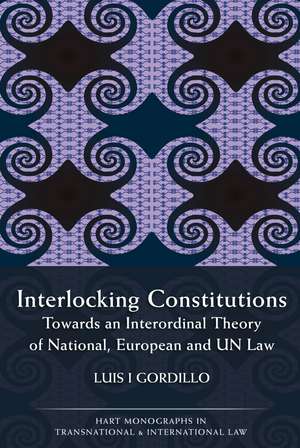
Interlocking Constitutions: Towards an Interordinal Theory of National, European and UN Law: Hart Monographs in Transnational and International Law
Autor Luis I Gordilloen Limba Engleză Hardback – 25 apr 2012
It is in the dynamic relationship between domestic constitutional laws, EU law, the ECHR and the UN Charter that the most persistent difficulties arise. In this context 'interordinal instability' not only provokes strong academic interest, but also affects what has been called 'governance' or 'global government' and undermines both legal certainty and individual fundamental rights. Different solutions - constitutionalist and pluralist - have been explored, but none of them has received global acceptance. In this book Luis Gordillo analyses the interordinal instabilities which arise at the European level, focusing on three main strands of case law and their implications: Solange, Bosphorus and Kadi. To solve the difficulties caused by this instability Gordillo proposes a form of soft constitutionalism, which he calls 'interordinal constitutionalism', as a means to bring order and stability to global legal governance.
The original Spanish thesis on which this book is based was awarded the Nicolás Pérez Serrano Prize by the Centro de Estudios Políticos y Constitucionales, for the best dissertation in constitutional law 2009-2010.
Din seria Hart Monographs in Transnational and International Law
- 31%
 Preț: 391.84 lei
 - 33%
 Preț: 624.20 lei
 - 33%
 Preț: 614.37 lei
 - 24%
 Preț: 255.52 lei
 - 30%
 Preț: 414.84 lei
 - 20%
 Preț: 342.40 lei
 - 33%
 Preț: 584.57 lei
 - 25%
 Preț: 269.51 lei
 - 19%
 Preț: 1164.35 lei
 - 34%
 Preț: 800.20 lei
 - 33%
 Preț: 583.59 lei
 - 20%
 Preț: 349.01 lei
 - 29%
 Preț: 278.54 lei
 - 22%
 Preț: 324.72 lei
 - 37%
 Preț: 546.52 lei
 - 33%
 Preț: 651.40 lei
 - 33%
 Preț: 585.61 lei
Preț: 662.37 lei
Preț vechi: 977.55 lei
-32%
Puncte Express: 994
Carte tipărită la comandă
Livrare economică 25 noiembrie-09 decembrie
Livrare prin curier în România Termenul estimat este afișat lângă disponibilitate.
Transport gratuit pentru acest produs Plată online sau ramburs, în funcție de opțiunile comenzii.
Retur gratuit în 14 zile Comandă securizată și suport în română.
Specificații
ISBN-13: 9781849462211
ISBN-10: 1849462216
Pagini: 410
Dimensiuni: 156 x 236 x 30 mm
Greutate: 0.8 kg
Editura: Bloomsbury Publishing
Colecția Hart Publishing
Seria Hart Monographs in Transnational and International Law
Locul publicării:London, United Kingdom
ISBN-10: 1849462216
Pagini: 410
Dimensiuni: 156 x 236 x 30 mm
Greutate: 0.8 kg
Editura: Bloomsbury Publishing
Colecția Hart Publishing
Seria Hart Monographs in Transnational and International Law
Locul publicării:London, United Kingdom
Cuprins
Introduction
Part I National Constitutional Law and EC/EU Law
1: Different Legal Orders and Different Legal Pyramids
2: The Attempted Reconciliation
Part II European Union Law and the European Convention on Human Rights
3: The Fundamental Rights and the Union
4: The European Convention on Human Rights According to the European Court of Justice
5: EC/EU Law According to the European Court of Human Rights
6: The Dialogue between Strasbourg and Luxembourg: Current Situation and Prospects
Part III The United Nations Charter, European Union Law and the European Convention on Human Rights
7: The UN Security Council as a 'Global Law Enforcement Power'
8: European Union Law and Security Council Resolutions: Participation of the European Union in the United Nations Sanctions Regime
9: European Convention on Human Rights and Security Council Resolutions: The Contribution of the European Court of Human Rights
Part IV Interlocking Supranational Orders of a Constitutional Nature
10: International Law According to the European Supranational Courts
11: The Pluralistic Conception versus the Constitutional Conception of the International Legal Order
12: The Position of the European Union on the International Scene after the Kadi Case
Part I National Constitutional Law and EC/EU Law
1: Different Legal Orders and Different Legal Pyramids
2: The Attempted Reconciliation
Part II European Union Law and the European Convention on Human Rights
3: The Fundamental Rights and the Union
4: The European Convention on Human Rights According to the European Court of Justice
5: EC/EU Law According to the European Court of Human Rights
6: The Dialogue between Strasbourg and Luxembourg: Current Situation and Prospects
Part III The United Nations Charter, European Union Law and the European Convention on Human Rights
7: The UN Security Council as a 'Global Law Enforcement Power'
8: European Union Law and Security Council Resolutions: Participation of the European Union in the United Nations Sanctions Regime
9: European Convention on Human Rights and Security Council Resolutions: The Contribution of the European Court of Human Rights
Part IV Interlocking Supranational Orders of a Constitutional Nature
10: International Law According to the European Supranational Courts
11: The Pluralistic Conception versus the Constitutional Conception of the International Legal Order
12: The Position of the European Union on the International Scene after the Kadi Case
Recenzii
Finalmente, hay que decir que, en conjunto, la capacidad científica y de abstracción de la que hace gala el professor de la Universidad de Deusto es extraordinaria. Ha aportado una nueva perspective del Derecho internacional, a mi juicio, jamás así tratada, y de calidad descomunal.
One of the merits of this book, together with its richness in terms of information and investigation and despite the incredible amount of literature existing in this field, is that Gordillo manages to find an autonomous collocation in such a scholarly ocean by making his argument very clear. Even the structure of the work reflects the rigorous methodology chosen for this intellectual enterprise...it is well documented and presents an originality of its own.
. an eminently readable, insightful book. Gordillo is on to something, and hopefully further research will be done, by him and by others, exploring the full potential of his 'interordinal constitutionalist' approach as an alternative to other existing models.
One of the merits of this book, together with its richness in terms of information and investigation and despite the incredible amount of literature existing in this field, is that Gordillo manages to find an autonomous collocation in such a scholarly ocean by making his argument very clear. Even the structure of the work reflects the rigorous methodology chosen for this intellectual enterprise...it is well documented and presents an originality of its own.
. an eminently readable, insightful book. Gordillo is on to something, and hopefully further research will be done, by him and by others, exploring the full potential of his 'interordinal constitutionalist' approach as an alternative to other existing models.