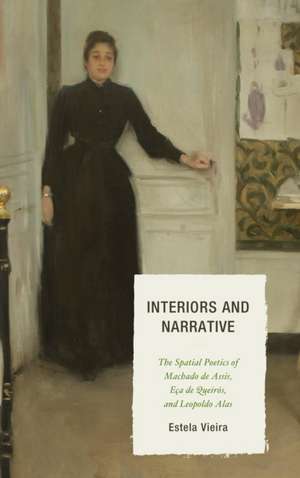
Interiors and Narrative: The Spatial Poetics of Machado de Assis, Eça de Queirós, and Leopoldo Alas
Autor Estela Vieiraen Limba Engleză Paperback – 16 oct 2014
| Toate formatele și edițiile | Preț | Express |
|---|---|---|
| Paperback (1) | 334.88 lei 6-8 săpt. | |
| Bloomsbury Publishing – 16 oct 2014 | 334.88 lei 6-8 săpt. | |
| Hardback (1) | 566.30 lei 6-8 săpt. | |
| Bloomsbury Publishing – 14 dec 2012 | 566.30 lei 6-8 săpt. |
Preț: 334.88 lei
Preț vechi: 431.95 lei
-22%
Puncte Express: 502
Preț estimativ în valută:
59.27€ • 69.26$ • 51.45£
59.27€ • 69.26$ • 51.45£
Carte tipărită la comandă
Livrare economică 20 februarie-06 martie
Preluare comenzi: 021 569.72.76
Specificații
ISBN-13: 9781611486223
ISBN-10: 161148622X
Pagini: 249
Ilustrații: 6 b/w photos
Dimensiuni: 157 x 231 x 19 mm
Greutate: 0.4 kg
Editura: Bloomsbury Publishing
Colecția Bucknell University Press
Locul publicării:New York, United States
ISBN-10: 161148622X
Pagini: 249
Ilustrații: 6 b/w photos
Dimensiuni: 157 x 231 x 19 mm
Greutate: 0.4 kg
Editura: Bloomsbury Publishing
Colecția Bucknell University Press
Locul publicării:New York, United States
Cuprins
Contents
Acknowledgments
Introduction: Interiors and Narrative
The Novel's Sense of the Interior
The Novelist's Sense of the Interior
Part One: Furnishing the Novel
The Threshold: The Ins and Outs of Quincas Borba
Movables and Immovables: The Legend of The Maias
The Corners of the World: Inside La Regenta
Part Two: Interiors and Interiority
Inside the Minds and Hearts of Machado's Characters
Eça's Interior Decorators
Memory and Movement: Ana's and Fermín's Interiors
Part Three: The Discourse of Interiors
Machado's Minimalism and the Meaning of Things
The Narrative Life of Eça's Furnishings
The Dramatic Effect of Clarín's Interior Architecture
Epilogue: From Voltaire's Garden to Galdós's Rooms
Works Cited
About the Author
Acknowledgments
Introduction: Interiors and Narrative
The Novel's Sense of the Interior
The Novelist's Sense of the Interior
Part One: Furnishing the Novel
The Threshold: The Ins and Outs of Quincas Borba
Movables and Immovables: The Legend of The Maias
The Corners of the World: Inside La Regenta
Part Two: Interiors and Interiority
Inside the Minds and Hearts of Machado's Characters
Eça's Interior Decorators
Memory and Movement: Ana's and Fermín's Interiors
Part Three: The Discourse of Interiors
Machado's Minimalism and the Meaning of Things
The Narrative Life of Eça's Furnishings
The Dramatic Effect of Clarín's Interior Architecture
Epilogue: From Voltaire's Garden to Galdós's Rooms
Works Cited
About the Author
Recenzii
This study by Estela Vieira is therefore particularly welcome in its attempt to bring together three of the major exponents of the novel in Portugal, Spain and Brazil. . . .[I]t is hard to dispute the convincing attention to detail dedicated by the author to the understanding of internal space and its significance within the three texts studied here. . . .[T]he author's demonstration of the exploration of inner space (both domestic and personal) by these three major writers who (in different respects) look forward to literary Modernism as much as they look back to the Realist tradition is a well-researched and original contribution to the understanding of their work.
Interiors and Narrative, as a whole, shows that 'the subjective search for an inner life associated with modernist writing originates in the private interior as a space of retreat for both female and male characters. In this interior world, attention and weight is given to the seemingly insignificant details that communicate an existential need and historical density.' For its overall conceptual rigor and for the acuteness of its reading of the three important novels in question, Estela Vieira's book deserves serious attention, not just from students of the authors and their works, but also from all those interested in the question of space in literature.
Interiors and Narrative, as a whole, shows that 'the subjective search for an inner life associated with modernist writing originates in the private interior as a space of retreat for both female and male characters. In this interior world, attention and weight is given to the seemingly insignificant details that communicate an existential need and historical density.' For its overall conceptual rigor and for the acuteness of its reading of the three important novels in question, Estela Vieira's book deserves serious attention, not just from students of the authors and their works, but also from all those interested in the question of space in literature.