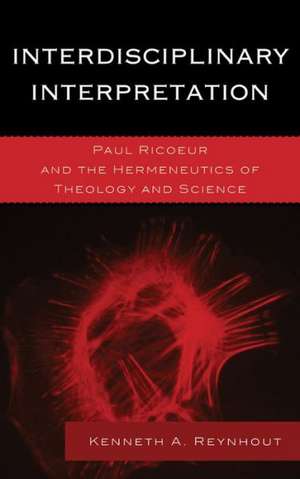
Interdisciplinary Interpretation: Paul Ricoeur and the Hermeneutics of Theology and Science: Studies in the Thought of Paul Ricoeur
Autor Kenneth A. Reynhouten Limba Engleză Paperback – 24 mar 2015
Din seria Studies in the Thought of Paul Ricoeur
- 14%
 Preț: 657.96 lei
 - 29%
 Preț: 344.18 lei
 - 32%
 Preț: 616.15 lei
 - 31%
 Preț: 529.95 lei
 - 34%
 Preț: 601.12 lei
 - 32%
 Preț: 617.46 lei
 - 33%
 Preț: 614.81 lei
 - 33%
 Preț: 703.64 lei
 - 27%
 Preț: 256.79 lei
 - 32%
 Preț: 583.24 lei
 - 27%
 Preț: 285.37 lei
 - 18%
 Preț: 257.00 lei
 - 37%
 Preț: 662.09 lei
 - 27%
 Preț: 257.50 lei
 - 32%
 Preț: 583.59 lei
 - 34%
 Preț: 581.63 lei
 - 28%
 Preț: 221.15 lei
 - 23%
 Preț: 222.16 lei
 - 33%
 Preț: 515.52 lei
 - 32%
 Preț: 567.55 lei
 - 28%
 Preț: 218.77 lei
 - 23%
 Preț: 327.54 lei
 - 28%
 Preț: 221.03 lei
 - 34%
 Preț: 526.47 lei
 - 36%
 Preț: 525.78 lei
 - 32%
 Preț: 551.50 lei
 - 26%
 Preț: 245.47 lei
 - 27%
 Preț: 256.60 lei
 - 30%
 Preț: 551.31 lei
 - 34%
 Preț: 555.70 lei
 - 32%
 Preț: 564.67 lei
 - 32%
 Preț: 563.96 lei
 - 32%
 Preț: 567.25 lei
Preț: 343.17 lei
Preț vechi: 482.74 lei
-29%
Puncte Express: 515
Carte tipărită la comandă
Livrare economică 08-22 decembrie
Livrare prin curier în România Termenul estimat este afișat lângă disponibilitate.
Transport gratuit de la 400.00 lei Plată online sau ramburs, în funcție de opțiunile comenzii.
Retur gratuit în 14 zile Comandă securizată și suport în română.
Specificații
ISBN-13: 9781498515870
ISBN-10: 1498515878
Pagini: 210
Dimensiuni: 152 x 230 x 17 mm
Greutate: 0.32 kg
Editura: Bloomsbury Publishing
Colecția Lexington Books
Seria Studies in the Thought of Paul Ricoeur
Locul publicării:New York, United States
ISBN-10: 1498515878
Pagini: 210
Dimensiuni: 152 x 230 x 17 mm
Greutate: 0.32 kg
Editura: Bloomsbury Publishing
Colecția Lexington Books
Seria Studies in the Thought of Paul Ricoeur
Locul publicării:New York, United States
Cuprins
Introduction
Chapter 1: Hermeneutics and the Interdisciplinary Question
Chapter 2: Ricoeur and the Expansion of Hermeneutics
Chapter 3: Interpretation as Understanding Through Explanation
Chapter 4: Interpretation and the Natural Sciences
Chapter 5: Interdisciplinary Interpretation
Conclusion
Chapter 1: Hermeneutics and the Interdisciplinary Question
Chapter 2: Ricoeur and the Expansion of Hermeneutics
Chapter 3: Interpretation as Understanding Through Explanation
Chapter 4: Interpretation and the Natural Sciences
Chapter 5: Interdisciplinary Interpretation
Conclusion
Recenzii
Kenneth Reynhout . . . has made a novel contribution not only in the science and theology dialogue but also in the philosophy of science and hermeneutic and interdisciplinary studies. . . . [A] superb work of scholarship. The book is consistent with Ricoeur's thought but has a freshness that goes well beyond Ricoeur . . . [This] book is highly accessible and can, therefore, act as an introduction to both Ricoeur and to interdisciplinary studies in science and theology.
Furthermore hermeneutics could function as a bridge between interreligious/intercultural dialogue and the dialogue between theology and natural science. This is exactly what for me personally is so exciting about Kenneth A. Reynhouts' study Interdisciplinary Interpretation - that it crosses borders between disciplines so far not in dialogue with each other and shows similarities i.e. analogies between different interdisciplinary dialogues as well as between the dialogue between theology and natural science and interreligious dialogue.
For those who have worked in the science and theology dialogue for many years this book comes like a breath of fresh air. Here at last is a careful and well-argued philosophical argument for that dialogue in terms that make sense for the constructive theological task. By mining the work of Paul Ricoeur the author gives us a much needed hermeneutic basis for that dialogue, culminating in a novel thesis, namely, an argument for faith seeking understanding through explanation. But this is no facile fideism, but rather a respectful acknowledgment of the importance of commitment and self-awareness of the experience of faith in the constructive task. Although this book is geared primarily to a theological audience, scientists coming to interdisciplinary conversations would benefit enormously from a careful reading of this book. Further, the author has argued convincingly in my view that theology is the poorer without such dialogue, so theologians are beholden to consider particular ways in which they can take up the challenge presented here. While this book is no easy read, and the language is primarily philosophical rather than theological, it is well worth the effort.
In this timely work, Kenneth Reynhout offers a foundation for establishing a sophisticated dialogue between theology and the natural sciences. He argues not only for the hermeneutic character of each but for the hermeneutic nature of the interchange. Particularly apt is his insistence that explanation -the traditional hallmark of the sciences- and understanding -the traditional hallmark of theology and the humanities- should not be characterized as separate spheres but as dialectical. In extending hermeneutic analysis to the natural sciences, Reynhout builds on and also responsibly goes beyond the hermeneutics of Paul Ricoeur. At the same time he importantly enlarges our conception of hermeneutics' reach.
Interdisciplinary Interpretation: Paul Ricoeur and the Hermeneutics of Theology and Science provides an effective antidote to contemporary discussions pitting theology and science against one another. Kenneth A. Reynhout renews "the interdisciplinary question" concerning the extent to which theology should engage the natural sciences in its attempt to understand the relation between God, the self, and the world. In a careful and considered reflection on this question, Reynhout draws inspiration from the work of Paul Ricoeur and contends that theology is inevitably a hermeneutical endeavor. This book advocates effectively for the opening of a productive dialogue between theology and science that will inform and enhance them both.
Furthermore hermeneutics could function as a bridge between interreligious/intercultural dialogue and the dialogue between theology and natural science. This is exactly what for me personally is so exciting about Kenneth A. Reynhouts' study Interdisciplinary Interpretation - that it crosses borders between disciplines so far not in dialogue with each other and shows similarities i.e. analogies between different interdisciplinary dialogues as well as between the dialogue between theology and natural science and interreligious dialogue.
For those who have worked in the science and theology dialogue for many years this book comes like a breath of fresh air. Here at last is a careful and well-argued philosophical argument for that dialogue in terms that make sense for the constructive theological task. By mining the work of Paul Ricoeur the author gives us a much needed hermeneutic basis for that dialogue, culminating in a novel thesis, namely, an argument for faith seeking understanding through explanation. But this is no facile fideism, but rather a respectful acknowledgment of the importance of commitment and self-awareness of the experience of faith in the constructive task. Although this book is geared primarily to a theological audience, scientists coming to interdisciplinary conversations would benefit enormously from a careful reading of this book. Further, the author has argued convincingly in my view that theology is the poorer without such dialogue, so theologians are beholden to consider particular ways in which they can take up the challenge presented here. While this book is no easy read, and the language is primarily philosophical rather than theological, it is well worth the effort.
In this timely work, Kenneth Reynhout offers a foundation for establishing a sophisticated dialogue between theology and the natural sciences. He argues not only for the hermeneutic character of each but for the hermeneutic nature of the interchange. Particularly apt is his insistence that explanation -the traditional hallmark of the sciences- and understanding -the traditional hallmark of theology and the humanities- should not be characterized as separate spheres but as dialectical. In extending hermeneutic analysis to the natural sciences, Reynhout builds on and also responsibly goes beyond the hermeneutics of Paul Ricoeur. At the same time he importantly enlarges our conception of hermeneutics' reach.
Interdisciplinary Interpretation: Paul Ricoeur and the Hermeneutics of Theology and Science provides an effective antidote to contemporary discussions pitting theology and science against one another. Kenneth A. Reynhout renews "the interdisciplinary question" concerning the extent to which theology should engage the natural sciences in its attempt to understand the relation between God, the self, and the world. In a careful and considered reflection on this question, Reynhout draws inspiration from the work of Paul Ricoeur and contends that theology is inevitably a hermeneutical endeavor. This book advocates effectively for the opening of a productive dialogue between theology and science that will inform and enhance them both.