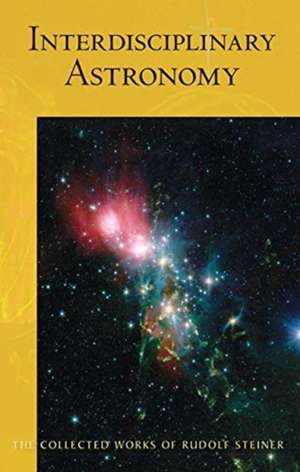
Interdisciplinary Astronomy
Autor Rudolf Steiner Traducere de Frederick Amrineen Limba Engleză Paperback – 4 feb 2020
Lucrarea de față este fundamentată pe viziunea lui Rudolf Steiner, o figură marcantă a începutului de secol XX, cunoscut pentru fondarea antroposofiei și pentru eforturile sale de a sintetiza rigoarea științifică occidentală cu întrebările spirituale profunde. În acest volum, Steiner nu se limitează la o descriere tehnică a astrelor, ci propune o metodologie de cercetare care să depășească barierele dintre disciplinele academice tradiționale. Apreciem modul în care autorul chestionează validitatea absolută a modelelor matematice tridimensionale în explicarea universului, sugerând că există puncte în care gândirea umană trebuie să transcendă limitele spațiale convenționale. Putem afirma că Interdisciplinary Astronomy reprezintă o piesă centrală în efortul lui Steiner de a prezenta omul ca un microcosmos. Spre deosebire de alte lucrări ale sale, precum Nutrition, unde se concentrează pe aspectele fiziologice și ecologice ale subzistenței, sau The Incarnation of Ahriman, care explorează polaritățile spirituale, acest curs de astronomie se ancorează în relația dintre dezvoltarea embrionară umană și mecanica cerească. Cartea acoperă aceeași arie tematică precum At Home in the Universe, însă Interdisciplinary Astronomy adoptă o abordare mult mai tehnică și orientată spre fundamentarea științifică a legăturii dintre constituția umană și structura cosmosului. Lectura dezvăluie un ton viu, specific prelegerilor directe, oferind un ritm intelectual alert care invită la reflecție asupra istoriei ideilor. Este o resursă valoroasă pentru cei interesați de modul în care antroposofia se intersectează cu științele naturii, oferind indicații pentru o cercetare viitoare care să refacă unitatea pierdută dintre observatorul uman și universul observat.
Preț: 245.98 lei
Carte disponibilă
Livrare economică 17 noiembrie-01 decembrie
Livrare express 31 octombrie-06 noiembrie pentru 36.54 lei
Specificații
ISBN-10: 1621480704
Pagini: 342
Ilustrații: Illustrations, unspecified
Dimensiuni: 160 x 232 x 27 mm
Greutate: 0.53 kg
Editura: Steiner Books
V-ar putea interesa
-
 My 21-Day Rite-Of-Passage JournalSherry Lee HeebPreț: 68.58 lei
 -
 Sovereignty ProducedDouglas W. CassesPreț: 119.25 lei
 -
 Clarity Is DivineKelsi MariePreț: 100.34 lei
 -
 Flame in MotionDenise StewartPreț: 207.64 lei
 -
 Come Walk with Me, JesusLisabeth Sue UdellPreț: 76.98 lei
 -
 Experiencing the Blessings and Good Fruit of CancerJudy J. StameyPreț: 49.33 lei
 -
 Journey Through Jerusalem with No HandsJanet PenneyPreț: 258.95 lei
 -
 Living in a Changing WorldEvon SmallPreț: 66.68 lei
 -
 Seasons of LoveGigi BorromeoPreț: 133.70 lei
 -
 SemillasMaribel Roman -. SantiagoPreț: 84.39 lei
 -
 Dare to Stand OutEnoch FolusoPreț: 203.36 lei
 -
 Sole to SoulEleanor MaclellanPreț: 292.01 lei
 -
 Lead Yourself TodayJohn E MarkleyPreț: 218.05 lei
 -
 Clean Off the DustRev Shelia M. WilsonPreț: 76.82 lei
 -
 The Logos and the New MysteriesMassimo ScaligeroPreț: 100.20 lei
 -
 EarthTownshend, FrankPreț: 86.77 lei
 -
 The Michael SchoolPeter SelgPreț: 103.26 lei
 -
 The First Class of the Michael SchoolRudolf SteinerPreț: 234.28 lei
De ce să citești această carte
Această carte este esențială pentru cititorii pasionați de epistemologie și de viziunea antroposofică asupra lumii. Oferă o perspectivă unică asupra astronomiei, tratând-o nu ca pe o știință izolată, ci ca pe o oglindă a biologiei umane. Veți câștiga o înțelegere mai profundă a modului în care gândirea poate depăși modelele matematice rigide pentru a sesiza armonia dintre om și cosmos, într-un format accesibil de prelegeri istorice.
Despre autor
Rudolf Steiner (1861–1925) a fost un filosof austriac, reformator social și fondator al antroposofiei, o mișcare spirituală cu rădăcini în idealismul german și știința goetheană. Recunoscut inițial ca editor al lucrărilor științifice ale lui Goethe, Steiner și-a dedicat viața creării unei „științe spirituale” care să aplice claritatea gândirii filosofice asupra domeniilor invizibile. Influența sa s-a extins dincolo de filosofie în domenii practice precum educația Waldorf, agricultura biodinamică și medicina antroposofică. Lucrările sale, adesea bazate pe prelegeri stenografiate, caută să stabilească o punte între cunoașterea empirică și experiența spirituală a ființei umane.
Descriere scurtă
"So you see, the most important thing to me has been to call forth within you an experience of the harmony between the human constitution and the structure of the cosmos. If you've really been following thus far, you can't possibly regard this harmony as a sin against the spirit of science" (from lecture 16)
What is the relationship between the human being and the world of the stars? Can we comprehend the structure and movement of celestial bodies solely through advanced mathematics, or is there in reality a point beyond which mathematical functions no longer apply? Can we, in fact, transcend the limits of three-dimensional space through our thinking?
In eighteen lively lectures from the beginning of 1921, Rudolf Steiner dives deeply and courageously, though carefully, into these and other profound questions. His conclusions and indications for further research are at once fascinating, stimulating, and quite possibly revolutionary in their implications.
The subject of these lectures is not astronomy, broadly considered, but the relationship of astronomy to the other fields of natural science. As he does elsewhere, Steiner maintains that the rigid specialization so prevalent in scientific endeavors will not bring us any closer to an integrated, singularly comprehensible understanding of the reality of our world. In particular, a true grasp of the workings of the universe will not be possible until its mirror, the study of human embryology, is recognized as such and penetrated with this reflective relationship in mind.
Steiner once again shows himself to be both an utterly unique and masterful commentator on scientific and intellectual history, as well as a living light, shining a possible forward path for human progress and self-knowledge.
This volume is a translation from German of Das Verh ltnis der verschiedenen naturwissenschaftlichen Gebiete zur Astronomie: Dritter naturwissenschaftlicher Kurs: Himmelskunde in Beziehung zum Menschen und zur Menschenkunde (GA 323, 2nd ed.), Rudolf Steiner Verlag, Dornach, Switzerland, 1983.