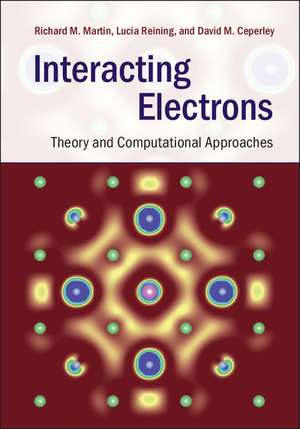
Interacting Electrons
Autor Richard M. Martin, Lucia Reining, David M. Ceperleyen Limba Engleză Hardback – 30 iun 2016
Suntem de părere că valoarea pedagogică a acestui volum rezidă în cele 203 exerciții integrate și setul egal de ilustrații, care transformă conceptele abstracte ale mecanicii cuantice în instrumente de lucru aplicabile. Interacting Electrons nu este doar un tratat teoretic, ci un ghid metodologic riguros care facilitează tranziția de la înțelegerea conceptuală la execuția calculelor cantitative în fizica stării solide și știința materialelor. Structura cărții reflectă o progresie logică, pornind de la limitările modelului particulelor independente și evoluând spre metode complexe de corelație electronică. Partea a III-a este deosebit de relevantă pentru cercetătorul modern, oferind detalii despre aproximarea GW și implementările practice GWA, elemente care lipsesc adesea din manualele introductive. În comparație cu Many-Electron Approaches in Physics, Chemistry and Mathematics de Volker Bach, care adoptă o perspectivă multidisciplinară axată pe fundamente matematice, lucrarea de față este orientată spre latura computațională și implementarea algoritmilor pe sisteme reale. Putem afirma că acest volum completează organic opera anterioară a lui Richard M. Martin, Electronic Structure. Dacă titlul precedent se concentra pe metodele de bază, precum teoria funcționalei de densitate (DFT), Interacting Electrons extinde orizontul către sistemele puternic corelate, utilizând metode many-body. Acoperă o arie similară cu Electronic Structure Calculations for Solids and Molecules de Jorge Kohanoff, însă se diferențiază printr-o abordare mult mai detaliată a funcțiilor Green și a simulărilor Monte Carlo cuantice, oferind cititorului argumentele necesare pentru a alege metoda optimă în funcție de fenomenul studiat.
Preț: 664.72 lei
Preț vechi: 746.89 lei
-11%
Carte tipărită la comandă
Livrare economică 26 noiembrie-10 decembrie
Specificații
ISBN-10: 0521871506
Pagini: 844
Ilustrații: 203 b/w illus. 5 tables 203 exercises
Dimensiuni: 175 x 250 x 49 mm
Greutate: 1.76 kg
Editura: Cambridge University Press
Locul publicării:Cambridge, United Kingdom
V-ar putea interesa
-
 Introductory Statistical MechanicsRoger Bowley-21%Preț: 403.00 lei509.21 lei
 -
 -33%Preț: 741.71 lei1108.97 lei
 -
 Polymer PhysicsMichael Rubinstein-31%Preț: 669.24 lei974.19 lei
 -
 MicrocavitiesAlexey V. Kavokin-20%Preț: 658.73 lei818.85 lei
 -
 Physics of Ferromagnetism 2eSoshin Chikazumi-24%Preț: 569.20 lei745.21 lei
 -
 Advanced FerroelectricityRobert Blinc-31%Preț: 792.60 lei1148.56 lei
 -
 Viscoelastic Behavior of Rubbery MaterialsC. Michael Roland-31%Preț: 826.15 lei1196.07 lei
 -
 Molecular NanomagnetsDante Gatteschi-12%Preț: 361.32 lei409.88 lei
 -
 Quasicrystals: A PrimerChristian Janot-28%Preț: 540.60 lei753.87 lei
 -
 Structural Inorganic ChemistryAlexander Frank Wells-30%Preț: 729.89 lei1042.62 lei
 -
 Mathematics for PhysicistsAndre Krzywicki-23%Preț: 148.70 lei193.38 lei
 -
 Non-Hermitian Quantum MechanicsNimrod Moiseyev-14%Preț: 1081.02 lei1257.00 lei
 -
 Mathematics of Quantization and Quantum FieldsJan Derezi Ski-26%Preț: 807.62 lei1090.44 lei
 -
 Physics of Electronic MaterialsJørgen RammerPreț: 519.89 lei
 -
 -11%Preț: 447.31 lei502.60 lei
 -
 -27%Preț: 1333.49 lei1814.87 lei
 -
 Peirce's Logic of Relations and Other StudiesRichard M. Martin-23%Preț: 878.18 lei1140.49 lei
 -
 Physics from SymmetryJakob SchwichtenbergPreț: 463.17 lei
 -
 Cavity OptomechanicsMarkus Aspelmeyer-18%Preț: 1271.07 lei1550.08 lei
 -
 QUANTUM MECHANICS (2ND ED)Ballentine Leslie E-15%Preț: 462.09 lei543.63 lei
 -
 Preț: 184.70 lei
 -
 CRYSTAL SYMME, LATTICE VIBRA & OPTIC SPECTROSCOPY OF SOLIDSBartolo Baldassare Di-18%Preț: 1090.38 lei1329.72 lei
 -
 -15%Preț: 443.52 lei521.79 lei
De ce să citești această carte
Recomandăm această carte doctoranzilor și cercetătorilor care au nevoie de o bază solidă în metodele many-body. Dincolo de rigoarea matematică, cititorul câștigă acces la ghiduri practice și exerciții care clarifică avantajele și dezavantajele fiecărei metode computaționale. Este instrumentul ideal pentru cei care doresc să treacă de la utilizarea software-ului de calcul la dezvoltarea și înțelegerea profundă a algoritmilor de structură electronică.
Despre autor
Richard M. Martin este profesor emerit la University of Illinois, Urbana-Champaign și profesor consultant la Stanford University. Este o figură centrală în fizica materiei condensate, recunoscut pentru contribuțiile sale majore la teoria structurii electronice. Experiența sa academică este sintetizată în lucrări de referință care au devenit standarde în domeniu. Co-autorii săi, Lucia Reining și David M. Ceperley, aduc expertiză suplimentară în spectroscopie teoretică și, respectiv, metode Monte Carlo cuantice, transformând acest colectiv într-unul dintre cele mai avizate pe plan internațional.