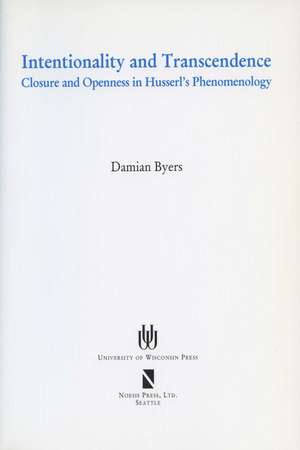
Intentionality And Transcendence: Closure And Openness In Husserl'S Phenomonoloy
Autor Damian Byersen Limba Engleză Paperback – 24 oct 2003
Damian Byers analyzes the form Husserl gives to the problem of knowledge—the way this form influences the development of the phenomenological method, and the results of its application. In a very clear fashion, Byers presents Husserl’s understanding of the roles of intentionality, idealism, temporalization, and kinesthesia in the constitution of knowledge. Drawing upon all of Husserl’s major texts, he corrects many misapprehensions about Husserl’s doctrines of intentionality and idealism. Byers argues that Husserl’s transcendental phenomenology is both a philosophy of closure and control and a philosophy of openness and vulnerability.
Preț: 211.22 lei
Puncte Express: 317
Carte disponibilă
Livrare economică 28 septembrie-12 octombrie
Livrare prin curier în România Termenul estimat este afișat lângă disponibilitate.
Transport gratuit de la 400.00 lei Plată online sau ramburs, în funcție de opțiunile comenzii.
Retur gratuit în 14 zile Comandă securizată și suport în română.
Specificații
ISBN-13: 9780299188542
ISBN-10: 029918854X
Pagini: 232
Dimensiuni: 178 x 235 x 18 mm
Greutate: 0.45 kg
Ediția:1
Editura: University of Wisconsin Press
Colecția University of Wisconsin Press
ISBN-10: 029918854X
Pagini: 232
Dimensiuni: 178 x 235 x 18 mm
Greutate: 0.45 kg
Ediția:1
Editura: University of Wisconsin Press
Colecția University of Wisconsin Press
V-ar putea interesa
-
 -16%Preț: 62.32 lei73.76 lei
 -
 PhenomenologyShaun GallagherPreț: 268.25 lei
 -
 Heidegger on Being and Acting – From Principles to AnarchyReiner SchürmannPreț: 237.07 lei
 -
 Contributions to Philosophy (From Enowning)Martin HeideggerPreț: 368.05 lei
 -
 Sketch for a Theory of the EmotionsJean-Paul SartrePreț: 135.63 lei
 -
 Preț: 154.37 lei
 -
 Maurice Merleau-Ponty: Basic WritingsThomas BaldwinPreț: 375.79 lei
 -
 Preț: 245.82 lei
 -
 HeideggerLee BraverPreț: 202.89 lei
 -
 Not SavedPeter SloterdijkPreț: 230.77 lei
 -
 The Bloomsbury Companion to ExistentialismDr Felicity Joseph-24%Preț: 278.50 lei366.81 lei
 -
 Existentialism: All That MattersDavid Cerbone-7%Preț: 65.31 lei70.19 lei
 -
 Communication Despite PostmodernismJoseph J. Pilotta-26%Preț: 1607.54 lei2184.28 lei
 -
 Toward an Existential Philosophy of the SoulRichard SchainPreț: 80.30 lei
 -
 Between Existentialism and MarxismJean-Paul SartrePreț: 223.22 lei
 -
 Introducing KierkegaardDave RobinsonPreț: 63.41 lei
 -
 Introducing ExistentialismOscar ZaratePreț: 63.35 lei
Recenzii
"The best book on intentionality and transcendence in Husserl that I have read. . . . It will undoubtedly become the standard reference work in the field."—James R. Mensch, St. Francis Xavier University
Notă biografică
Damian Byers is a fellow in the department of Philosophy, University of Melbourne, Australia.
Descriere
Damian Byers analyzes the form Husserl gives to the problem of knowledge—the way this form influences the development of the phenomenological method, and the results of its application. In a very clear fashion, Byers presents Husserl’s understanding of the roles of intentionality, idealism, temporalization, and kinesthesia in the constitution of knowledge. Drawing upon all of Husserl’s major texts, he corrects many misapprehensions about Husserl’s doctrines of intentionality and idealism. Byers argues that Husserl’s transcendental phenomenology is both a philosophy of closure and control and a philosophy of openness and vulnerability.