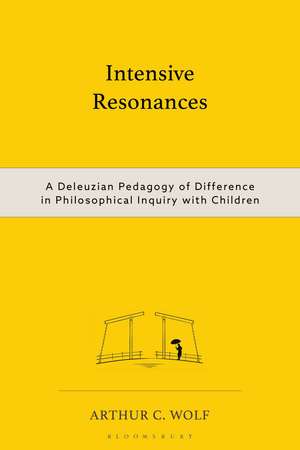
Intensive Resonances: A Deleuzian Pedagogy of Difference in Philosophical Inquiry with Children: Philosophy of Childhood
Autor Arthur C. Wolfen Limba Engleză Hardback – 12 oct 2026
What changes when philosophical inquiry begins not with reason alone, but with the affects, bodies, encounters, and problems that compel us to think?
In Intensive Resonances, Arthur C. Wolf brings Gilles Deleuze's philosophy into conversation with Matthew Lipman's Philosophy for Children. Challenging conceptions of thinking that privilege rational deliberation, Wolf develops a more inclusive pedagogy attentive to affect, embodiment, imagination, and more-than-human relations.
Drawing on Deleuze's philosophy of immanence and assemblages, the book reimagines the Community of Philosophical Inquiry as an experimental ecology of thinking. Its practical culmination, the Thinking Radar, helps educators map the relations among five dimensions of inquiry-feeling (phenomenology), understanding (hermeneutics), analyzing (analytic), dialogue (dialectics), and imagination (speculation)-and compose conditions in which new possibilities of thought can emerge.
Bridging continental philosophy, Philosophy for Children, and educational practice, Intensive Resonances offers a compelling account of what becomes possible when thinking is approached as an embodied, relational, and creative event.




Preț: 563.44 lei
Preț vechi: 830.28 lei
-32% Precomandă
Puncte Express: 845
Carte nepublicată încă
Livrare prin curier în România Precomanda se expediază când titlul devine disponibil.
Transport gratuit pentru acest produs Plată online sau ramburs, în funcție de opțiunile comenzii.
Retur gratuit în 14 zile Comandă securizată și suport în română.
Doresc să fiu notificat când acest titlu va fi disponibil:
Se trimite...
Specificații
ISBN-13: 9781666971668
ISBN-10: 1666971669
Pagini: 256
Ilustrații: 8 bw illus
Dimensiuni: 152 x 229 x 25 mm
Greutate: 0.45 kg
Editura: Bloomsbury Publishing
Colecția Bloomsbury Academic
Seria Philosophy of Childhood
Locul publicării:New York, United States
ISBN-10: 1666971669
Pagini: 256
Ilustrații: 8 bw illus
Dimensiuni: 152 x 229 x 25 mm
Greutate: 0.45 kg
Editura: Bloomsbury Publishing
Colecția Bloomsbury Academic
Seria Philosophy of Childhood
Locul publicării:New York, United States
Cuprins
Acknowledgments
List of Figures
List of Relays
Part I: The Pedagogical Problem and a New Heuristic
Introduction: Setting the Horizon
1. A Practical Heuristic to Track Resonances across Inquiries
2. Lipman's Approach: Roots and Problems
3. Gilles Deleuze and the Power of Life
Part II: Deleuze's Conceptual Toolbox
4. Difference and the Production of Sense
5. Embracing Immanence and the Process of Becoming
6. Affect
7. The Erogeneity of Bodies
8. Learning
9. Ideas: When Questions Think Us
10. Intensive Time and the Tick of the Clock
11. Thinking with the Earth
Part III: Pedagogy of Difference
12. Events of Learning and Micropolitics
13. The Image of Thought
14. An Affective Conception of Thinking
References
Appendix A
Appendix B
Index
List of Figures
List of Relays
Part I: The Pedagogical Problem and a New Heuristic
Introduction: Setting the Horizon
1. A Practical Heuristic to Track Resonances across Inquiries
2. Lipman's Approach: Roots and Problems
3. Gilles Deleuze and the Power of Life
Part II: Deleuze's Conceptual Toolbox
4. Difference and the Production of Sense
5. Embracing Immanence and the Process of Becoming
6. Affect
7. The Erogeneity of Bodies
8. Learning
9. Ideas: When Questions Think Us
10. Intensive Time and the Tick of the Clock
11. Thinking with the Earth
Part III: Pedagogy of Difference
12. Events of Learning and Micropolitics
13. The Image of Thought
14. An Affective Conception of Thinking
References
Appendix A
Appendix B
Index
Recenzii
Arthur C. Wolf's Intensive Resonances is a creative, remarkable, and rigorous study that nurtures itself mainly from two fields: the so-called continental European philosophy (most specifically, the work of French philosopher Gilles Deleuze) and the already consolidated field of philosophy for children, contemporarily founded by Matthew Lipman and Ann Margares Sharp. For those scholarly interested in the work of Gilles Deleuze, the book opens many unexpected windows in terms of the educational unfoldings of his work. For those interested and working in philosophy for children, it is possible to not only deepen and put into question the foundation of the enterprise, but also to acknowledge and imagine different possibilities of practices. In effect, these 'intensive resonances' have multiple implications, intersections, and crossings with practitioners and scholars focused on the relationships between education, philosophy, and community. In a time when thinking is more attacked and needed than ever, Intensive Resonances is an indispensable source of inspiration not only for scholars in the humanities but also for teachers, artists, and all sorts of practitioners who are not disposed to give up thinking.
Intensive Resonances is both a much-needed and a most unusual book. Tracing the deep-seated historical dichotomy between affect and thinking, Arthur Wolf develops the implications of an affective theory of thinking. With Deleuze as his principal interlocutor, he neither shies away from philosophical depth nor loses sight of concrete experience. Moving deftly between philosophical reflection and pedagogical practice, Wolf does more than argue that affect and thinking are intertwined: he demonstrates how thinking and affect are two sides of one movement.
The result is a playful and compelling back and forth between the historical unraveling of dualism and the immediate question of what its undoing might mean for our everyday encounters with students in the classroom. Rather than diminishing philosophical depth, the concrete dialogues and pedagogical examples draw us into deeper thinking, inviting us to become participants rather than remote bystanders. Conversely, the philosophical excursions never lose touch with lived experience: with what is authentically felt, how we relate to one another, and how we inhabit the world as democratic citizens. In this way, Intensive Resonances succeeds in bringing philosophy and pedagogy into a genuinely productive resonance, where each transforms and intensifies the other.
Intensive Resonances is both a much-needed and a most unusual book. Tracing the deep-seated historical dichotomy between affect and thinking, Arthur Wolf develops the implications of an affective theory of thinking. With Deleuze as his principal interlocutor, he neither shies away from philosophical depth nor loses sight of concrete experience. Moving deftly between philosophical reflection and pedagogical practice, Wolf does more than argue that affect and thinking are intertwined: he demonstrates how thinking and affect are two sides of one movement.
The result is a playful and compelling back and forth between the historical unraveling of dualism and the immediate question of what its undoing might mean for our everyday encounters with students in the classroom. Rather than diminishing philosophical depth, the concrete dialogues and pedagogical examples draw us into deeper thinking, inviting us to become participants rather than remote bystanders. Conversely, the philosophical excursions never lose touch with lived experience: with what is authentically felt, how we relate to one another, and how we inhabit the world as democratic citizens. In this way, Intensive Resonances succeeds in bringing philosophy and pedagogy into a genuinely productive resonance, where each transforms and intensifies the other.