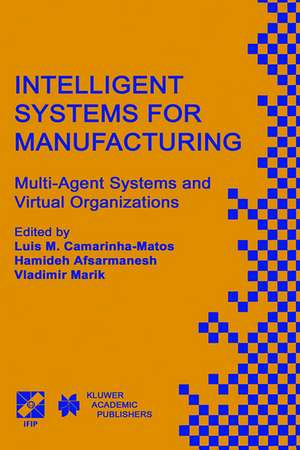
Intelligent Systems for Manufacturing
Editat de Luis M Camarinha-Matos, Hamideh Afsarmaneshen Limba Engleză Hardback – 31 aug 1998
Preț: 1337.99 lei
Preț vechi: 1672.49 lei
-20%
Puncte Express: 2007
Carte tipărită la comandă
Livrare economică 20 noiembrie-04 decembrie
Livrare prin curier în România Termenul estimat este afișat lângă disponibilitate.
Transport gratuit pentru acest produs Plată online sau ramburs, în funcție de opțiunile comenzii.
Retur gratuit în 14 zile Comandă securizată și suport în română.
Specificații
ISBN-13: 9780412846700
ISBN-10: 0412846705
Pagini: 634
Ilustrații: XXVI, 634 p.
Dimensiuni: 160 x 241 x 40 mm
Greutate: 1.14 kg
Ediția:1998 edition
Editura: Springer Us
Locul publicării:New York, NY, United States
ISBN-10: 0412846705
Pagini: 634
Ilustrații: XXVI, 634 p.
Dimensiuni: 160 x 241 x 40 mm
Greutate: 1.14 kg
Ediția:1998 edition
Editura: Springer Us
Locul publicării:New York, NY, United States
V-ar putea interesa
-
 -20%Preț: 89.95 lei112.23 lei
 -
 Computer VisionSimon J. D. Prince-20%Preț: 574.23 lei717.78 lei
 -
 Machine LearningPeter Flach-20%Preț: 386.84 lei483.55 lei
 -
 Multi-Agent Machine LearningSchwartz-20%Preț: 658.33 lei822.91 lei
 -
 Wavelet Neural NetworksAntonis K Alexandridis-20%Preț: 615.48 lei769.35 lei
 -
 Practical Introduction to CompDawson-Howe-20%Preț: 501.15 lei626.44 lei
 -
 Recent Advances in Reinforcement LearningLeslie Pack Kaelbling-20%Preț: 620.52 lei775.66 lei
 -
 Virtual Enterprises and Collaborative NetworksLuis M. Camarinha-Matos-15%Preț: 533.24 lei627.35 lei
 -
 Machine Learning, Meta-Reasoning and LogicsPavel B. Brazdil-20%Preț: 955.45 lei1194.32 lei
 -
 Parallel Execution of Logic ProgramsJohn S. Conery-20%Preț: 315.47 lei394.34 lei
 -
 Super-Intelligent MachinesBill Hibbard-20%Preț: 620.83 lei776.05 lei
 -
 Business Component-Based Software EngineeringFranck Barbier-20%Preț: 638.89 lei798.62 lei
 -
 -20%Preț: 630.88 lei788.60 lei
 -
 Intelligent SystemsL. S. Sterling-20%Preț: 322.48 lei403.10 lei
 -
 Machine Learning: An Algorithmic Perspective, Second EditionStephen Marsland-20%Preț: 614.34 lei767.93 lei
 -
 Collaborative Business Ecosystems and Virtual EnterprisesLuis M. Camarinha-Matos-20%Preț: 983.29 lei1229.11 lei
 -
 Infrastructures for Virtual EnterprisesLuis M. Camarinha-Matos-18%Preț: 1199.78 lei1463.15 lei
 -
 Processes and Foundations for Virtual OrganizationsLuis M. Camarinha-Matos-15%Preț: 640.96 lei754.07 lei
 -
 -9%Preț: 987.33 lei1084.98 lei
 -
 Emerging Trends in Technological InnovationLuis M. Camarinha-Matos-20%Preț: 979.77 lei1224.72 lei
 -
 Adaptation and Value Creating Collaborative NetworksLuis M. Camarinha-Matos-46%Preț: 561.18 lei1040.72 lei
 -
 Believable BotsPhilip Hingston-20%Preț: 676.70 lei845.88 lei
 -
 Collaborative Networks in the Internet of ServicesLuis M. Camarinha-Matos-54%Preț: 591.77 lei1290.52 lei
Public țintă
ResearchCuprins
One: Multi-Agent Systems and Mobile Agents.- An agent-based approach to holonic manufacturing systems.- PVS 98 agent models and their application in production planning.- Mobile Agent technology in support of sales order processing in the virtual enterprise.- Using multiagent systems and the Internet in care services for the ageing society.- Two: Multi-Agent Systems in Scheduling.- Multiagent perspectives to agile scheduling.- Decentralised resource allocation planning through negotiation.- Scheduling in a Multi-Agent Environment.- Three: Building Multi-Agent Systems.- Agents and objects: Towards component integration for manufacturing systems re-engineering.- Analytical design methodology of agent oriented manufacturing systems.- Agent-based manufacturing: A database point of view.- Four: Intelligent Supervision Systems.- Application of machine learning techniques in water distribution networks assisted by domain experts.- Fuzzy cognitive map model for supervisory manufacture systems.- Using of expert systems in evaluation of high-voltage insulating systems.- Five: Virtual Enterprises.- Virtual enterprises: A Mexican case study.- Concurrent engineering in virtual enterprises: The extended CIM-FACE architecture.- Composing enterprise models: The extended and the virtual enterprise.- Six: Infrastructures for Virtual Enterprises.- Basic services for the management of Virtual Enterprises: A case study.- Secure electronic commerce in virtual enterprises of SMEs.- Extended enterprise communications based on the client / server paradigm.- Seven: Collaborative Work.- Telework Business Process Co-ordination — The supporting tool engineering life cycle.- The “coach” methaphor in CSCW decision making system design.- Eight: Knowledge Based Systems in Design.- Modelingexpertise for selecting manufacturing technology.- Some artificial intelligent techniques to design robotic systems.- Support for component based systems: Can contemporary technology cope?.- Nine: Planning and Scheduling.- A CIM application of a multi-agent system.- Simultaneous design and process planning by indicators.- Solving resource-constrained project scheduling problems using tabu search.- Ten: Modeling in Manufacturing.- Object oriented modelling of product oriented manufacturing systems.- Enhanced production flow schema for modeling the complex resource sharing system.- AOP3S: A balanced approach to model distributed manufacturing systems.- Eleven: Manufacturing Information Systems.- Perspective: A standards-based manufacturing information system.- An approach for real-time applications engineering.- Information systems for eco-effective manufacturing.- Twelve: Product Data Management.- Rule-based management of product data in CIM systems.- Integrating manufacturer and customer: The funSTEP way.- Integrated product model centred design in a virtual design office.- Thirteen: Anthropocentric Approaches in Manufacturing.- Information systems requirements specification through the mediation of technical and organizational perspectives.- Representation of human intent in product models.- Assistance systems supporting operators in manufacturing.- Fourteen: Quality Management.- Knowledge based methods and tools for TQM in small batch flexible manufacturing and complex assembly.- Computer aided part programming for improved part quality and productivity.- Fifteen: Soft-Computing.- Using fuzzy logic in high level control functions.- Fuzzy optimal control of mechanical systems.- A simple robust fuzzy-logic sliding-mode controller of the diagonal type.- Sixteen: PatternRecognition and Diagnostics.- An intelligent pattern recognition algorithm and its application in cutting tool condition monitoring process.- Vision-based sensors for production control — The experience gathered in applications.- Seventeen: Simulation and Design.- Integration of manufacturing system and product design wit DMU.- Development of a feature-based computer-assisted fixturing system.- Eighteen: Theoretical Aspects of Design.- A contribution to algebraic approach for a CAD/CAPP specification.- Interactive design of integrated systems.- Human integration and participation in time constraint workshops with limiting transportation resources.- Nineteen: Workshop 1: Soft-Computing for Automation.- Object-oriented implementation of fuzzy logic systems.- Scheduling the arrivals in a no-wait flowshop with fuzzy processing times.- Fuzzy approximation of the functions minimum and maximum.- Fuzzy knowledge-based prediction of yeast’s morphological characteristics for sparkling wine manufacturing.- Twenty: Workshop 2: Multi-Agent Systems.- Problems of learning in multi-agent systems.- User interface for multi-agent systems: A case study.