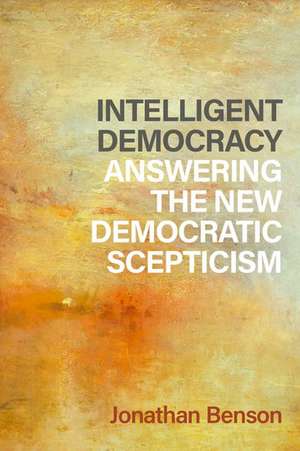
Intelligent Democracy: Answering the New Democratic Scepticism: Philosophy, Politics, and Economics
Autor Jonathan Bensonen Limba Engleză Hardback – 23 apr 2025



Preț: 421.15 lei
Preț vechi: 599.13 lei
-30%
Puncte Express: 632
Carte disponibilă
Livrare economică 06-11 noiembrie
Livrare express 22-28 octombrie pentru 122.86 lei
Livrare prin curier în România Termenul estimat este afișat lângă disponibilitate.
Transport gratuit pentru acest produs Plată online sau ramburs, în funcție de opțiunile comenzii.
Retur gratuit în 14 zile Comandă securizată și suport în română.
Specificații
ISBN-13: 9780197767283
ISBN-10: 0197767281
Pagini: 272
Ilustrații: 4
Dimensiuni: 162 x 240 x 25 mm
Greutate: 0.55 kg
Editura: Oxford University Press
Colecția OUP USA
Seria Philosophy, Politics, and Economics
Locul publicării:New York, United States
ISBN-10: 0197767281
Pagini: 272
Ilustrații: 4
Dimensiuni: 162 x 240 x 25 mm
Greutate: 0.55 kg
Editura: Oxford University Press
Colecția OUP USA
Seria Philosophy, Politics, and Economics
Locul publicării:New York, United States
Recenzii
Benson starts his analysis with an examination of the epistemic shortcomings of regular elections and free markets, given that these 'have become the dominant institutions of liberal democratic societies,' and many democratic sceptics believe that the free market is the best determinant of the desires and needs of any populace...Benson takes a broad view of democracy, emphasizing that it 'in practice extends far beyond any one body or institution'. Thus, the epistemic abilities of democracy are not housed in any one institution.
The argument is largely successful, though one wonders whether, at least in the American context, an additional veto point in the legislative process would make democracy more responsive to public opinion or would instead maintain the status quo. Highly recommended. Advanced undergraduates through faculty.
Benson's book adds an important new perspective to the project of justifying democracy on epistemic grounds. The book's systemic perspective enrichesthe debate, and the comparison of epistemic democracy with Hayek's epistemic justifications of markets provides a new critical dimension. In doing so, Intelligent Democracy also offers a new take on the debate about whether democracyis tasked with tracking a correctness standard. Most importantly, Benson's book strengthens the argument for epistemic democracy and makes a compelling case for thinking about democracy as a system for knowledge use and production. Intelligent Democracy will become an important resource for anyone interested in debates concerning the recent epistemic turn in democratic theory and deserves to be read widely.
The argument is largely successful, though one wonders whether, at least in the American context, an additional veto point in the legislative process would make democracy more responsive to public opinion or would instead maintain the status quo. Highly recommended. Advanced undergraduates through faculty.
Benson's book adds an important new perspective to the project of justifying democracy on epistemic grounds. The book's systemic perspective enrichesthe debate, and the comparison of epistemic democracy with Hayek's epistemic justifications of markets provides a new critical dimension. In doing so, Intelligent Democracy also offers a new take on the debate about whether democracyis tasked with tracking a correctness standard. Most importantly, Benson's book strengthens the argument for epistemic democracy and makes a compelling case for thinking about democracy as a system for knowledge use and production. Intelligent Democracy will become an important resource for anyone interested in debates concerning the recent epistemic turn in democratic theory and deserves to be read widely.
Notă biografică
Jonathan Benson is a Hallsworth Research Fellow at The University of Manchester. His research centers around political and democratic theory and has a strong connection to the interdisciplinary tradition of politics, philosophy, and economics. He has written widely on contemporary challenges to democracy, the role and limits of markets, as well as issues of political knowledge and communication. Benson received a PhD in Politics from The University of Manchester and previously taught at King's College London and Utrecht University.
Cuprins
- Introduction: The new deomcratic scepticism
- 1. Democracy's epistemic problems
- 2. The limits of elections and markets
- 3. Democracy and the division of knowledge
- 4. Bias, misinformation, and the democratic system
- 5. Polycentricity for and against democracy
- 6. Diversity and political problem-solving
- 7. Elections and elite rule
- 8. The sortition branch
- Conclusion: A more intelligent democracy