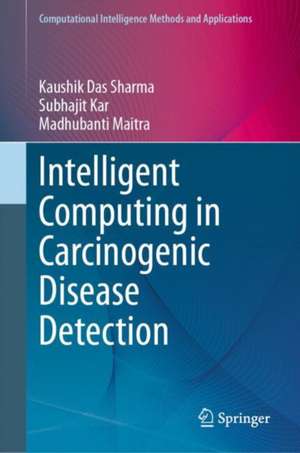
Intelligent Computing in Carcinogenic Disease Detection: Computational Intelligence Methods and Applications
Autor Kaushik Das Sharma, Subhajit Kar, Madhubanti Maitraen Limba Engleză Hardback – 17 mai 2024
Chapters 3, 4 and 5 elaborate on several intelligent gene selection methodologies such as filter methodologies and wrapper methodologies. In addition, various gene selection philosophies for identifying relevant carcinogenic genes are described in detail. In turn, Chapters 6 and 7 tackle the issues of using cell-level and tissue-level datasets to effectively detect carcinogenic diseases. The performance of different intelligent feature selection techniques is evaluated on cell-level and tissue-level datasets to validate their effectiveness in the context of carcinogenic disease detection.
In closing, the book presents illustrative case studies that demonstrate the value of intelligent computing strategies.
Din seria Computational Intelligence Methods and Applications
- 18%
 Preț: 1271.28 lei
 - 20%
 Preț: 1205.94 lei
 - 18%
 Preț: 1007.67 lei
 - 20%
 Preț: 672.48 lei
 - 20%
 Preț: 1029.35 lei
 - 20%
 Preț: 665.61 lei
 - 20%
 Preț: 781.91 lei
 - 20%
 Preț: 338.85 lei
 - 24%
 Preț: 955.60 lei
 - 18%
 Preț: 1040.06 lei
 - 20%
 Preț: 1233.55 lei
 - 24%
 Preț: 843.44 lei
 - 20%
 Preț: 1206.28 lei
 - nou
 Preț: 1191.64 lei
Preț: 1082.67 lei
Preț vechi: 1353.33 lei
-20%
Puncte Express: 1624
Carte tipărită la comandă
Livrare economică 30 noiembrie-14 decembrie
Livrare prin curier în România Termenul estimat este afișat lângă disponibilitate.
Transport gratuit pentru acest produs Plată online sau ramburs, în funcție de opțiunile comenzii.
Retur gratuit în 14 zile Comandă securizată și suport în română.
Specificații
ISBN-13: 9789819724239
ISBN-10: 9819724236
Pagini: 196
Ilustrații: XIV, 180 p. 88 illus., 35 illus. in color.
Dimensiuni: 160 x 241 x 17 mm
Greutate: 0.41 kg
Ediția:2024
Editura: Springer
Colecția Computational Intelligence Methods and Applications
Seria Computational Intelligence Methods and Applications
Locul publicării:Singapore, Singapore
ISBN-10: 9819724236
Pagini: 196
Ilustrații: XIV, 180 p. 88 illus., 35 illus. in color.
Dimensiuni: 160 x 241 x 17 mm
Greutate: 0.41 kg
Ediția:2024
Editura: Springer
Colecția Computational Intelligence Methods and Applications
Seria Computational Intelligence Methods and Applications
Locul publicării:Singapore, Singapore
V-ar putea interesa
-
 Oxford Handbook of OncologyMiranda PaynePreț: 292.86 lei
 -
 Atlas of Diagnostic Oncology: Expert Consult - Online and PrintArthur T. Skarin-24%Preț: 1127.28 lei1479.55 lei
 -
 DNA MicroarraysUlrike Nuber-8%Preț: 608.28 lei661.17 lei
 -
 -39%Preț: 394.79 lei646.62 lei
 -
 Specialty Imaging: HRCT of the LungSantiago Martínez-Jiménez-28%Preț: 1453.50 lei2014.17 leiRecomandat
 -
 -5%Preț: 1165.29 lei1226.62 lei
 -
 -5%Preț: 1276.67 lei1343.85 lei
 -
 Diseases of the Breast 5eJay R. Harris MD-21%Preț: 2453.93 lei3101.30 lei
 -
 The Complete Guide to Breast CancerLiz O'RiordanPreț: 136.67 lei
 -
 Recent Advances in Histopathology - 27Fred T Bosman-5%Preț: 410.18 lei431.77 lei
 -
 Advances in Intelligent Disease Diagnosis and TreatmentChee-Peng Lim-20%Preț: 1236.64 lei1545.80 lei
 -
 Statistics for ScientistsUmberto Michelucci-20%Preț: 275.88 lei344.84 lei
 -
 Preț: 376.75 lei
 -
 -20%Preț: 662.85 lei828.56 lei
 -
 Smart Computational Strategies: Theoretical and Practical AspectsAshish Kumar Luhach-20%Preț: 948.82 lei1186.02 lei
 -
 -5%Preț: 1451.35 lei1527.74 lei
 -
 Intelligent TechnologiesHimansu Das-20%Preț: 1230.95 lei1538.68 lei
 -
 Computational Intelligence in Healthcare InformaticsD. P. Acharjya-20%Preț: 1216.24 lei1520.30 lei
 -
 -18%Preț: 1179.90 lei1438.89 lei
Cuprins
Chapter 1. Introduction.- Chapter 2. Biological Background of Benchmark Carcinogenic Data Sets.- Chapter 3. Intelligent Computing Approaches for Carcinogenic Disease Detection: A Review.- Chapter 4. Classical Approaches in Gene Evaluation for Carcinogenic Disease Detection.- Chapter 5. Intelligent Computing Approach in Gene Evaluation for Carcinogenic Disease Detection.- Chapter 6. Intelligent Computing Approach for Leukocyte Identification.- Chapter 7. Intelligent Computing Approach for Lung Nodule Detection.- Chapter 8. Conclusion.- Index.
Notă biografică
Kaushik Das Sharma is currently a Professor at the Electrical Engineering Section of the Department of Applied Physics, University of Calcutta, India. In 2019, he was invited to serve as a Teacher-Researcher Fellow at the University of Paris-Est Créteil, France. He is a recipient of the Kanodia Research Scholarship (2002) and University Gold Medal (2004), both from the University of Calcutta. Dr. Das Sharma’s key research interests include fuzzy control, stochastic optimization, machine learning, robotics and computational biology. He has authored/co-authored more than 70 technical articles, including 40 international journal papers and two books with Springer Nature. Dr. Das Sharma is a senior member of the IEEE (USA) and a life member of the Indian Science Congress Association. He is currently serving as Chair of the IEEE Joint CSS-IMS Kolkata Chapter. He is also an editor for IEEE Transactions of Vehicular Technology and editor for Elsevier Engineering Applications of Artificial Intelligence.
Subhajit Kar is currently an Associate Professor and Head of the Department at the Department of Electrical Engineering, Institute of Engineering & Management, Kolkata, India. He is a member of the IEEE (USA) and currently serves as honorary treasurer of the IEEE Joint CSS-IMS Kolkata Chapter. He has authored/co-authored several international journal and international conference papers. His research interests include computational biology, biomedical imaging, stochastic optimization and machine learning techniques.
Madhubanti Maitra is currently a Professor at the Department of Electrical Engineering, Jadavpur University, India. She has previously served as a research scientist for the DRDL-sponsored projects on Control and Guidance of Agni and Nag Missiles; and as a teacher-investigator and coordinator for DRDL- and ADA-sponsored projects on CLAW IV and V for LCA (Light Combat Aircraft). She has 22 classified articles on Agni, Nag and LCA and more than 65 international journal and conference papers to her credit. She has authored/co-authored several books with international publishers, as well as seven book chapters in edited volumes including LNCS. She has supervised and is supervising more than 20 PhD and MEE students. She has acted as PI and Co-PI of several UGC- and AICTE-funded projects. She is a senior member of the IEEE, USA, and a founder member of both the ComSoc (Communication Society) Chapter, IEEE Kolkata Section, Region 10, and the Joint CSS-IMS Chapter, IEEE Kolkata Section, Region 10.
Subhajit Kar is currently an Associate Professor and Head of the Department at the Department of Electrical Engineering, Institute of Engineering & Management, Kolkata, India. He is a member of the IEEE (USA) and currently serves as honorary treasurer of the IEEE Joint CSS-IMS Kolkata Chapter. He has authored/co-authored several international journal and international conference papers. His research interests include computational biology, biomedical imaging, stochastic optimization and machine learning techniques.
Madhubanti Maitra is currently a Professor at the Department of Electrical Engineering, Jadavpur University, India. She has previously served as a research scientist for the DRDL-sponsored projects on Control and Guidance of Agni and Nag Missiles; and as a teacher-investigator and coordinator for DRDL- and ADA-sponsored projects on CLAW IV and V for LCA (Light Combat Aircraft). She has 22 classified articles on Agni, Nag and LCA and more than 65 international journal and conference papers to her credit. She has authored/co-authored several books with international publishers, as well as seven book chapters in edited volumes including LNCS. She has supervised and is supervising more than 20 PhD and MEE students. She has acted as PI and Co-PI of several UGC- and AICTE-funded projects. She is a senior member of the IEEE, USA, and a founder member of both the ComSoc (Communication Society) Chapter, IEEE Kolkata Section, Region 10, and the Joint CSS-IMS Chapter, IEEE Kolkata Section, Region 10.
Textul de pe ultima copertă
This book draws on a range of intelligent computing methodologies to effectively detect and classify various carcinogenic diseases. These methodologies, which have been developed on a sound foundation of gene-level, cell-level and tissue-level carcinogenic datasets, are discussed in Chapters 1 and 2.
Chapters 3, 4 and 5 elaborate on several intelligent gene selection methodologies such as filter methodologies and wrapper methodologies. In addition, various gene selection philosophies for identifying relevant carcinogenic genes are described in detail. In turn, Chapters 6 and 7 tackle the issues of using cell-level and tissue-level datasets to effectively detect carcinogenic diseases. The performance of different intelligent feature selection techniques is evaluated on cell-level and tissue-level datasets to validate their effectiveness in the context of carcinogenic disease detection.
In closing, the book presents illustrative case studies that demonstrate the value of intelligent computing strategies.
Chapters 3, 4 and 5 elaborate on several intelligent gene selection methodologies such as filter methodologies and wrapper methodologies. In addition, various gene selection philosophies for identifying relevant carcinogenic genes are described in detail. In turn, Chapters 6 and 7 tackle the issues of using cell-level and tissue-level datasets to effectively detect carcinogenic diseases. The performance of different intelligent feature selection techniques is evaluated on cell-level and tissue-level datasets to validate their effectiveness in the context of carcinogenic disease detection.
In closing, the book presents illustrative case studies that demonstrate the value of intelligent computing strategies.
Caracteristici
Comprehensively presents intelligent methodologies for detecting and classifying carcinogenic diseases Blends theory and practice, presenting state-of-the-art methodologies Present case studies involving carcinogenic datasets at the gene level, cell level and tissue level