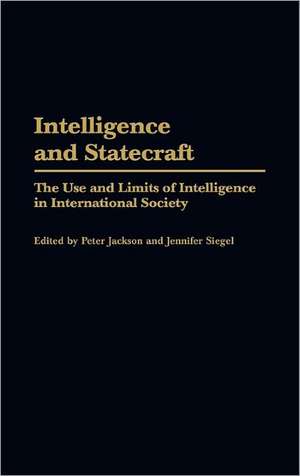
Intelligence and Statecraft: The Use and Limits of Intelligence in International Society
Autor Peter Jackson, Jennifer Siegelen Limba Engleză Hardback – 30 apr 2005
The practices of war and international politics were transformed by the conflicts of the French Revolution and the Napoleonic era. One of the most important outcomes of this transformation was the gradual emergence of permanent and increasingly professionalized intelligence services within the military and foreign policy establishments of the Great Powers. The contributions in this volume consider the causes and consequences of this trend as well as its impact on war, strategy, and statecraft. The rise of permanent intelligence bureaucracies has combined with technological progress to transform practices of intelligence collection and analysis that have remained essentially unchanged since the Roman era. Ultimately, however, the nature and limits of intelligence have remained constant, rendering intelligence little or no more effective in reducing uncertainty at the opening of the 21st century than in centuries past.
Preț: 609.65 lei
Preț vechi: 861.15 lei
-29%
Puncte Express: 914
Carte tipărită la comandă
Livrare economică 08-22 decembrie
Livrare prin curier în România Termenul estimat este afișat lângă disponibilitate.
Transport gratuit pentru acest produs Plată online sau ramburs, în funcție de opțiunile comenzii.
Retur gratuit în 14 zile Comandă securizată și suport în română.
Specificații
ISBN-13: 9780275972950
ISBN-10: 027597295X
Pagini: 302
Dimensiuni: 155 x 234 x 23 mm
Greutate: 0.58 kg
Ediția:New.
Editura: Bloomsbury Publishing
Colecția Praeger
Locul publicării:New York, United States
ISBN-10: 027597295X
Pagini: 302
Dimensiuni: 155 x 234 x 23 mm
Greutate: 0.58 kg
Ediția:New.
Editura: Bloomsbury Publishing
Colecția Praeger
Locul publicării:New York, United States
V-ar putea interesa
-
 GCHQRichard AldrichPreț: 108.54 lei
 -
 The Defence of the RealmChristopher AndrewPreț: 141.80 lei
 -
 -19%Preț: 380.86 lei469.90 lei
 -
 The CIA and the Cold War: A MemoirScott D. Breckinridge-38%Preț: 477.92 lei767.34 lei
 -
 -30%Preț: 472.25 lei674.26 lei
 -
 Intelligence Power in Peace and WarMichael HermanPreț: 423.25 lei
 -
 The House on Garibaldi StreetIsser Harel-15%Preț: 424.63 lei499.57 lei
 -
 @WarShane Harris-26%Preț: 68.44 lei92.76 lei
 -
 Food Words: Essays in Culinary CulturePeter Jackson-25%Preț: 619.75 lei829.54 lei
 -
 Race and Racism: Essays in Social GeographyPeter JacksonPreț: 474.35 lei
 -
 The Spy Who LovedClare Mulley-42%Preț: 54.45 lei94.19 lei
 -
 Cases in Intelligence AnalysisSarah Miller Beebe-15%Preț: 641.05 lei754.17 lei
 -
 Gideon's SpiesGordon Thomas-23%Preț: 147.66 lei191.79 lei
 -
 Philosophy and the End of SacrificePeter JacksonPreț: 223.42 lei
Cuprins
List of Abbreviations and Acronyms
Introduction by Peter Jackson and Jennifer Siegel
Historical Reflections on the Uses and Limits of Intelligence by Peter Jackson
Poor Intelligence, Flawed Results: Metternich, Radetzky and the Crisis-Management of Austria's "Occupation" of Ferrara in 1847 by Alan Sked
Sanctioned Spying: The Development of the Military Attache in the 19th Century by Maureen O'Connor
Russia's Great Game in Tibet: Tsarist Intelligence and the Younghusband's Expedition by David Schimmelpennick van der Oye
Training Thieves: The Instruction of "Efficient Intelligence Officers" in pre-1914 Britain by Jennifer Siegel
The Royal Navy, War Planning and Intelligence Assessments of Japan between the Two World Wars by Christopher Bell
Soviet Intelligence on Barbarossa: The Limits of Intelligence History by David Stone
Operation Matchbox and the Technological Containment of the USSR by Paul Maddrell
The Stasi and the Evolution of the FGR's "Ostpolitik," 1969-1974 by Mary Elise Sarotte
Introduction by Peter Jackson and Jennifer Siegel
Historical Reflections on the Uses and Limits of Intelligence by Peter Jackson
Poor Intelligence, Flawed Results: Metternich, Radetzky and the Crisis-Management of Austria's "Occupation" of Ferrara in 1847 by Alan Sked
Sanctioned Spying: The Development of the Military Attache in the 19th Century by Maureen O'Connor
Russia's Great Game in Tibet: Tsarist Intelligence and the Younghusband's Expedition by David Schimmelpennick van der Oye
Training Thieves: The Instruction of "Efficient Intelligence Officers" in pre-1914 Britain by Jennifer Siegel
The Royal Navy, War Planning and Intelligence Assessments of Japan between the Two World Wars by Christopher Bell
Soviet Intelligence on Barbarossa: The Limits of Intelligence History by David Stone
Operation Matchbox and the Technological Containment of the USSR by Paul Maddrell
The Stasi and the Evolution of the FGR's "Ostpolitik," 1969-1974 by Mary Elise Sarotte
Recenzii
[T]races the rise and development of the military attache from the nineteenth century and links this to the increasing demand for intelligence generated by the requirements of modern war..[f]ascinating new tidbits of information. This remains a fertile field for cultivation.