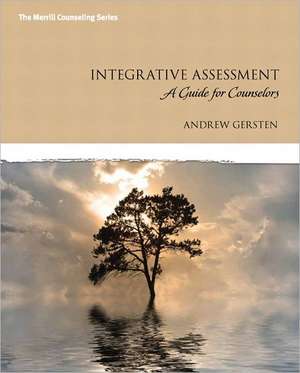
Integrative Assessment: A Guide for Counselors: Merrill Counseling
Autor Andrew Gerstenen Limba Engleză Paperback – 5 aug 2012
Preț: 965.49 lei
Preț vechi: 1016.30 lei
-5%
Puncte Express: 1448
Carte tipărită la comandă
Livrare economică 03-17 iunie
Specificații
ISBN-13: 9780135034859
ISBN-10: 013503485X
Pagini: 432
Dimensiuni: 185 x 231 x 15 mm
Greutate: 0.57 kg
Ediția:New.
Editura: Pearson
Seria Merrill Counseling
ISBN-10: 013503485X
Pagini: 432
Dimensiuni: 185 x 231 x 15 mm
Greutate: 0.57 kg
Ediția:New.
Editura: Pearson
Seria Merrill Counseling
V-ar putea interesa
-
 Williams Manual of Pregnancy ComplicationsKenneth Leveno-34%Preț: 450.55 lei684.87 lei
 -
 Love's ExecutionerIrvin YalomPreț: 75.32 lei
 -
 -26%Preț: 230.44 lei311.81 lei
 -
 The Self Under Siege: A Therapeutic Model for DifferentiationRobert W. Firestone-5%Preț: 440.50 lei463.69 lei
 -
 Preț: 394.57 lei
 -
 Visual CBTAvy Joseph-5%Preț: 107.25 lei112.89 lei
 -
 -5%Preț: 541.03 lei569.50 leiRecomandat
 -
 -28%Preț: 214.77 lei298.22 lei
 -
 -5%Preț: 116.06 lei122.17 lei
 -
 Philosophy for LifeJules Evans-31%Preț: 70.25 lei101.81 lei
 -
 The Complete CBT Guide for AnxietyLee Brosan-29%Preț: 94.34 lei133.21 lei
 -
 -30%Preț: 182.33 lei260.94 lei
Notă biografică
Dr. Andrew Gersten is a private practitioner specializing in the assessment and treatment of children with emotional and behavioral disorders. Since his internship training at the University of Massachusetts Medical Center Developmental Clinic in 1986 he has provided cognitive and psychological assessments of children-pre-school through adolescence. He has worked in community mental health as a therapist, assessor, and supervisor and has consulted to elementary and middle schools on school climate, behavioral program development and special education services. In addition, Andy is a teacher, presenter, supervisor, and researcher. He has been teaching in counseling programs for over 19 years. Andy is currently adjunct faculty at Antioch University New England where he has been teaching Assessment: Principles and Methods and Psychopathology: an Ecological Approach since 2008. Prior to Antioch he was an Associate Professor of Counseling at Rivier College, Nashua, New Hampshire, where he taught graduate students in school and mental health counseling and teacher education programs. His courses included: Assessment and Appraisal, Theories of Counseling, Human Development, Child Therapy, Techniques of Counseling, Fundamentals of Research, and Professional Issues and Orientation. He has presented at regional and national counseling and psychology conferences on various topics including: DSM-5, counselor intentionality, school counseling models, and Interpersonal problem solving. Dr. Gersten has co-authored several articles on the affects of shift work on sleep and well-being and counselor intentionality. A member of: the American Counseling Association, Association of Counselor Education and Supervision, New Hampshire Psychological Association, and American Psychological Association his current research focuses on the development of intentionality in counselor trainees.
Cuprins
Chapter 1: Introduction to Psychological Assessment
Chapter 2: Ethical and Legal Considerations: Preparing for the Assessment
Chapter 3: Interviewing adults and youth: Principles, Methods and Skills
Chapter 4: Exploring Presenting Problems, Readiness for Change, and Risks and Resources
Chapter 5: Observations, Inferences, and Behavioral Assessment
Chapter6: Psychological Tests and Measurement Concepts
Chapter 7: Reliability and Validity
Chapter 8: Personality and Interest Measures
Chapter 9: Assessing Psychopathology: Mood and Anxiety Disorders
Chapter 10: Child and adolescent measures
Chapter 11: Standardized Risk Assessments: Suicide and Dangerousness to Others
Chapter 12: Assessing Substance Use Disorders
Chapter 13: Assessment of Intellectual and Cognitive Abilities and Achievement
Chapter 14: Assessing the Therapeutic Alliance
Chapter15: Putting it All Together
Chapter 2: Ethical and Legal Considerations: Preparing for the Assessment
Chapter 3: Interviewing adults and youth: Principles, Methods and Skills
Chapter 4: Exploring Presenting Problems, Readiness for Change, and Risks and Resources
Chapter 5: Observations, Inferences, and Behavioral Assessment
Chapter6: Psychological Tests and Measurement Concepts
Chapter 7: Reliability and Validity
Chapter 8: Personality and Interest Measures
Chapter 9: Assessing Psychopathology: Mood and Anxiety Disorders
Chapter 10: Child and adolescent measures
Chapter 11: Standardized Risk Assessments: Suicide and Dangerousness to Others
Chapter 12: Assessing Substance Use Disorders
Chapter 13: Assessment of Intellectual and Cognitive Abilities and Achievement
Chapter 14: Assessing the Therapeutic Alliance
Chapter15: Putting it All Together
Textul de pe ultima copertă
In this all-new guide, helping professional practitioners, students in training, and those preparing for licensure get valuable assessment information and guidance they can apply to various mental health, school, community, and organizational settings. Using a case study approach--in a practitioner's voice--this practical resource helps beginning and future counselors understand and use various effective assessment methods, from interviewing and observing to tests and counselor- and client-friendly standardized measures. Based on the premise that assessment is an on-going information gathering process that relies on multiple methods and sources for making decisions or answering questions, this guide takes a balanced, comprehensive approach that looks at much more than the traditional coverage of assessment alone, including the risks and resources approach to assessment, interviewing principles and methods, exploring presenting problems and readiness for change, informal and formal observations, assessing the therapeutic alliance; standardized risk assessments, dangerousness to self and others, and assessing substance use.
- Practitioners and students in training and those preparing for licensure are engaged in learning the concepts and methods through the book's helpful case study approach woven throughout each chapter.
- Learning and understanding is enhanced and accelerated through a number of helpful pedagogical features: the case study approach; practice suggestion boxes; chapter objectives, overviews, and summaries; reflection questions and experiential exercise; and sub-headings for specific tests and measures
- Readers see first hand the methods, interviews, tests, and measures they will be exposed to and need to understand as professionals.
- Multicultural counseling competencies are developed through the Cultural Considerations Sections. These sections integrate cultural concepts across different dimensions and help students understand multi-cultural factors that affect the selection and interpretation of specific tests and measures.