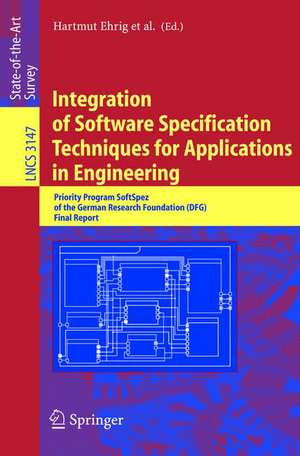
Integration of Software Specification Techniques for Applications in Engineering
Editat de Hartmut Ehrig, Werner Damm, Jörg Desel, Martin Große-Rhode, Wolfgang Reif, Eckehard Schnieder, Engelbert Westkämperen Limba Engleză Paperback – 22 sep 2004
Preț: 353.37 lei
Preț vechi: 441.71 lei
-20%
Puncte Express: 530
Carte tipărită la comandă
Livrare economică 23 noiembrie-07 decembrie
Livrare prin curier în România Termenul estimat este afișat lângă disponibilitate.
Transport gratuit de la 400.00 lei Plată online sau ramburs, în funcție de opțiunile comenzii.
Retur gratuit în 14 zile Comandă securizată și suport în română.
Specificații
ISBN-13: 9783540231356
ISBN-10: 3540231358
Pagini: 644
Ilustrații: X, 630 p.
Dimensiuni: 155 x 235 x 35 mm
Greutate: 0.96 kg
Ediția:2004
Editura: Springer
Locul publicării:Berlin, Heidelberg, Germany
ISBN-10: 3540231358
Pagini: 644
Ilustrații: X, 630 p.
Dimensiuni: 155 x 235 x 35 mm
Greutate: 0.96 kg
Ediția:2004
Editura: Springer
Locul publicării:Berlin, Heidelberg, Germany
V-ar putea interesa
-
 -27%Preț: 676.09 lei926.15 lei
 -
 Software Modeling and DesignHassan Gomaa-20%Preț: 665.25 lei831.56 lei
 -
 KanbanDavid J. Anderson-20%Preț: 264.20 lei330.25 lei
 -
 The Human Side of AgileGil BrozaPreț: 271.68 lei
 -
 Software EngineeringRuneson-20%Preț: 457.31 lei571.64 lei
 -
 Professional GitBrent Laster-20%Preț: 256.78 lei320.97 lei
 -
 Python AlgorithmsMagnus Lie Hetland-20%Preț: 468.00 lei584.99 lei
 -
 The Definitive Guide to HTML5 WebSocketVanessa Wang-20%Preț: 372.28 lei465.36 lei
 -
 Head First AgileAndrew Stellman-20%Preț: 343.20 lei429.00 lei
 -
 Continuous Delivery with Visual Studio ALM 2015Mathias Olausson-20%Preț: 299.70 lei374.63 lei
 -
 Design It! : Pragmatic ProgrammersMicahel Keeling-20%Preț: 257.10 lei321.38 lei
 -
 Mastering ServiceNow - Second EditionMartin Wood-20%Preț: 368.74 lei460.93 lei
 -
 ProzeßinformatikEckehard SchniederPreț: 358.11 lei
 -
 -20%Preț: 339.28 lei424.11 lei
 -
 Preț: 377.32 lei
 -
 Engineering and Managing Software RequirementsAybüke Aurum-20%Preț: 964.51 lei1205.64 lei
 -
 Model Checking SoftwarePatrick Godefroid-20%Preț: 322.37 lei402.96 lei
 -
 Formal Methods and Software EngineeringKung-Kiu Lau-20%Preț: 333.24 lei416.55 lei
 -
 -20%Preț: 328.94 lei411.17 lei
 -
 Algorithms - ESA 2006Yossi Azar-20%Preț: 679.22 lei849.03 lei
 -
 Object Modeling with the OCLTony Clark-20%Preț: 321.74 lei402.18 lei
 -
 -20%Preț: 335.69 lei419.60 lei
 -
 Instandhaltungsmanagement in neuen OrganisationsformenEngelbert WestkämperPreț: 469.51 lei
 -
 Computer Aided VerificationWerner Damm-20%Preț: 336.71 lei420.88 lei
 -
 Towards the Re-Industrialization of EuropeEngelbert Westkämper-15%Preț: 660.18 lei776.69 lei
Public țintă
ResearchCuprins
Integration of Software Specification Techniques for Applications in Engineering: Introduction and Overview of Results.- Integration of Software Specification Techniques for Applications in Engineering: Introduction and Overview of Results.- I: Reference Case Study Production Automation.- Basic Principles for Software Specification.- Challenges of Next Generation Manufacturing Systems.- Development of Hierarchical Broadcasting Software Architectures Using UML 2.0.- An Engineer’s Workstation to Support Integrated Development of Flexible Production Control Systems.- A Formal Component Concept for the Specification of Industrial Control Systems.- II: Reference Case Study Traffic Control Systems.- Specification Methodology, Case Studies, and Experiments – An Introduction to the Subject Area of Traffic Control Systems.- Reference Case Study “Traffic Control Systems” for Comparison and Validation of Formal Specifications Using a Railway Model Demonstrator.- Precise Definition of the Single-Track Level Crossing in Radio-Based Operation in UML Notation and Specification of Safety Requirements.- Executable HybridUML and Its Application to Train Control Systems.- The Use of UML for Development of a Railway Interlocking System.- III: Petri Nets and Related Approaches in Engineering.- Process Description Languages and Methods: Introduction to the Chapter Petri Nets and Related Approaches in Engineering.- Specification and Formal Verification of Temporal Properties of Production Automation Systems.- STOP – Specification Technique of Operational Processes.- Specification and Validation of an Edge Router Discovery Protocol for Mobile Ad Hoc Networks.- A Guide to Modelling and Control with Modules of Signal Nets.- Conceptual Design of an Engineering Model for Product andPlant Automation.- IV: Charts.- to Subject Area “Charts”.- The Rhapsody Semantics of Statecharts (or, On the Executable Core of the UML).- Interactive Verification of Statecharts.- Live Sequence Charts.- A Unifying Semantics for Sequential Function Charts.- V: Verification.- to Subject Area “Verification”.- “UML–ising” Formal Techniques.- Model Based Formal Verification of Distributed Production Control Systems.- Combining Formal Methods and Safety Analysis – The ForMoSA Approach.- Formal Verification of LSCs in the Development Process.- Verification of PLC Programs Given as Sequential Function Charts.- Modeling and Formal Verification of Production Automation Systems.- VI: Integration Modeling.- On Model Integration and Integration Modelling.- On the Integration of Modular Heterogeneous Specifications.- Semantical Integration of Object-Oriented Viewpoint Specification Techniques.