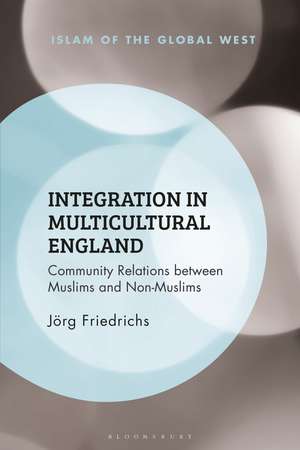
Integration in Multicultural England: Community Relations between Muslims and Non-Muslims: Islam of the Global West
Autor Dr Jörg Friedrichsen Limba Engleză Hardback – 21 aug 2025
Given their unique everyday experience, inner city residents prove to be experts when it comes to community relations. To give them a voice and learn from their experience, the book takes us on a tour of diverse English inner cities. Reassuringly, the grassroots perspective of residents is consistent with a vision of integration in multicultural England. Residents are concerned not so much about hot-button issues like extremism or terrorism. Instead, their minds are set on practical matters: how to coexist peacefully in stressful urban environments, and how to find love and raise families when norms diverge.
Caught between grievance and aspiration, inner city residents from any background express disappointment at Muslim and non-Muslim parents sending their children to different schools. They also discuss whether governance should be community-blind or community-based, and if Britain is ready for a Muslim Prime Minister. In all of this, Muslim and non-Muslim residents acknowledge that we live in a multicultural society. For most, however, it does not follow that we should adopt multiculturalism as an ideology. Instead, most people crave and support a move towards greater integration.






Preț: 583.98 lei
Preț vechi: 864.48 lei
-32%
Puncte Express: 876
Carte tipărită la comandă
Livrare economică 07-21 decembrie
Livrare prin curier în România Termenul estimat este afișat lângă disponibilitate.
Transport gratuit pentru acest produs Plată online sau ramburs, în funcție de opțiunile comenzii.
Retur gratuit în 14 zile Comandă securizată și suport în română.
Specificații
ISBN-13: 9781350555242
ISBN-10: 135055524X
Pagini: 270
Ilustrații: 10 bw illus
Dimensiuni: 156 x 238 x 20 mm
Greutate: 0.56 kg
Editura: Bloomsbury Publishing
Colecția Bloomsbury Academic
Seria Islam of the Global West
Locul publicării:London, United Kingdom
ISBN-10: 135055524X
Pagini: 270
Ilustrații: 10 bw illus
Dimensiuni: 156 x 238 x 20 mm
Greutate: 0.56 kg
Editura: Bloomsbury Publishing
Colecția Bloomsbury Academic
Seria Islam of the Global West
Locul publicării:London, United Kingdom
Cuprins
List of Figures
Preface
Acknowledgements
1. Introduction: A Tale of Three Neighbourhoods
2. Community Relations: Views of the Present, Visions for the Future
3. Getting On while Getting By: Community Cohesion despite Hardship
4. Bonds without Bondage: Finding Love and Raising Families
5. "It sometimes feels like living in the Bronx": Coping with Delinquency
6. Caring about Education: Segregation and Mixing in Schools
7. "They didn't take it from you personally": Aspiration vs Grievance
8. Community Governance: Community-Blind or Community-Based?
9. Conclusion: Is Britain ready for a Muslim Prime Minister?
Bibliography
Index
Preface
Acknowledgements
1. Introduction: A Tale of Three Neighbourhoods
2. Community Relations: Views of the Present, Visions for the Future
3. Getting On while Getting By: Community Cohesion despite Hardship
4. Bonds without Bondage: Finding Love and Raising Families
5. "It sometimes feels like living in the Bronx": Coping with Delinquency
6. Caring about Education: Segregation and Mixing in Schools
7. "They didn't take it from you personally": Aspiration vs Grievance
8. Community Governance: Community-Blind or Community-Based?
9. Conclusion: Is Britain ready for a Muslim Prime Minister?
Bibliography
Index
Recenzii
This book provides a very welcome and new perspective, with insights about integration from 'the undisputable experts' - local people themselves. It comes at a time when relations between Muslims and non-Muslims have become highly politicised, threatening cohesion in many different countries. The author focuses on three areas in and around Muslim-majority communities in England capturing and mediating the views of local residents. The results are unexpected, with a strong bias towards integration and with some clear and challenging implications for the way that multiculturalism has been conceived.
Joerg Friedrichs has produced a fine contribution to this pioneering series. He tackles crucial debates about community relations that are not only relevant to understanding contemporary British society but what is going on in the West more generally. He grounds those debates within research undertaken in three urban, multicultural English locales and skilfully explores people's varying understandings of such crucial terms as Muslim identity, integration, family and community. Challenging and thought-provoking.
Friedrichs provides a rich and innovative exploration of community relations and issues pertaining to Muslim-majority contexts. Although focusing on three urban situations, the tenor of the findings is indicative of the sorts of questions, problems and answers that can be found elsewhere. Written in an engaging and lively style, this book is worthy of anyone interested in the lived realities of Muslims in England today. Having experienced a Hindu Prime Minister, is Britain ready for a Muslim? Read on to find out!
Friedrichs' book is a treat. Rich in detail, it tackles the most difficult questions about class, racism, integration, sexism, crime, and isolationist strategies in deprived inner-city areas, all while giving voice to those who live there. This important work deserves widespread discussion.
This is an impressive panoramic view of multiculturalism - not in theory but as it works in practice - in three inner-city areas of England. Based on open-ended interviews with a substantial sample of Muslim and non-Muslim residents from a range of ethnic backgrounds, it documents how people think about and deal with cultural difference as they go about their daily lives. We meet people from all walks of life, such as Shabir, the practising-Muslim chairman of a Rotary Club, and Alison, the white British 'community cohesion co-ordinator' in a Muslim-majority school. Participants hold a wide range of views, but the analysis reveals substantial commonality across the themes they choose to discuss. Overall, the findings support a strong case for integration within a multicultural society. This readable, balanced resource will be of immense value to anyone concerned with community relations.
Joerg Friedrichs has produced a fine contribution to this pioneering series. He tackles crucial debates about community relations that are not only relevant to understanding contemporary British society but what is going on in the West more generally. He grounds those debates within research undertaken in three urban, multicultural English locales and skilfully explores people's varying understandings of such crucial terms as Muslim identity, integration, family and community. Challenging and thought-provoking.
Friedrichs provides a rich and innovative exploration of community relations and issues pertaining to Muslim-majority contexts. Although focusing on three urban situations, the tenor of the findings is indicative of the sorts of questions, problems and answers that can be found elsewhere. Written in an engaging and lively style, this book is worthy of anyone interested in the lived realities of Muslims in England today. Having experienced a Hindu Prime Minister, is Britain ready for a Muslim? Read on to find out!
Friedrichs' book is a treat. Rich in detail, it tackles the most difficult questions about class, racism, integration, sexism, crime, and isolationist strategies in deprived inner-city areas, all while giving voice to those who live there. This important work deserves widespread discussion.
This is an impressive panoramic view of multiculturalism - not in theory but as it works in practice - in three inner-city areas of England. Based on open-ended interviews with a substantial sample of Muslim and non-Muslim residents from a range of ethnic backgrounds, it documents how people think about and deal with cultural difference as they go about their daily lives. We meet people from all walks of life, such as Shabir, the practising-Muslim chairman of a Rotary Club, and Alison, the white British 'community cohesion co-ordinator' in a Muslim-majority school. Participants hold a wide range of views, but the analysis reveals substantial commonality across the themes they choose to discuss. Overall, the findings support a strong case for integration within a multicultural society. This readable, balanced resource will be of immense value to anyone concerned with community relations.
Notă biografică
Jörg Friedrichs is Associate Professor of Politics at the University of Oxford, UK.