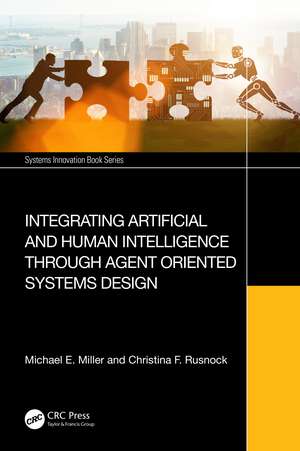
Integrating Artificial and Human Intelligence through Agent Oriented Systems Design: Systems Innovation Book Series
Autor Michael E. Miller, Christina F. Rusnocken Limba Engleză Paperback – 19 iul 2026
Integrating Artificial and Human Intelligence through Agent Oriented Systems Design discusses the potential impact of AI on human work and life and explores why teamwork is necessary today for complex work environments. The book explains the processes and methods humans employ to effectively team with one another and presents the elements of artificial agents that permit them to function as team members in joint human and artificial teams. It discusses design goals and illustrates how the methods that have been used to model the complex interactions among human and artificial agents can be expanded to enable the design of interaction between them to make possible the attainment of the shared goals. Model-Based Systems Engineering (MBSE) tools that provide logical designs of human–agent teams, the AI within these teams, training to be deployed for human and artificial agent team members, and the interfaces between human and artificial agent team members are all covered. MBSE files containing profiles and examples for building MBSE models used in the design approach are featured on the author’s website (https://lodesterresci.com/hat).
This book is an ideal read for students, professors, engineers, and project managers associated with designing and developing AI systems or systems that seek to incorporate AI.
Din seria Systems Innovation Book Series
- 8%
 Preț: 448.01 lei
 - 8%
 Preț: 436.25 lei
 - 15%
 Preț: 718.40 lei
 - 18%
 Preț: 927.04 lei
 -
 Preț: 478.85 lei
 - 8%
 Preț: 436.69 lei
 -
 Preț: 314.03 lei
 - 18%
 Preț: 954.47 lei
 - 18%
 Preț: 1343.00 lei
 - 15%
 Preț: 683.39 lei
 -
 Preț: 479.44 lei
 - 18%
 Preț: 711.42 lei
 - 18%
 Preț: 681.03 lei
 - 18%
 Preț: 927.70 lei
 - 15%
 Preț: 633.99 lei
 - 15%
 Preț: 546.29 lei
 - 15%
 Preț: 422.92 lei
 -
 Preț: 484.25 lei
 - 15%
 Preț: 458.34 lei
 - 15%
 Preț: 621.67 lei
 - 20%
 Preț: 761.82 lei
 - 15%
 Preț: 530.47 lei
 - 18%
 Preț: 702.19 lei
 - 18%
 Preț: 1252.24 lei
 - 18%
 Preț: 928.48 lei
 - 18%
 Preț: 1258.47 lei
 -
 Preț: 484.07 lei
 - 9%
 Preț: 1164.37 lei
 - 15%
 Preț: 604.06 lei
 - 18%
 Preț: 1412.81 lei
 - 18%
 Preț: 688.26 lei
 -
 Preț: 480.21 lei
 - 18%
 Preț: 786.40 lei
 -
 Preț: 484.25 lei
 - 18%
 Preț: 921.36 lei
 - 18%
 Preț: 917.40 lei
 - 15%
 Preț: 672.05 lei
 -
 Preț: 475.93 lei
Preț: 365.40 lei
Preț vechi: 519.08 lei
-30% Nou
Puncte Express: 548
Carte indisponibilă temporar
Doresc să fiu notificat când acest titlu va fi disponibil:
Se trimite...
Specificații
ISBN-13: 9781032549361
ISBN-10: 103254936X
Pagini: 322
Ilustrații: 150
Dimensiuni: 156 x 234 mm
Greutate: 0.6 kg
Ediția:1
Editura: CRC Press
Colecția CRC Press
Seria Systems Innovation Book Series
ISBN-10: 103254936X
Pagini: 322
Ilustrații: 150
Dimensiuni: 156 x 234 mm
Greutate: 0.6 kg
Ediția:1
Editura: CRC Press
Colecția CRC Press
Seria Systems Innovation Book Series
V-ar putea interesa
-
 Using Artificial Intelligence Absolute Beginner's GuideMichael Miller-20%Preț: 189.01 lei236.26 lei
 -
 Human-Centered AIBen Shneiderman-31%Preț: 105.07 lei152.53 lei
 -
 Evolutionary IntelligenceW. Russell Neuman-23%Preț: 137.72 lei178.89 lei
 -
 -14%Preț: 729.69 lei848.47 lei
 -
 The Power of Design and Convergence of AITai Lee Siang-20%Preț: 414.05 lei517.56 lei
 -
 -20%Preț: 406.00 lei507.50 lei
 -
 -20%Preț: 414.55 lei518.19 lei
 -
 Preț: 103.52 lei
 -
 Agentic AI For DummiesPam Baker-20%Preț: 143.73 lei179.66 lei
 -
 The Essential Book of AIAnne Rooney-20%Preț: 74.07 lei92.59 lei
 -
 -42%Preț: 56.53 lei97.47 lei
 -
 AI Agents in ActionMicheal Lanham-20%Preț: 329.68 lei412.10 lei
 -
 -21%Preț: 188.58 lei239.36 lei
 -
 How to Make AI UsefulMagnus Reiner-11%Preț: 82.14 lei92.64 lei
 -
 At the Edge of AI: Human Computation Systems and Their Intraverting RelationsLibuše Hannah Veprek-25%Preț: 338.73 lei451.70 lei
 -
 Managing teams in the Age of AIAnkur Agrawal-20%Preț: 177.17 lei221.46 lei
 -
 How to AIChristopher MimsPreț: 174.07 lei
 -
 More HumanRasmus HougaardPreț: 181.81 lei
 -
 -26%Preț: 136.99 lei186.29 lei
Public țintă
Professional Practice & DevelopmentNotă biografică
Michael E. Miller is a Professor of Systems Engineering at the Air Force Institute of Technology where he teaches courses in human factors, human performance modeling, and human systems integration, including a course in Human-Agent Teaming. Mike’s recent research has focused on human representations in systems engineering models, including a SysML extension for developing descriptive models of systems which include small teams of humans and agents working to seek common goals. Mike has contributed to more than 100 issued U.S. patents on digital imaging and display systems, 50 peer‐reviewed journal articles, and numerous conference proceedings.
Lt Col Christina F. Rusnock is an Adjunct Associate Professor of the Department of Systems Engineering and Management at the Air Force Institute of Technology, Wright Patterson AFB, OH. Dr. Rusnock earned her Ph.D. in Industrial Engineering, Human Factors/Ergonomics Specialization, from the University of Central Florida, and an MS in Research and Development Management from the Air Force Institute of Technology. Her research interests include human performance modeling, mental workload, trust in automation, and situation awareness, with a focus on applications in human-machine teaming for autonomous systems. She has contributed to over 50 books, journal articles, and conference proceedings.
Lt Col Christina F. Rusnock is an Adjunct Associate Professor of the Department of Systems Engineering and Management at the Air Force Institute of Technology, Wright Patterson AFB, OH. Dr. Rusnock earned her Ph.D. in Industrial Engineering, Human Factors/Ergonomics Specialization, from the University of Central Florida, and an MS in Research and Development Management from the Air Force Institute of Technology. Her research interests include human performance modeling, mental workload, trust in automation, and situation awareness, with a focus on applications in human-machine teaming for autonomous systems. She has contributed to over 50 books, journal articles, and conference proceedings.
Cuprins
1. Introducing Human–AI Teaming. 2. Defining Your System. 3. Goals and Responsibilities. 4. What is Teaming?. 5. Automation and System Redesign. 6. AI Methods and Agent Architectures. 7. Allocation. 8. Human–AI Agent Team Architectural Patterns. 9. Decision-Making and Decision Support Systems. 10. Designing for Exceptions. 11. System Verification through Coactive Design. 12. Human Capabilities and Capacity. 13. Completing System Specifications in the AOSM. 14. Future of Agent-Oriented Systems Modeling. Appendix A: AOSM Profile, Language Extension
Descriere
This book subscribes to the assumption that AI systems will provide a maximal advantage when designed to augment human intelligence. In this book are methods for designing effective systems that involve one or more humans and AI entities, providing an approach that assumes automation does not replace but changes the structure of human work.