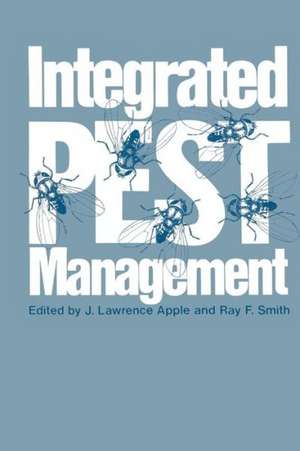
Integrated Pest Management
Editat de J. Appleen Limba Engleză Paperback – 6 apr 2012
Preț: 611.57 lei
Preț vechi: 719.49 lei
-15%
Puncte Express: 917
Carte tipărită la comandă
Livrare economică 30 noiembrie-14 decembrie
Livrare prin curier în România Termenul estimat este afișat lângă disponibilitate.
Transport gratuit pentru acest produs Plată online sau ramburs, în funcție de opțiunile comenzii.
Retur gratuit în 14 zile Comandă securizată și suport în română.
Specificații
ISBN-13: 9781461572718
ISBN-10: 1461572711
Pagini: 220
Ilustrații: XIV, 200 p.
Dimensiuni: 152 x 229 x 12 mm
Greutate: 0.3 kg
Ediția:Softcover reprint of the original 1st ed. 1976
Editura: Springer Us
Colecția Springer
Locul publicării:New York, NY, United States
ISBN-10: 1461572711
Pagini: 220
Ilustrații: XIV, 200 p.
Dimensiuni: 152 x 229 x 12 mm
Greutate: 0.3 kg
Ediția:Softcover reprint of the original 1st ed. 1976
Editura: Springer Us
Colecția Springer
Locul publicării:New York, NY, United States
V-ar putea interesa
-
 Plant PathologyGeorge N. Agrios-21%Preț: 601.29 lei761.12 lei
 -
 Plant Pathogen Resistance BiotCollinge-9%Preț: 1295.85 lei1424.01 lei
Public țintă
ResearchCuprins
I The Origins of Integrated Pest Management Concepts for Agricultural Crops.- Evolution of Pest Control Practices.- Early Advocates of an Ecological Approach to Pest Control.- Early Pest Management for the Cotton Boll Weevil.- Return to Ecological Approaches in Pest Control.- The Modern Integrated Pest Management Approach.- Literature Cited.- II Integrating Economics and Pest Management.- Farm Strategy.- Regional Strategies.- Conclusions.- Literature Cited.- III Implementing Pest Management Programs: An International Perspective.- Situation and Outlook.- Needs for Development of Effective Pest Management.- The Situation at the National Level.- The Situation at the International Level.- Some Future Challenges.- IV Pest Management: Principles and Philosophy.- Traditional Crop Protection Procedures.- Pest Management.- Summary and Conclusion.- Literature Cited.- V Pest Management in Ecological Perspective.- Pest Problems: Their Nature and Causes.- Pest Problems: Their Possible Solutions.- Literature Cited.- VI The Agroecosystem: A Simplified Plant Community.- The Quality of Management.- The Simplified Plant Community.- The Diversification Principle.- Inadequate Supply of Biological Nitrogen.- Root Health: Prerequisite to Plant Productivity.- Literature Cited.- VII Tobacco Pest Management.- Disease and Insect Control Subsystems.- Action Programs in Tobacco Pest Management.- Integration of Insect and Disease Management.- Seeking a Practical Level of Sophistication.- Literature Cited.- VIII Systems Approach to Cotton Insect Pest Management.- Systems Approach to Increased Cotton Efficiency.- The Argument for the Systems Approach.- The Cotton Ecosystem.- Modeling the Cotton Ecosystem.- Cotton Plant-Insect Pest Interactions.- Cotton Crop Growth Models.- Dispersal and Pheromone Drift Models.- Uses of Models and Systems Analysis in Decision Making.- Conclusions.- Literature Cited.- IX Pest Management on Deciduous Fruits: Multidisciplinary Aspects.- Pest Management in Humid Areas.- Pest Management in Semiarid Areas.- Literature Cited.- X Integrated Forest Pest Management: A Silvicultural Necessity.- The Forest as a Dynamic Ecosystem.- The Forest as a Renewable Resource for Humans.- Forest Pest Management Systems.- Current Practices and Future Needs.- Summary and Recommendations.- Literature Cited.- XI Progress, Problems, and Prospects for Integrated Pest Management.- Implementation Status of Integrated Pest Management in the United States.- Implementation Status of Integrated Pest Management Programs Outside the United States.- Problems and Prospects for Developing Integrated Pest Management Programs.- Literature Cited.