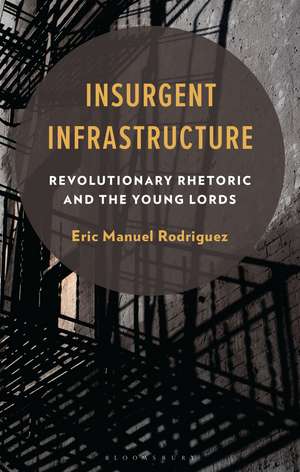
Insurgent Infrastructure: Revolutionary Rhetoric and the Young Lords
Autor Eric Manuel Rodriguezen Limba Engleză Hardback – 11 dec 2026
Examining the Young Lords, a revolutionary nationalist organization forged from conditions of colonial displacement, racial capitalism, and urban neglect, this book argues that rhetorical studies requires recalibration to account for rhetoric's material dimensions and its capacity to coordinate collective survival. Through sustained analysis of the Young Lords' bilingual newspaper Palante, their 13-Point Program and Platform, Rules of Discipline, and the occupations, clinics, and educational programs that constituted their revolutionary praxis, Rodriguez demonstrates how rhetoric coordinated bodies, resources, and time under conditions of organized abandonment.
Drawing on decolonial theory, foquismo, and the concept of kairos, the study reframes rhetorical action as the construction of counter-institutions - free clinics, autonomous media, community defense, liberation schools - that sustained collective survival. Tracing the organization's rhetorical evolution from Chicago to New York and its eventual fracture, Eric Manuel Rodriguez reveals how print, pedagogy, and occupation functioned as logistical media for mobilization, and how the three principles - insurgent infrastructure, dialectical pedagogy, and collective logistics - connect the Young Lords' legacy to contemporary movements and abolitionist organizing.
Preț: 520.58 lei
Preț vechi: 733.29 lei
-29% Precomandă
Puncte Express: 781
Carte nepublicată încă
Livrare prin curier în România Precomanda se expediază când titlul devine disponibil.
Transport gratuit pentru acest produs Plată online sau ramburs, în funcție de opțiunile comenzii.
Retur gratuit în 14 zile Comandă securizată și suport în română.
Doresc să fiu notificat când acest titlu va fi disponibil:
Se trimite...
Specificații
ISBN-13: 9781666981681
ISBN-10: 1666981680
Pagini: 192
Dimensiuni: 152 x 229 mm
Editura: Bloomsbury Publishing
Colecția Bloomsbury Academic
Locul publicării:New York, United States
ISBN-10: 1666981680
Pagini: 192
Dimensiuni: 152 x 229 mm
Editura: Bloomsbury Publishing
Colecția Bloomsbury Academic
Locul publicării:New York, United States
Cuprins
Introduction: Rhetoric as Resistance
1. The Young Lords: A Blueprint for Rhetorical Resistance
2. Revolutionary Timing: Foquismo, Kairos, and the Seizure of Conjuncture
3. Print as Logistics, Not Symbolism
4. Rhetorical Fracture: Geography, Ideology, and the Split
5. Revolutionary Rhetoric and the Work of Liberation
Epilogue: Writing as Action: Revolutionary Incompleteness and the Rhetoric of the Present
Bibliography
Index
About the Author
1. The Young Lords: A Blueprint for Rhetorical Resistance
2. Revolutionary Timing: Foquismo, Kairos, and the Seizure of Conjuncture
3. Print as Logistics, Not Symbolism
4. Rhetorical Fracture: Geography, Ideology, and the Split
5. Revolutionary Rhetoric and the Work of Liberation
Epilogue: Writing as Action: Revolutionary Incompleteness and the Rhetoric of the Present
Bibliography
Index
About the Author
Recenzii
A compelling and original assessment of both the Young Lords' rhetorical strategies as well as the contemporary field of rhetorical studies. Rodriguez looks to the Lords to argue for understanding rhetoric as infrastructure and not merely as symbolism. In doing so, he shows just how much the group still has to teach us about contemporary organizing and the fight for material change.
Both easy to read and theoretically insightful, Insurgent Infrastructure offers a much-needed corrective to modern rhetorical studies: rather than viewing rhetoric as merely persuasion, we need to explore the community impact of rhetorical practices. Rodriquez argues convincingly for this view through a sustained examination of the Young Lords' print culture, which created the conditions for community action, connection, and even liberation. Brilliantly done.
Both easy to read and theoretically insightful, Insurgent Infrastructure offers a much-needed corrective to modern rhetorical studies: rather than viewing rhetoric as merely persuasion, we need to explore the community impact of rhetorical practices. Rodriquez argues convincingly for this view through a sustained examination of the Young Lords' print culture, which created the conditions for community action, connection, and even liberation. Brilliantly done.