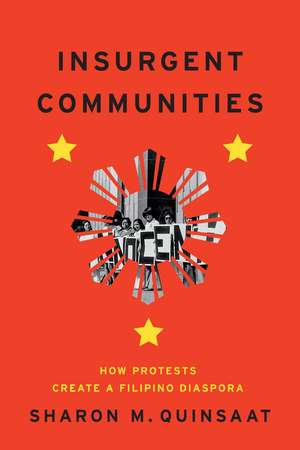
Insurgent Communities: How Protests Create a Filipino Diaspora
Autor Sharon M. Quinsaaten Limba Engleză Paperback – 8 mar 2024
When people migrate and settle in other countries, do they automatically form a diaspora? In Insurgent Communities, Sharon M. Quinsaat explains the dynamic process through which a diaspora is strategically constructed. Quinsaat looks to Filipinos in the United States and the Netherlands—examining their resistance against the dictatorship of Ferdinand Marcos, their mobilization for migrants’ rights, and the construction of a collective memory of the Marcos regime—to argue that diasporas emerge through political activism. Social movements provide an essential space for addressing migrants’ diverse experiences and relationships with their homeland and its history. A significant contribution to the interdisciplinary field of migration and social movements studies, Insurgent Communities illuminates how people develop collective identities in times of social upheaval.
Preț: 206.80 lei
Puncte Express: 310
Carte disponibilă
Livrare economică 31 octombrie-14 noiembrie
Livrare express 17-23 octombrie pentru 24.65 lei
Livrare prin curier în România Termenul estimat este afișat lângă disponibilitate.
Transport gratuit de la 400.00 lei Plată online sau ramburs, în funcție de opțiunile comenzii.
Retur gratuit în 14 zile Comandă securizată și suport în română.
Specificații
ISBN-13: 9780226831688
ISBN-10: 022683168X
Pagini: 240
Ilustrații: 7 halftones, 1 tables
Dimensiuni: 152 x 229 x 18 mm
Greutate: 0.34 kg
Ediția:First Edition
Editura: University of Chicago Press
Colecția University of Chicago Press
ISBN-10: 022683168X
Pagini: 240
Ilustrații: 7 halftones, 1 tables
Dimensiuni: 152 x 229 x 18 mm
Greutate: 0.34 kg
Ediția:First Edition
Editura: University of Chicago Press
Colecția University of Chicago Press
Notă biografică
Sharon M. Quinsaat is a scholar of social movements and migration and an associate professor of sociology at Grinnell College. She has published her research in Mobilization, Journal of Ethnic and Migration Studies, Ethnic and Racial Studies, Mass Communication and Society, Sociology Compass, and Asian Survey.
Cuprins
List of Abbreviations
Preface
Introduction
1 Movement(s) and Identities: Toward a Theory of Diaspora Construction through Contention
2 Roots and Routes: Global Migration of Filipinos
3 Patriots and Revolutionaries: Anti-Dictatorship Movement and Loyalty to the Homeland
4 Workers and Minorities: Mobilizations for Migrants’ Rights and Ethnic/National Solidarity
5 Storytellers and Interlocutors: Collective Memory Activism and Shared History
Conclusion
Acknowledgments
Appendix: Methodology
Notes
References
Index
Preface
Introduction
1 Movement(s) and Identities: Toward a Theory of Diaspora Construction through Contention
2 Roots and Routes: Global Migration of Filipinos
3 Patriots and Revolutionaries: Anti-Dictatorship Movement and Loyalty to the Homeland
4 Workers and Minorities: Mobilizations for Migrants’ Rights and Ethnic/National Solidarity
5 Storytellers and Interlocutors: Collective Memory Activism and Shared History
Conclusion
Acknowledgments
Appendix: Methodology
Notes
References
Index
Recenzii
“Insurgent Communities is a book I could not recommend more. It is a brilliant sociological study on the political activism of Filipinos inside and outside of the homeland. A must-read for scholars of migration and social movements, it illustrates how a diaspora is not just a shared identity, but instead a political accomplishment.”
“This is an entertaining and powerful book on Filipinos living in the United States and the Netherlands, full of wonderful conversations, but it also shows how we all put bits and pieces of meaning together from many sources to craft a world and our identity in it. Specifically, Quinsaat shows how immigrants become a self-conscious diaspora through activism, which has never been a more important question than it is today.”
“Joining theories of migration and social movements, Insurgent Communities explores how diasporic identities are politically made and remade. Anti-Marcos insurgents had to convince Filipinos in the United States and the Netherlands that loyalty to the Filipino nation required opposition to the Philippine state, and Sharon Quinsaat’s account of how they did that is compelling.”
"With Insurgent Communities, Sharon Quinsaat provides us with a bold and insightful analysis of how a diaspora is invented through the political mobilizations of migrants. Skillfully articulating political sociology, transnational studies and migration studies, the book is a masterful empirical study of Filipinos' anti-dictatorship actions in the Netherlands and in the United States, as well as a profound and original reflection about the social and political construction of migrant communities."
"Insurgent Communities is an absolute must-read. Through the meticulous examination of Filipino migrant activism in the US and The Netherlands, Quinsaat effectively demonstrates how contentious politics forge diaspora movements. Her impressive fieldwork, interviews, and archival research effectively illustrate how episodes of contention reconfigure migrants’ sense of their ‘imagined' communities, identities, and corresponding solidarities. Using rich accounts that highlight the lived experiences of Filippino activists, she shows how these episodes motivate migrants to act collectively to increase their rights and political influence, both at home and abroad. By shedding light on how diasporas are constructed and become effective forces for change, Quinsaat's book makes an outstanding contribution to the study of social movements, culture, migration, and transnational sociology."
"Sharon Quinsaat’s Insurgent Communities provides an engaging and accessible history of overseas Filipino mobilization over several decades. Drawing on extensive fieldwork and in-depth interviews conducted in the Philippines, the Netherlands, and the United States, Quinsaat challenges the common yet simplistic assumption that migrants naturally associate and act collectively with their compatriots. Instead, the book convincingly argues that diaspora identities are shaped and solidified through protest actions, rather than serving as a precondition for them."
“An indispensable contribution to the field. . . Recommended.”