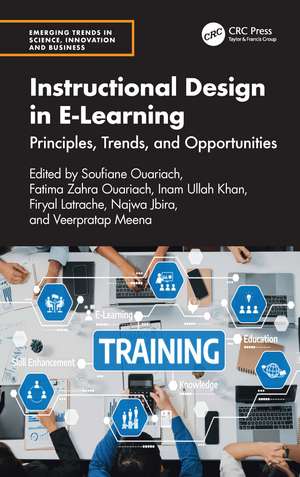
Instructional Design in E-Learning: Principles, Trends, and Opportunities: Emerging Trends in Science, Innovation and Business
Editat de Soufiane Ouariach, Fatima Zahra Ouariach, Inam Ullah Khan, Firyal Latrache, Najwa Jbira, Veerpratap Meenaen Limba Engleză Hardback – 24 iul 2026
The volume grounds its recommendations in foundational instructional design models, including ADDIE, TPACK, and the Community of Inquiry framework, to demonstrate how these approaches are being reconfigured for digital transformation. It explores multimedia learning design through Cognitive Load Theory, Dual Coding Theory, and Mayer’s Cognitive Theory of Multimedia Learning, offering guidance on optimizing the integration of text, images, audio, video and interactive elements. The text presents architectural frameworks for flipped classrooms using Small Private Online Courses and examines the integration of synchronous and asynchronous modalities in blended higher education. Accessibility is addressed through Universal Design for Learning and Web Content Accessibility Guidelines implementation strategies, while emotional design principles illustrate the creation of meaningful learner‑content connections. The volume explores emerging technologies, including GenAI integration within learning management systems for personalized feedback and intelligent tutoring, AI‑driven adaptive learning systems, and virtual reality and augmented reality applications that foster embodied cognition and situated learning across disciplines, from medical education to historical reconstruction.
This collection is designed for instructional designers, educational technologists and faculty members seeking evidence‑based strategies for digital course development. It will help graduate students, curriculum developers, and policymakers in promoting equitable access to quality online education.

Preț: 1093.44 lei
Preț vechi: 1569.86 lei
-30% Nou
Puncte Express: 1640
Carte indisponibilă temporar
Doresc să fiu notificat când acest titlu va fi disponibil:
Se trimite...
Specificații
ISBN-13: 9781041161042
ISBN-10: 1041161042
Pagini: 352
Ilustrații: 90
Dimensiuni: 156 x 234 mm
Greutate: 0.81 kg
Ediția:1
Editura: CRC Press
Colecția CRC Press
Seria Emerging Trends in Science, Innovation and Business
ISBN-10: 1041161042
Pagini: 352
Ilustrații: 90
Dimensiuni: 156 x 234 mm
Greutate: 0.81 kg
Ediția:1
Editura: CRC Press
Colecția CRC Press
Seria Emerging Trends in Science, Innovation and Business
Public țintă
Academic, Postgraduate, and Professional ReferenceCuprins
1. Assessment Methods and Strategies in Digital Education 2. Optimizing Multimedia Elements for Effective Digital Learning: Principles, Practices, and Innovations 3. An Architectural Proposal Based on the SPOC Approach to Flipped Classroom 4. Synthesizing Cognitive Models and Learning Theories in Instructional Design for Equitable and Epistemically Just Digital Education 5. Instructional Design Frameworks for Accessible and Inclusive E‑Learning 6. Integrating Synchronous and Asynchronous Modalities in Blended Higher Education: A Systematic Literature Review 7. Designing for All: Instructional Design for Accessible and Inclusive E‑Learning 8. Emotional Design Principles for Enhanced Learner Engagement 9. Building Sustainable Futures through Smart Learning: Integrating Gamification and Technology in E‑Learning Design 10. Artificial Intelligence in Instructional Design: A Framework for Adaptive and Data‑Driven E‑Learning 11. Artificial Intelligence for Resilient and Human‑Centered E‑Learning Systems 12. The Role of Artificial Intelligence in E‑Learning Automation 13. AI‑Driven Adaptive Learning Systems: A Bibliometric Study 14. The Use of Virtual Reality and Augmented Reality as Emerging Technologies in E‑Learning 15. Artificial Intelligence and the Future of Education: Shaping the Next Era of Teaching and Learning 16. Future Trends and Innovations in Instructional Design for E‑Learning: A Systematic Literature Review
Notă biografică
Soufiane Ouariach holds a doctorate in Computer Science and University Pedagogical Engineering. His scholarly work centers on innovative instructional approaches, with a particular focus on flipped classroom models supported by SPOCs (Small Private Online Courses), as well as the design and implementation of distance learning environments. His research contributes to advancing pedagogical methodologies within the broader field of educational technology, with the aim of redefining effective, learner‑centered digital education. He has served as a reviewer for internationally recognized publishing houses and international conferences. His academic expertise extends into instructional design for online and blended learning systems, where he remains committed to exploring forward‑looking trends, emerging technologies, and opportunities that can drive meaningful innovation in the e‑learning landscape.
Fatima Zahra Ouariach holds a doctorate in Communication and Educational Technology and serves as a temporary professor at Abdelmalek Essaadi University. Her research focuses on managing communication tools in e‑learning through an LMS platform, with the aim of designing an efficient communication architecture for online learning environments. In addition to her research activities, she serves as an associate editor, editor, and reviewer for reputed publishing houses. She has participated in numerous international conferences and has served as a jury member for oral interviews at her university, demonstrating her strong commitment to research, education, and academic service.
Inam Ullah Khan is a distinguished academic, industry professional, and technological pioneer whose expertise in artificial intelligence (AI), artificial general intelligence (AGI), machine learning, deep learning, and evolutionary computing drives innovation across critical fields like cryptography, unmanned aerial vehicles (UAVs), routing protocols and intrusion detection systems (IDS). As the Founder of AI‑Explain Your Science (AI‑EYS), he currently spearheads three major AI and AGI projects. He earned his PhD in Electronics Engineering from Isra University, Islamabad, and he has research experience as a visiting researcher at King’s College London, UK. He holds a postdoctoral research fellowship at Multimedia University, Malaysia, and he serves as a research fellow in AI and cybersecurity at the National Cyber Emergency Response Team of Pakistan. He is currently serving as an assistant professor and head of the Business Incubation Center at Fazaia Bilquis College of Education for Women, Rawalpindi. He is a senior member of IEEE and a global mentor and guest lecturer at IE University, Madrid, Spain. In addition, he serves as an adjunct professor at Lincoln University College, Malaysia, and PSGR Krishnammal College for Women, India. In the past, he has collaborated with the HEC, the British Council, and leading universities to develop the National Curriculum for AI for Cybersecurity courses at the master’s and PhD levels. Furthermore, he developed five national‑level curricula on FinTech, including AI for Banking, AI for Financial Institutions, Power BI, SAGE, and TALLY, which have been operational in Pakistan for the past two years. He has also served as a Trainer at NAVTTC and as an Advisor for Cisco Community Pakistan. He has authored or co‑authored over 120 articles and has served in editorial roles for approximately 30+ books. His books have been formally recognized by an Ivy League institution, with five of his books officially cataloged in the esteemed Yale University Library. He is also a recognized innovator, holding a UK design patent for an agricultural drone for crop health monitoring, an Indian patent for a digital pen, and a UK design patent for a solar‑powered nutrient tracking device in greywater systems. He serves as General Chair for multiple international conferences, including ICTIST, ICAI, and ICETI. He is frequently featured as a technology expert on Pakistani national and international television, further solidifying his role as a leading voice in emerging technologies and national policy.
Firyal Latrache holds a doctorate in Mechanics and Energy Engineering, with a special emphasis on the mathematical modeling of energy systems and energy efficiency in buildings. She currently serves as an adjunct professor at Mohammed First University, Oujda, Morocco, where she delivers courses on thermodynamics, underground hydraulics, and automotive technologies. Her research contributions focus mainly on the deployment of the sustainable development goals (SDGs) and the implementation of energy transition policies by introducing innovative approaches and green mathematical models. She recently published an edited book that explores the operationalization of an innovative energy transition using sustainable digital technologies, with the aim of decarbonizing the planet by 2050. She has reviewed several research works and has participated in the organization of international conferences on green education and the environment.
Najwa Jbira holds a doctorate in Energetics and Energy Efficiency, with a special emphasis on the optimization of energy use within industrial systems. Her research centers on two key optimization approaches widely applied in industrial engineering: Pinch analysis and Exergy analysis. She has explored these methods extensively, particularly within the dairy sector, where energy integration and process optimization play a critical role in reducing energy consumption and improving sustainability. Throughout her academic career, she has reviewed numerous scientific papers for conferences and journals and has organized several doctoral workshops and scientific events, contributing to the advancement of knowledge in energy systems and industrial optimization. She also serves at the Ministry of the Interior on renewable energy projects and supports initiatives aimed at enhancing environmental sustainability and energy transition efforts across the region.
Veerpratap Meena is an assistant professor in the Department of Electrical Engineering at the National Institute of Technology (NIT), Jamshedpur, India. He received his BTech degree in Electrical Engineering from Government Engineering College, Bikaner, in 2018, followed by an MTech in Power System Engineering from the Indian Institute of Technology (IIT) Roorkee in 2020. He completed his PhD in Electrical Engineering at Malaviya National Institute of Technology (MNIT), Jaipur, in 2023 and a postdoctoral fellowship at Amrita Vishwa Vidyapeetham, Bengaluru, in 2024. He has been actively involved in IEEE and currently serves as the Chair of the IEEE Systems Council Systems Education Technical Committee, USA (since 2023). He was also appointed as Chair of the Student Chapter Educational Program (SCEP) Subcommittee for the term 2025–2027. In addition, he holds leadership positions in the IEEE Delhi Section and Rajasthan Subsection, including Chair of the IEEE Delhi Section–Rajasthan Aerospace and Electronic Systems Society Chapter and the IEEE Systems Council Joint Section Chapter. He is also the Founder and General Chair of two international IEEE conference series: IEEE ICE2CPT and IEEE AIEI. His research interests include microgrids, renewable energy, power electronics, optimization, artificial intelligence, machine learning, smart grids, net‑zero energy grids, electric vehicles, control systems, peer‑to‑peer energy trading, and healthcare applications. He has published more than 125 international research papers, one book, and one patent, and he has contributed extensively to reputed journals and conference proceedings. He serves as an associate editor for several reputed journals. In 2024 and 2025, he was listed among the World’s Top 2% Scientists by Stanford University and Elsevier for his impactful research contributions.
Fatima Zahra Ouariach holds a doctorate in Communication and Educational Technology and serves as a temporary professor at Abdelmalek Essaadi University. Her research focuses on managing communication tools in e‑learning through an LMS platform, with the aim of designing an efficient communication architecture for online learning environments. In addition to her research activities, she serves as an associate editor, editor, and reviewer for reputed publishing houses. She has participated in numerous international conferences and has served as a jury member for oral interviews at her university, demonstrating her strong commitment to research, education, and academic service.
Inam Ullah Khan is a distinguished academic, industry professional, and technological pioneer whose expertise in artificial intelligence (AI), artificial general intelligence (AGI), machine learning, deep learning, and evolutionary computing drives innovation across critical fields like cryptography, unmanned aerial vehicles (UAVs), routing protocols and intrusion detection systems (IDS). As the Founder of AI‑Explain Your Science (AI‑EYS), he currently spearheads three major AI and AGI projects. He earned his PhD in Electronics Engineering from Isra University, Islamabad, and he has research experience as a visiting researcher at King’s College London, UK. He holds a postdoctoral research fellowship at Multimedia University, Malaysia, and he serves as a research fellow in AI and cybersecurity at the National Cyber Emergency Response Team of Pakistan. He is currently serving as an assistant professor and head of the Business Incubation Center at Fazaia Bilquis College of Education for Women, Rawalpindi. He is a senior member of IEEE and a global mentor and guest lecturer at IE University, Madrid, Spain. In addition, he serves as an adjunct professor at Lincoln University College, Malaysia, and PSGR Krishnammal College for Women, India. In the past, he has collaborated with the HEC, the British Council, and leading universities to develop the National Curriculum for AI for Cybersecurity courses at the master’s and PhD levels. Furthermore, he developed five national‑level curricula on FinTech, including AI for Banking, AI for Financial Institutions, Power BI, SAGE, and TALLY, which have been operational in Pakistan for the past two years. He has also served as a Trainer at NAVTTC and as an Advisor for Cisco Community Pakistan. He has authored or co‑authored over 120 articles and has served in editorial roles for approximately 30+ books. His books have been formally recognized by an Ivy League institution, with five of his books officially cataloged in the esteemed Yale University Library. He is also a recognized innovator, holding a UK design patent for an agricultural drone for crop health monitoring, an Indian patent for a digital pen, and a UK design patent for a solar‑powered nutrient tracking device in greywater systems. He serves as General Chair for multiple international conferences, including ICTIST, ICAI, and ICETI. He is frequently featured as a technology expert on Pakistani national and international television, further solidifying his role as a leading voice in emerging technologies and national policy.
Firyal Latrache holds a doctorate in Mechanics and Energy Engineering, with a special emphasis on the mathematical modeling of energy systems and energy efficiency in buildings. She currently serves as an adjunct professor at Mohammed First University, Oujda, Morocco, where she delivers courses on thermodynamics, underground hydraulics, and automotive technologies. Her research contributions focus mainly on the deployment of the sustainable development goals (SDGs) and the implementation of energy transition policies by introducing innovative approaches and green mathematical models. She recently published an edited book that explores the operationalization of an innovative energy transition using sustainable digital technologies, with the aim of decarbonizing the planet by 2050. She has reviewed several research works and has participated in the organization of international conferences on green education and the environment.
Najwa Jbira holds a doctorate in Energetics and Energy Efficiency, with a special emphasis on the optimization of energy use within industrial systems. Her research centers on two key optimization approaches widely applied in industrial engineering: Pinch analysis and Exergy analysis. She has explored these methods extensively, particularly within the dairy sector, where energy integration and process optimization play a critical role in reducing energy consumption and improving sustainability. Throughout her academic career, she has reviewed numerous scientific papers for conferences and journals and has organized several doctoral workshops and scientific events, contributing to the advancement of knowledge in energy systems and industrial optimization. She also serves at the Ministry of the Interior on renewable energy projects and supports initiatives aimed at enhancing environmental sustainability and energy transition efforts across the region.
Veerpratap Meena is an assistant professor in the Department of Electrical Engineering at the National Institute of Technology (NIT), Jamshedpur, India. He received his BTech degree in Electrical Engineering from Government Engineering College, Bikaner, in 2018, followed by an MTech in Power System Engineering from the Indian Institute of Technology (IIT) Roorkee in 2020. He completed his PhD in Electrical Engineering at Malaviya National Institute of Technology (MNIT), Jaipur, in 2023 and a postdoctoral fellowship at Amrita Vishwa Vidyapeetham, Bengaluru, in 2024. He has been actively involved in IEEE and currently serves as the Chair of the IEEE Systems Council Systems Education Technical Committee, USA (since 2023). He was also appointed as Chair of the Student Chapter Educational Program (SCEP) Subcommittee for the term 2025–2027. In addition, he holds leadership positions in the IEEE Delhi Section and Rajasthan Subsection, including Chair of the IEEE Delhi Section–Rajasthan Aerospace and Electronic Systems Society Chapter and the IEEE Systems Council Joint Section Chapter. He is also the Founder and General Chair of two international IEEE conference series: IEEE ICE2CPT and IEEE AIEI. His research interests include microgrids, renewable energy, power electronics, optimization, artificial intelligence, machine learning, smart grids, net‑zero energy grids, electric vehicles, control systems, peer‑to‑peer energy trading, and healthcare applications. He has published more than 125 international research papers, one book, and one patent, and he has contributed extensively to reputed journals and conference proceedings. He serves as an associate editor for several reputed journals. In 2024 and 2025, he was listed among the World’s Top 2% Scientists by Stanford University and Elsevier for his impactful research contributions.
Descriere
This comprehensive guide examines the restructuring of instructional design principles and practices for digital learning environments. It combines established pedagogical principles with the latest technological innovations to help practitioners create effective, learner-centred online experiences.