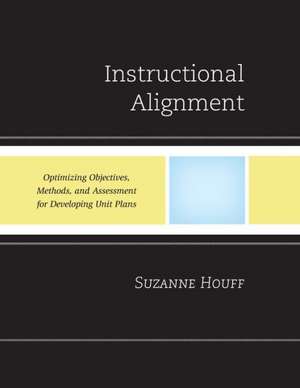
Instructional Alignment: Optimizing Objectives, Methods, and Assessment for Developing Unit Plans
Autor Suzanne Houffen Limba Engleză Paperback – 13 sep 2012
Houff guides the reader through the process of developing objectives that identify what the learners should know and be able to do at the end of the lesson. Next, the readers study assessment strategies and tools that correlate with the stated objective in order to accurately determine if the objective has been met. Direct and indirect instructional strategies are then explored to provide the reader with a variety of options or methods to best meet the objective. Final alignment is demonstrated through a project-based unit example that provides a visual representation of theory into practice. With the concluding glossary of current trends and terms in instructional design, readers will finish this key guidebook with a thorough understanding of effective instruction, as well as the capacity to adopt methodical, tested, lessons in the classroom.
Preț: 217.07 lei
Preț vechi: 292.31 lei
-26%
Puncte Express: 326
Carte tipărită la comandă
Livrare economică 07-21 noiembrie
Livrare prin curier în România Termenul estimat este afișat lângă disponibilitate.
Transport gratuit de la 400.00 lei Plată online sau ramburs, în funcție de opțiunile comenzii.
Retur gratuit în 14 zile Comandă securizată și suport în română.
Specificații
ISBN-13: 9781607094531
ISBN-10: 1607094533
Pagini: 96
Ilustrații: 6 b/w illustrations; 27 tables
Dimensiuni: 204 x 278 x 10 mm
Greutate: 0.24 kg
Ediția:New.
Editura: Bloomsbury Publishing
Colecția R&L Education
Locul publicării:New York, United States
ISBN-10: 1607094533
Pagini: 96
Ilustrații: 6 b/w illustrations; 27 tables
Dimensiuni: 204 x 278 x 10 mm
Greutate: 0.24 kg
Ediția:New.
Editura: Bloomsbury Publishing
Colecția R&L Education
Locul publicării:New York, United States
Cuprins
Preface
Introduction
Chapter 1Planning: Designing a Plan for Effective Instruction
Chapter 2 Assessment: Using assessment to drive instruction
Chapter 3Instruction: Instructional strategies for maximum learning.
Chapter 4Alignment: A Project-based Learning Unit
Appendices
A:Lesson Plan Template
B:Unit Template
Glossary
References
About the Author
Introduction
Chapter 1Planning: Designing a Plan for Effective Instruction
Chapter 2 Assessment: Using assessment to drive instruction
Chapter 3Instruction: Instructional strategies for maximum learning.
Chapter 4Alignment: A Project-based Learning Unit
Appendices
A:Lesson Plan Template
B:Unit Template
Glossary
References
About the Author
Recenzii
Instructional Alignment provides readers with a comprehensive look at effective standards-based planning and instruction through the use of meaningful assessment. With case studies and practical tools provided, the text is a 'must have' for all classroom teachers as they work to align standards to assessments, planning, and instruction in a common sense way to meet the needs of all learners.
With Instructional Alignment, Dr. Suzanne Houff extends her excellent series of books of practical advice for classroom teachers. Based on sound scholarship but told through a practitioner's voice, Dr. Houff shows the importance of planning, the purposes of assessment, and variety of instructional techniques that can be aligned to achieve student success. Case studies are engaging while illustrating the concept at hand. This book provides practical advice as well as many references for further study. It can serve as a pocket mentor for a new teacher or a handbook for those supervising classroom teachers. In my role as an educational consultant, I am always looking for resources to recommend to teachers and administrators. This book is definitely on my 'go to' list for best practices.
With Instructional Alignment, Dr. Suzanne Houff extends her excellent series of books of practical advice for classroom teachers. Based on sound scholarship but told through a practitioner's voice, Dr. Houff shows the importance of planning, the purposes of assessment, and variety of instructional techniques that can be aligned to achieve student success. Case studies are engaging while illustrating the concept at hand. This book provides practical advice as well as many references for further study. It can serve as a pocket mentor for a new teacher or a handbook for those supervising classroom teachers. In my role as an educational consultant, I am always looking for resources to recommend to teachers and administrators. This book is definitely on my 'go to' list for best practices.