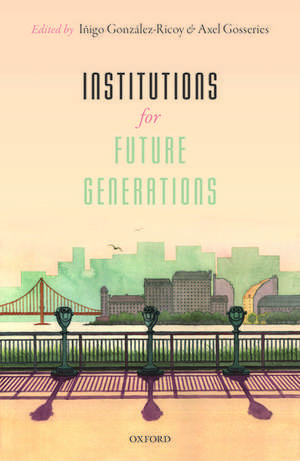
Institutions For Future Generations
Editat de Iñigo González-Ricoy, Axel Gosseriesen Limba Engleză Hardback – 22 dec 2016
Preț: 825.02 lei
Preț vechi: 1195.38 lei
-31%
Puncte Express: 1238
Carte tipărită la comandă
Livrare economică 03-08 decembrie
Livrare prin curier în România Termenul estimat este afișat lângă disponibilitate.
Transport gratuit pentru acest produs Plată online sau ramburs, în funcție de opțiunile comenzii.
Retur gratuit în 14 zile Comandă securizată și suport în română.
Specificații
ISBN-13: 9780198746959
ISBN-10: 0198746954
Pagini: 450
Dimensiuni: 169 x 239 x 29 mm
Greutate: 0.78 kg
Editura: OUP OXFORD
Colecția OUP Oxford
Locul publicării:Oxford, United Kingdom
ISBN-10: 0198746954
Pagini: 450
Dimensiuni: 169 x 239 x 29 mm
Greutate: 0.78 kg
Editura: OUP OXFORD
Colecția OUP Oxford
Locul publicării:Oxford, United Kingdom
V-ar putea interesa
-
 Tolerance: A Sensorial Orientation to PoliticsLars Tonder-12%Preț: 241.05 lei272.51 lei
 -
 Kant's Politics in ContextReidar Maliks-31%Preț: 724.31 lei1052.85 lei
 -
 A General Theory of Domination and JusticeFrank Lovett-21%Preț: 386.08 lei490.44 lei
 -
 -31%Preț: 870.45 lei1268.30 lei
 -
 Agricultural Input Subsidies: The Recent Malawi ExperienceEphraim Chirwa-34%Preț: 728.94 lei1096.86 lei
 -
 Democratic Justice and the Social ContractAlbert Weale-31%Preț: 826.20 lei1191.23 lei
 -
 -31%Preț: 773.47 lei1123.35 lei
 -
 -11%Preț: 374.78 lei421.08 lei
 -
 U.S.-India Security Relations: Engagement & Strategic PerspectivesMalcolm E Miller-27%Preț: 1055.43 lei1438.72 lei
Recenzii
This excellent collection of essays is devoted to the diagnosis and especially therapy of what is widely considered a flaw of current Western democracies: shorttermism- i.e., the prioritization of present over future benefits. [...] All in all, the contributions in this book are original, instructive, and exciting to read, especially given the urgency and seriousness of the subject matter.
wIñigo González-Ricoy and Axel Gosseries, the editors, deserve much praise from the outset for their laudable service of putting together what is (to my knowledge) the latest and to date perhaps most comprehensive volume on institutional responses to the widespread problem of "short-termism". ... this volume does an excellent service to students and scholars of intergenerational justice alike, and one can only hope that it will find many vigilant and engaged readers.
Excellent collection of essays ... the contributions in this book are original, instructive, and exciting to read, especially given the urgency and seriousness of the subject matter. The introduction and the contributions in part two equip the reader with the knowledge necessary to form a qualified opinion on the institutional changes proposed in parts three and four. Moreover, as I have argued, there is at least one package of proposed changes that promises to remedy short-termism and brings along other gains in terms of democracy and justice.
Perhaps the main flaw of democratic governments is that periodical elections induce a short time horizon and make it politically risky for governments to undertake projects that take a long time to mature. Measures for climate change abatement are the paradigmatic case. Even worse, in many modern governments, the actual and expected turnover of ministers is so high that their time horizon is truncated over and above the normal shortening effect produced by the electoral cycle. This path-breaking volume is the first to address this issue in its full depth and complexity.
One of the most important issues we face today is whether, to what extent, and how to address the interests of future generations. Much of the philosophical literature has considered this issue only from the perspective of moral principles. This excellent collection, with essays by leading scholars, considers the issue from the perspective of institutional design. The proposals ranging from a world climate bank to youth quotas on representative bodies to the management of pension funds -- are innovative, well considered and important. This volume will be of value not only to philosophers, but also policy analysts, economists and, indeed, anyone concerned with the quality of the lives yet to come.
The short-sightedness of elected governments is easily lamented. The hard part is figuring out what to do about it. This book represents the most systematic consideration to date of the prospects for designing political institutions to induce more future-oriented policymaking. The volume combines sharp analysis of the sources of short-termism in democratic politics with careful evaluation of institutional devices that might correct democracy's biases toward the present. Blending normative theory with political, psychological, economic, and legal analysis, this book offers a wide-ranging and thought-provoking exploration of one of the deepest challenges of democratic governance.
wIñigo González-Ricoy and Axel Gosseries, the editors, deserve much praise from the outset for their laudable service of putting together what is (to my knowledge) the latest and to date perhaps most comprehensive volume on institutional responses to the widespread problem of "short-termism". ... this volume does an excellent service to students and scholars of intergenerational justice alike, and one can only hope that it will find many vigilant and engaged readers.
Excellent collection of essays ... the contributions in this book are original, instructive, and exciting to read, especially given the urgency and seriousness of the subject matter. The introduction and the contributions in part two equip the reader with the knowledge necessary to form a qualified opinion on the institutional changes proposed in parts three and four. Moreover, as I have argued, there is at least one package of proposed changes that promises to remedy short-termism and brings along other gains in terms of democracy and justice.
Perhaps the main flaw of democratic governments is that periodical elections induce a short time horizon and make it politically risky for governments to undertake projects that take a long time to mature. Measures for climate change abatement are the paradigmatic case. Even worse, in many modern governments, the actual and expected turnover of ministers is so high that their time horizon is truncated over and above the normal shortening effect produced by the electoral cycle. This path-breaking volume is the first to address this issue in its full depth and complexity.
One of the most important issues we face today is whether, to what extent, and how to address the interests of future generations. Much of the philosophical literature has considered this issue only from the perspective of moral principles. This excellent collection, with essays by leading scholars, considers the issue from the perspective of institutional design. The proposals ranging from a world climate bank to youth quotas on representative bodies to the management of pension funds -- are innovative, well considered and important. This volume will be of value not only to philosophers, but also policy analysts, economists and, indeed, anyone concerned with the quality of the lives yet to come.
The short-sightedness of elected governments is easily lamented. The hard part is figuring out what to do about it. This book represents the most systematic consideration to date of the prospects for designing political institutions to induce more future-oriented policymaking. The volume combines sharp analysis of the sources of short-termism in democratic politics with careful evaluation of institutional devices that might correct democracy's biases toward the present. Blending normative theory with political, psychological, economic, and legal analysis, this book offers a wide-ranging and thought-provoking exploration of one of the deepest challenges of democratic governance.
Notă biografică
Iñigo González-Ricoy is Assistant Professor of Political Philosophy at the University of Barcelona. He has been postdoctoral fellow at the University of Louvain and Pompeu Fabra University and visiting fellow at Columbia University and Goethe University in Frankfurt. His research is in democratic and constitutional theory, and has been published in the Journal of Applied Philosophy, Social Theory and Practice, and Ratio Juris.Axel Gosseries is a Maitre de recherches at the Fonds de la Recherche Scientifique, Professor at the University of Louvain, Franz Weyr Fellow of the Czech Academy of Sciences, and Distinguished Visiting Professor at the Institute for Future Studies, Stockholm. He is the author of Penser la justice entre les générations (2004) and the co-editor of Intergenerational Justice (OUP, 2009, with Lukas Meyer). He has published numerous papers in philosophy, law, and economics journals, including the Journal of Political Philosophy, Politics, Philosophy & Economics, Loyola of Los Angeles Law Review, New York University Environmental Law Journal, International Economic Review, Economics & Philosophy, and the Journal of Environmental Economics and Management.