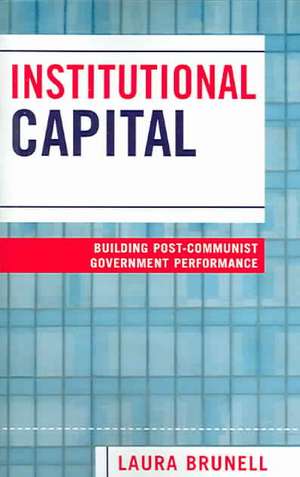
Institutional Capital: Building Post-Communist Government Performance
Autor Laura Brunellen Limba Engleză Paperback – 11 ian 2005
Preț: 354.00 lei
Preț vechi: 533.72 lei
-34%
Puncte Express: 531
Carte tipărită la comandă
Livrare economică 02-16 decembrie
Livrare prin curier în România Termenul estimat este afișat lângă disponibilitate.
Transport gratuit de la 400.00 lei Plată online sau ramburs, în funcție de opțiunile comenzii.
Retur gratuit în 14 zile Comandă securizată și suport în română.
Specificații
ISBN-13: 9780761829560
ISBN-10: 0761829563
Pagini: 270
Dimensiuni: 136 x 214 x 20 mm
Greutate: 0.46 kg
Ediția:New.
Editura: Bloomsbury Publishing
Colecția University Press of America
Locul publicării:New York, United States
ISBN-10: 0761829563
Pagini: 270
Dimensiuni: 136 x 214 x 20 mm
Greutate: 0.46 kg
Ediția:New.
Editura: Bloomsbury Publishing
Colecția University Press of America
Locul publicării:New York, United States
V-ar putea interesa
-
 The Oxford Handbook of Political ScienceRobert E. Goodin-11%Preț: 344.20 lei386.86 lei
 -
 -31%Preț: 530.51 lei769.65 lei
 -
 The Modern StateChristopher Pierson-15%Preț: 418.91 lei492.84 lei
 -
 New Parties in Government: In Power for the First TimeKris DeschouwerPreț: 163.87 lei
 -
 Preț: 309.27 lei
 -
 Secessionism and Separatism in Europe and Asia: To Have a State of One’s OwnJean-Pierre Cabestan-18%Preț: 1256.91 lei1532.82 lei
 -
 -18%Preț: 1257.26 lei1533.24 lei
 -
 Political Philosophy versus History?Jonathan FloydPreț: 230.37 lei
 -
 The Original ArgumentGlenn BeckPreț: 98.55 lei
 -
 The Future of PowerJoseph Nye, Jr.-26%Preț: 89.14 lei120.89 lei
 -
 -27%Preț: 1216.78 lei1659.05 lei
 -
 Shaping Health Policy: Case Study Methods and AnalysisMark ExworthyPreț: 347.84 lei
 -
 American PoliticsJon RoperPreț: 80.43 lei
Cuprins
Chapter 1 Making Post-Communist Democracies Work: State-Society Relations in Post-Communist Europe; Civil Society and State Performance; Civic Traditions, Economic Development and the State Variation in Performance within Regimes; Explaining Performance; Link
Chapter 2 Measuring Institutional Capital and Research Methods: Analytic Conceptualization and Terminology; Conceptualizing the Relationship Between Institutional Capital and Performance; Operationalizing Institutional Capital; State Contributions to Institut
Chapter 3 The State and Institutional Capital: Governing the Post-Communist City: Components of the Local State's Institutional Capital; Discursiveness; Information Gathering and Dissemination Strategies; Bureaucratizing Public In formation; Institutionalizin
Chapter 4 Raising Institutional Capital in Civil Society: Components of Civil Society's Institutional Capital; Third Sector Heterogeneity: Heterogeneity of Group Type and Size; Heterogeneity of Funding Sources; Horizontal Links among Activists; Activity Acros
Chapter 5 New Stocks of Institutional Capital and Prospects for Performance: Discourse and Protest in Krakow's Stock of Institutional Capital; Institutional Capital: Continuity or Change?; Repertorial Continuity; Repertorial Expansion or Contraction?; Krakow'
Chapter 6 Putting Institutional Capital to Work: The Political Economy of Development Planning and Waste Disposal: Economic Planning and Waste Disposal Under State Socialism and Today: From Autarky to Governance; New Conditions and Strategies; Managing Waste
Chapter 7 Governing Women: Domestic Violence and the Politics of Institutionalizing Women's Social Rights: Social Rights and Gender in Post-Communist Poland: Family Law and Domestic Violence; Domestic Violence in Poland; The Institutional Terrain of Gen
Chapter 8 Historical Sources of Institutional Capital: Development, Class Composition and Civic Traditions in Krakow; Development; Self-Government, Class, and Civic Traditions; Development in the 19th Century; Class and Civic Traditions in the 19th Century; C
Chapter 9 Opposition Movements Influences on Institutional Capital: Krakow: The Intellectual's City in a Worker's Era; Workers' Srodowiska; Church-based Srodowiska; Student Srodowiska; Intelligentsia Srodowiska; State-Society Relations
Chapter 10 Institutional Capital and Post-Communist State Performance: Beyond Civic Traditions; State Initiative; Embedding the State: Creating Partners in Performance; Two Types of Post-Communist Performance; Final Remarks
Chapter 11 Appendices: Groups Surveyed; Interviewees; Individual Questionnaire; Group Questionnaire; City Elite Survey
Chapter 12 Bibliography
Chapter 13 Index
Chapter 2 Measuring Institutional Capital and Research Methods: Analytic Conceptualization and Terminology; Conceptualizing the Relationship Between Institutional Capital and Performance; Operationalizing Institutional Capital; State Contributions to Institut
Chapter 3 The State and Institutional Capital: Governing the Post-Communist City: Components of the Local State's Institutional Capital; Discursiveness; Information Gathering and Dissemination Strategies; Bureaucratizing Public In formation; Institutionalizin
Chapter 4 Raising Institutional Capital in Civil Society: Components of Civil Society's Institutional Capital; Third Sector Heterogeneity: Heterogeneity of Group Type and Size; Heterogeneity of Funding Sources; Horizontal Links among Activists; Activity Acros
Chapter 5 New Stocks of Institutional Capital and Prospects for Performance: Discourse and Protest in Krakow's Stock of Institutional Capital; Institutional Capital: Continuity or Change?; Repertorial Continuity; Repertorial Expansion or Contraction?; Krakow'
Chapter 6 Putting Institutional Capital to Work: The Political Economy of Development Planning and Waste Disposal: Economic Planning and Waste Disposal Under State Socialism and Today: From Autarky to Governance; New Conditions and Strategies; Managing Waste
Chapter 7 Governing Women: Domestic Violence and the Politics of Institutionalizing Women's Social Rights: Social Rights and Gender in Post-Communist Poland: Family Law and Domestic Violence; Domestic Violence in Poland; The Institutional Terrain of Gen
Chapter 8 Historical Sources of Institutional Capital: Development, Class Composition and Civic Traditions in Krakow; Development; Self-Government, Class, and Civic Traditions; Development in the 19th Century; Class and Civic Traditions in the 19th Century; C
Chapter 9 Opposition Movements Influences on Institutional Capital: Krakow: The Intellectual's City in a Worker's Era; Workers' Srodowiska; Church-based Srodowiska; Student Srodowiska; Intelligentsia Srodowiska; State-Society Relations
Chapter 10 Institutional Capital and Post-Communist State Performance: Beyond Civic Traditions; State Initiative; Embedding the State: Creating Partners in Performance; Two Types of Post-Communist Performance; Final Remarks
Chapter 11 Appendices: Groups Surveyed; Interviewees; Individual Questionnaire; Group Questionnaire; City Elite Survey
Chapter 12 Bibliography
Chapter 13 Index