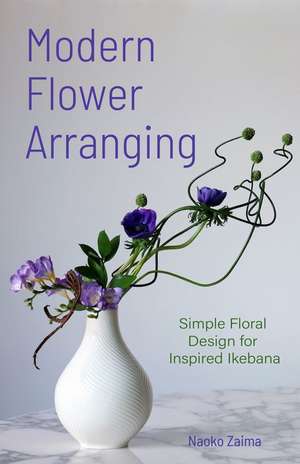
Inspired Ikebana
Autor Naoko Zaimaen Limba Engleză Paperback – 6 dec 2022
Preț: 217.43 lei
Puncte Express: 326
Preț estimativ în valută:
38.49€ • 44.71$ • 33.34£
38.49€ • 44.71$ • 33.34£
Carte disponibilă
Livrare economică 09-23 februarie
Preluare comenzi: 021 569.72.76
Specificații
ISBN-13: 9781642508628
ISBN-10: 1642508624
Pagini: 288
Ilustrații: color photographs throughout; 100 Illustrations, unspecified
Dimensiuni: 189 x 232 x 20 mm
Greutate: 0.7 kg
Editura: Turner Publishing Company
ISBN-10: 1642508624
Pagini: 288
Ilustrații: color photographs throughout; 100 Illustrations, unspecified
Dimensiuni: 189 x 232 x 20 mm
Greutate: 0.7 kg
Editura: Turner Publishing Company
Cuprins
- History of ikebana.
- There are various theories about the origin of ikebana. But it is thought that ikebana was started as Buddhist ritual flowers. Then ikebana was established as traditional Japanese art of flowers during Muromachi Period. (late 14th century ? mid 16th century)
- Why Ikebana?
- Even with small amounts of materials (about 3-10 stems), you can make a dynamic, yet poetic arrangement.
- With big amounts of materials, you can also create gorgeous arrangement.
- Dialogue with flowers. Dialogue with the space. Dialog with yourself. (Connecting with inner self.)
- From minimal to dynamic style.
- Essential tools for ikebana.
- Kenzan. (Flower frog)
- How to choose a useful size and type of kenzan. (No small kenzan, they can't hold materials firmly.)
- Ikebana scissors.
- Where to buy Kenzan, scissors, and other tools? (Most things are now available on Amazon.)
- Other useful tools for ikebana. (Green wire, brown wire, pliers, saw, etc.)
- Basic style with Kenzan.
- Suitable vessel.
- How to use kenzan well to fix materials firmly.
- How to arrange branches? (Bending branches technique.)
- Vertical composition & Horizontal composition.
- Basic style with vase.
- Suitable vases.
- Cross-Bar fixture to fix materials firmly.
- Vertical composition & Horizontal composition.
- Being conscious of Negative Space.
- Negative space is also a part of the work.
- One kind of material arrangement.
- By using 7-10 stems of 1 kind of flower to create a beautiful arrangement. (Flowers from the grocery markets like Whole Foods or Trader Joe's are sold by bunch.)
- How to make a focal point.
- Organically-moving arrangement.
- A variety of materials arrangement.
- Gorgeous arrangement.
- Big arrangement.
- Arrangement on the floor.
- Wall decoration.
- Using recycling materials. (Dry materials.)
- Hanging arrangement with wall vases.
- Wreaths. (One of kind style wreaths.)
- Centerpiece arrangement for table.
- Floating arrangement. (Especially for summer.)
- 360 degrees arrangement for table.
- Nice for a dinner party.
- Wabi-sabi arrangement.
- Simplified arrangement.
- The beauty of less is more.
- The beauty in imperfection.
- Only flowers arrangements.
- Only a few kinds of flowers with no leaves or branches.
- Organically-moving arrangement.
- Only leaves arrangement.
- Only a few kinds of leaves with no flowers or branches.
- Palm leaves, monstera, aspidistra, fern leaves, air plants, etc.
- Composition of mass and line.
- Intertwining plant materials.
- Only branches arrangement.
- Only a few kinds of branches with no flowers or branches.
- Composition of line.
- Vines.
- Glass vase arrangement.
- How to arrange flowers and leaves in a glass vase.
- Cleanly organize the inside of the glass vase.
- Two or more vases arrangement.
- By using multiple small vases to make a fun arrangement.
- This arrangement is useful for where the space is limited.
- Vegetable arrangement.
- Using kales, cabbages, Swiss chard, dills, asparagus, more.
- Arrangement like a sculpture.
- Techniques for personify flowers and plants.
- Color combinations of materials.
- Similar colors.
- Opposite colors.
- Pastel colors
- Vivid colors.
- Rustic and natural style arrangement.
- Create a rustic and natural yet sophisticated beauty to make a difference than other flower arrangement.
Notă biografică
Naoko Zaimais teaches classes about how to create ikebana arrangements and sells her arrangements through local stores. She is very affirming and believes that all Ikebana is precious, beautiful, and loveable?because it has been created using a sense of feeling and is a reflection of a person's spirit and state of mind. She has also recently started a minimalist jewelry business called The Sheek. She is from Japan but now lives in Santa Monica, California.