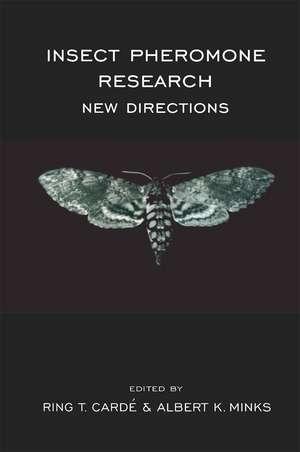
Insect Pheromone Research
Autor R T Carde, A K Minksen Limba Engleză Paperback – 17 oct 2012
Preț: 1904.93 lei
Preț vechi: 2323.07 lei
-18%
Puncte Express: 2857
Carte tipărită la comandă
Livrare economică 30 noiembrie-14 decembrie
Livrare prin curier în România Termenul estimat este afișat lângă disponibilitate.
Transport gratuit pentru acest produs Plată online sau ramburs, în funcție de opțiunile comenzii.
Retur gratuit în 14 zile Comandă securizată și suport în română.
Specificații
ISBN-13: 9781461379263
ISBN-10: 1461379261
Pagini: 684
Ilustrații: XXIII, 684 p.
Dimensiuni: 152 x 229 x 38 mm
Greutate: 1.01 kg
Ediția:Softcover Reprint of the Original 1st 1997 edition
Editura: Springer Us
Locul publicării:New York, NY, United States
ISBN-10: 1461379261
Pagini: 684
Ilustrații: XXIII, 684 p.
Dimensiuni: 152 x 229 x 38 mm
Greutate: 1.01 kg
Ediția:Softcover Reprint of the Original 1st 1997 edition
Editura: Springer Us
Locul publicării:New York, NY, United States
Public țintă
ResearchCuprins
I. Control of Pheromone Production.- 1. Neural and Endocrine Control of Pheromone Production and Release in Cockroaches.- 2. Control of Pheromone Production in Moths.- 3. Regulation of Pheromone Production in Lepidoptera: The Need for an Ecological Perspective.- 4. Interaction of PBAN with Biosynthetic Enzymes.- 5. PBAN Regulation of Sex Pheromone Biosynthesis in.- 6.The Effect of PBAN on Conversion of Fatty Acyls to Pheromone Aldehydes in Female.- 7. Structure—Function Relationships of PBAN/MRCH.- 8. Multifunctionality of PBAN-Related Neuropeptides: Melanotropic Activity of FXPRLamide Peptides.- 9. Physiological and Cellular Mode of Action of Pheromone Biosynthesis Activating Neuropeptide (PBAN) in the Control of Pheromonotropic Activity of Female Moths.- 10.Mode of Action of Pheromone Biosynthesis Activating Neuropeptide inBombyx mori.- 11.Involvement of the Nervous System with PBAN.- Rapporteur’s Summary.- 12.Pheromonotropism in Insects: Molecules to Molecular Biology.- II. Sensory Processing of Pheromone Signals.- 13.Sensory Processing of Pheromone Signals.- 14. Molecular Mechanisms of Pheromone Perception in Insect Antennae.- 15. Pheromone-Binding Proteins, Pheromone Recognition, and Signal Transduction in Moth Olfaction.- 16. Olfactory Coding Mechanisms for Pheromone and Interspecific Signal Information in Related Species of Moths.- 17. Antennal Lobe Projection Patterns of Pheromone-Specific Olfactory Receptor Neurons in Moths.- 18. Anatomical and Physiological Diversity in the Central Processing of Sex-Pheromone Information in Different Moth Species.- 19. Neuroendocrine Factors in the Photoperiodic Control of Male Moth Responsiveness to Pheromone.- Rapporteur’s Summary.- 20. Neurobialogy of Pheromonal Signal Processing in Insects.- III. Neuroethology ofPheromone-Mediated Responses.- 21.Odor Plumes and the Signal They Provide.- 22. A Tentative Intercausal Nexus and Its Computer Model on Insect Orientation in Windborne Pheromone Plumes.- 23.Pheromone-Mediated Flight in Moths.- 24.Modulation of Pheromone-Mediated Flight in Male Moths.- 25.Mechanisms of Flight of Male Moths to Pheromone.- 26. Pheromone Processing in the Lateral Accessory Lobes of the Moth Brain: Flip-Flopping Signals Related to Zigzagging Upwind Walking.- 27. Active Behavior and Reflexive Responses: Another Perspective on Odor-Modulated Locomotion.- Rapporteur’s Summary.- 28.Neuroethological Study of Pheromone-Modulated Responses.- IV. Use of Pheromones in Direct Control.- 29.Mechanisms of Mating Disruption in Moths.- 30. Measuring Pheromone Concentrations in Cotton Fields with the EAG Method.- 31. Measuring Pheromone Dispersion in the Field with the Single Sensillum Recording Technique.- 32.Mating Disruption of the Codling Moth.- 33.Mating Disruption in European Vineyards.- 34. Successful Area-Wide Program to Control Pink Bollworm by Mating Disruption.- 35.Integrating Pheromones into Vegetable Crop Production.- 36. Mating Disruption of the Lightbrown Apple Moth: Portable Electroantennogram Equipment and Other Aspects.- 37. Disruption of Semiochemical-Mediated Aggregation in Bark Beetles.- 38.First Steps in the Use of Aphid Sex Pheromones.- Rapporteur’s Summary.- 39.Putting Pheromones to Work: Paths Forward for Direct Control.- V. Evolution of Pheromone Communication.- 40. Pheromone and Morphology-Based Phylogenies in New Zealand Tortricid Moths.- 41. A Phylogenetic Analysis of Pheromone Communication in Primitive Moths.- 42. Evolution of Male Lepidopteran Pheromones:A Phylogenetic Perspective.- 43. Evolution of Sex Pheromone Communication inPlant-Feeding Scarab Beetles.- 44. A Genetic Study on Pheromonal Communication in TwoCtenopseustisMoths.- 45.Genetics of Pheromone Communication in the Cabbage Looper MothTrichoplusia ni.- 46. Effects of Interspecific Hybridization betweenHeliothis virescensandHeliothis subflexaon the Sex Pheromone Communication System.- 47. Can Population Genetic Simulations Help to Interpret Pheromone Evolution?.- Rapporteur’s Summary.- 48.Genetic and Phylogenetics in the Evolution of Sex Pheromones.- References.