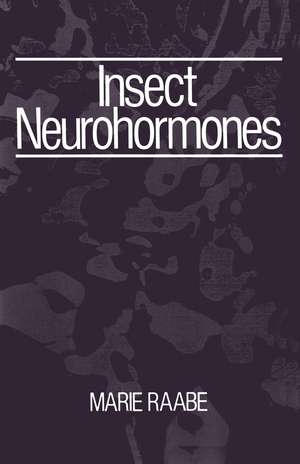
Insect Neurohormones
Autor Marie Raabeen Limba Engleză Paperback – 3 apr 2012
Preț: 379.80 lei
Puncte Express: 570
Carte tipărită la comandă
Livrare economică 08-22 decembrie
Livrare prin curier în România Termenul estimat este afișat lângă disponibilitate.
Transport gratuit de la 400.00 lei Plată online sau ramburs, în funcție de opțiunile comenzii.
Retur gratuit în 14 zile Comandă securizată și suport în română.
Specificații
ISBN-13: 9781468440157
ISBN-10: 1468440152
Pagini: 372
Ilustrații: XVI, 352 p.
Dimensiuni: 152 x 229 x 21 mm
Greutate: 0.54 kg
Ediția:Softcover reprint of the original 1st ed. 1982
Editura: Springer
Locul publicării:New York, NY, United States
ISBN-10: 1468440152
Pagini: 372
Ilustrații: XVI, 352 p.
Dimensiuni: 152 x 229 x 21 mm
Greutate: 0.54 kg
Ediția:Softcover reprint of the original 1st ed. 1982
Editura: Springer
Locul publicării:New York, NY, United States
V-ar putea interesa
-
 -20%Preț: 296.03 lei371.68 lei
 -
 Insect Physiological Ecology: Mechanisms and PatternsSteven L. Chown-27%Preț: 467.41 lei642.61 lei
 -
 -28%Preț: 383.88 lei536.16 lei
 -
 -27%Preț: 393.73 lei539.32 lei
 -
 The Infested Mind: Why Humans Fear, Loathe, and Love InsectsJeffrey LockwoodPreț: 170.00 lei
 -
 Biology Blood Sucking Insects 2edM. J. Lehane-11%Preț: 549.41 lei617.32 lei
 -
 Conservation BiologyAndrew S. Pullin-19%Preț: 506.65 lei625.49 lei
 -
 Journey to the AntsBert HölldoblerPreț: 239.25 lei
 -
 The Insects - An Outline of EntomologyP. J. Gullan-19%Preț: 460.08 lei568.01 lei
 -
 The Braconid and Ichneumonid Parasitoid WaspsDonald L J Quicke-9%Preț: 1415.86 lei1555.89 lei
Public țintă
ResearchCuprins
1 Synthesis, Storage, and Release of Neurohormones.- 1.1. The Neurosecretory Cells.- 1.2. Neurohormone Release Sites.- 1.3. Neurohormones and Biogenic Amines.- 1.4. Conclusions.- 2 Control of Endocrine Gland Activity.- 2.1. Molting Gland.- 2.2. Corpora Cardiaca.- 2.3. Corpora Allata.- 3 Diapause.- 3.1. Imaginal Diapause.- 3.2. Pupal Diapause.- 3.3. Larval Diapause.- 3.4. Embryonic Diapause.- 3.5. Conclusions.- 4 Reproduction.- 4.1. Sex Determination.- 4.2. Gonial Mitosis and Meiosis.- 4.3. Differentiation of the Ovariole—Previtellogenesis.- 4.4. Vitellogenesis.- 4.5. Oostatic Hormone (Antigonadotropin).- 4.6. Spermatogenesis.- 4.7. Accessory Glands, Pheromone Production, Sexual Behavior.- 4.8. Ovulation.- 4.9, Egg Laying.- 4.10. Conclusions.- 5 Functioning of the Visceral Muscles.- 5.1. The Visceral Muscles: Innervation and Functioning.- 5.2. Source of Myotropic Factors, Multiplicity.- 5.3. Release Sites of Myotropic Factors.- 5.4. Reality of the Existence of Myotropic Factors.- 5.5. Separation and Identification of Active Factors.- 5.6. Mode of Action of Myotropic Factors.- 5.7. Conclusions.- 6 Morphological and Physiological Color Change.- 6.1. Morphological Color Change.- 6.2. Physiological Color Change.- 6.3. Conclusions.- 7 Behavior and Rhythmic Phenomena.- 7.1. Flight.- 7.2. Circadian Rhythms and Activity Level.- 7.3. Eclosion Rhythm.- 7.4. Endogenous Nerve Activity.- 7.5. Egg Care.- 7.6. Polymorphism and Phase.- 7.7. Conclusions.- 8 Osmoregulation.- 8.1. Techniques.- 8.2. Diuretic Hormone.- 8.3. Antidiuretic Hormone.- 8.4. Diuretic or Antidiuretic Function of Other Hormones.- 8.5. Purification of Diuretic and Antidiuretic Hormones.- 8.6. Mode of Action of Diuretic Hormone.- 8.7. Ion Metabolism.- 8.8. Conclusions.- 9 Metabolism.- 9.1. Proteases and Amylases.-9.2. Proteins.- 9.3. Carbohydrates.- 9.4. Lipids.- 9.5. Respiratory Metabolism.- 9.6. Purification of Metabolic Neurohormones.- 9.7. Metabolic Hormones of Vertebrates and Insects.- 9.8. Mode of Action of Metabolic Hormones.- 9.9. Conclusions.- 10 Neurohormones and Cuticle.- 10.1. Tanning.- 10.2. Plasticization.- 10.3. Melanization.- 10.4. Endocuticle Secretion.- 10.5. Disaggregation of Cell Fragments of the Wings.- 10.6. Diuresis Linked to Tanning.- 10.7. Puparium Formation.- 10.8. Interspecific Activity.- 10.9. Neurohormone Purification.- 10.10. Mode of Action of Tanning Hormones.- 10.11. Conclusions.- Concluding Remarks.- Addendum.- A.1. Synthesis, Storage, and Release of Neurohormones.- A.1.1. Neurophysin and Neurohormones.- A.1.2. Immunoreactive Compounds.- A.1.3. Brain Neurosecretory Cells.- A.1.4. Neurosecretory Cells of the Sympathetic Nervous System.- A.1.5. Peripheral Neurosecretory Cells.- A.1.6. Release Sites of Brain Neurosecretory Products.- A.2. Control of Endocrine Gland Activity.- A.2.1. Control of Brain Hormone Secretion.- A.2.2. Molting Gland Activation.- A.2.3. Molting Gland-Innervating Neurons.- A.2.4. Juvenile Hormone and Molting Gland Stimulation.- A.2.5. Brain Hormone Purification.- A.2.6. Ecdysone Production in the Ovary.- A.2.7. Ecdysone and Corpora Allata Activity.- A.2.8. Juvenile Hormone Esterase Regulation.- A.3. Diapause.- A.3.1. Pupal Diapause Regulation.- A.3.2. Embryonic Diapause.- A.4. Reproduction.- A.4.1. Vitellogenesis.- A.4.2. Ecdysone and Brain Neurosecretory Activity.- A.4.3. Origin of Antigonadotropins.- A.5. Functioning of the Visceral Muscles.- A.5.1. Proctolin Source Cells.- A.5.2. Myotropic Factors.- A.6. Morphological and Physiological Color Change.- A.6.1. Insect and Crustacean Chromactivating Factors.- A.7. Behavior and Rhythmic Phenomena.- A.7.1. Eclosion Hormone.- A.8. Osmoregulation.- A.8.1. Diuretic Hormone.- A.8.2. Origin of Diuretic Hormone.- A.8.3. Ion Regulation.- A.8.4. Mode of Action of Diuretic Hormone.- A.9. Metabolism.- A.9.1. Protease and Amylase Regulation.- A.9.2. Adipokinetic Hormone Interspecific Activity.- A.9.3. Hypertrehalosemic and Adipokinetic Hormones.- A.9.4. Insulinlike and Glucagonlike Substances in Insects.- A.10. Neurohormones and Cuticle.- A.10.1. A New Factor Involved in Pupariation.- Reviews and Monographs.- References.- Species Index.