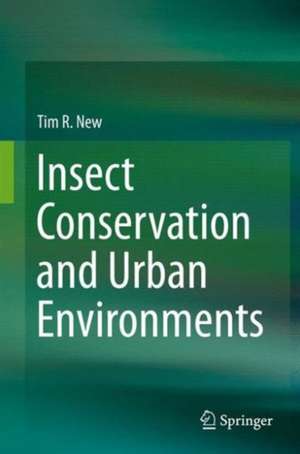
Insect Conservation and Urban Environments
Autor Tim R. Newen Limba Engleză Hardback – 29 sep 2015
Subliniem autoritatea incontestabilă a lui Tim R. New, profesor emerit a cărui cercetare a fundamentat decenii de strategii în entomologie. În lucrarea Insect Conservation and Urban Environments, autorul își extinde expertiza de la studiile axate pe biodiversitatea sălbatică — regăsite în volume precum Insect Conservation sau Insect Conservation in Australia: Why and How — către frontiera critică a spațiilor antropice. Considerăm această ediție prima sinteză globală care analizează riguros modul în care urbanizarea forțează adaptarea insectelor, oferind un cadru teoretic și practic necesar într-o eră a expansiunii urbane accelerate.
Notăm cu interes structura logică a celor 11 capitole, care ghidează cititorul de la înțelegerea gradienților urban-rural și a bunăstării insectelor, până la impactul specific al speciilor invazive și al managementului dăunătorilor. Lucrarea completează perspectiva oferită de Urban Habitats de C. Philip Wheater, adăugând o analiză tehnică detaliată asupra conectivității peisajului și a habitatelor novatoare, precum acoperișurile verzi, elemente care lipsesc din ghidurile generale de habitate. De asemenea, se distinge de Routledge Handbook of Urban Biodiversity prin focalizarea strictă pe grupurile taxonomice ale insectelor, oferind soluții de management aplicabile atât la nivel guvernamental, cât și pentru grupurile de tip „citizen scientist”.
Abordarea lui Tim R. New este una pragmatică: autorul nu se limitează la inventarierea declinului, ci explorează opțiunile de conservare în spațiile deschise din zonele construite. De la impactul poluării luminoase la fragmentarea habitatelor, volumul integrează date recente pentru a demonstra că mediul urban poate deveni un refugiu pentru biodiversitate dacă este gestionat corect. Este o resursă esențială pentru cercetători, oferind o bază solidă pentru viitoarele politici de mediu.
Preț: 953.95 lei
Preț vechi: 1163.35 lei
-18%
Carte disponibilă
Livrare economică 23 octombrie-06 noiembrie
Specificații
ISBN-10: 3319212230
Pagini: 260
Ilustrații: XIII, 244 p. 61 illus., 13 illus. in color.
Dimensiuni: 160 x 241 x 19 mm
Greutate: 0.61 kg
Ediția:1st ed. 2015
Editura: Springer
Locul publicării:Cham, Switzerland
V-ar putea interesa
-
 Preț: 129.16 lei
 -
 Love Canal Revisited: Race, Class, and Gender in Environmental ActivismElizabeth D. BlumPreț: 224.63 lei
 -
 Preț: 102.97 lei
 -
 The Wisdom of WaterAlanna MoorePreț: 134.23 lei
 -
 Insect Conservation and IslandsTim R. New-20%Preț: 636.75 lei795.94 lei
 -
 Preț: 228.39 lei
 -
 Principles of Ecosystem StewardshipF Stuart Chapin IiiPreț: 472.07 lei
 -
 Fencing for ConservationMichael J. Somers-18%Preț: 920.32 lei1122.34 lei
 -
 WaterAllerd StikkerPreț: 85.01 lei
 -
 -18%Preț: 1117.55 lei1362.87 lei
 -
 Insects, Fire and ConservationTim R. New-15%Preț: 645.39 lei759.27 lei
 -
 Rewilding European LandscapesHenrique M. PereiraPreț: 428.33 lei
 -
 Ecology and Conservation of Mountaintop grasslands in BrazilGeraldo Wilson Fernandes-18%Preț: 1206.25 lei1471.04 lei
 -
 -24%Preț: 1652.93 lei2174.91 lei
 -
 Alien Species and Insect ConservationTim R. New-15%Preț: 646.64 lei760.76 lei
 -
 Coastal Change, Ocean Conservation and Resilient CommunitiesMarcha Johnson-15%Preț: 618.91 lei728.14 lei
 -
 High Mountain Conservation in a Changing WorldJordi CatalanPreț: 442.60 lei
 -
 Mutualisms and Insect ConservationTim R. New-18%Preț: 951.47 lei1160.33 lei
 -
 Forests and Insect Conservation in AustraliaTim R. New-15%Preț: 649.22 lei763.78 lei
 -
 Conservation of the Richmond Birdwing Butterfly in AustraliaDonald P. A. Sands-18%Preț: 907.16 lei1106.29 lei
 -
 -18%Preț: 913.61 lei1114.15 lei
 -
 -18%Preț: 904.00 lei1102.43 lei
Public țintă
ResearchDe ce să citești această carte
Recomandăm această lucrare cercetătorilor și studenților la ecologie care doresc să înțeleagă dinamica speciilor în orașe. Cititorul câștigă o viziune de ansamblu asupra strategiilor de conservare urbană, de la designul habitatelor la educarea publicului. Este un instrument teoretic și practic indispensabil pentru oricine studiază entomologia aplicată și planificarea urbană sustenabilă, scris de unul dintre cei mai respectați specialiști în domeniu.