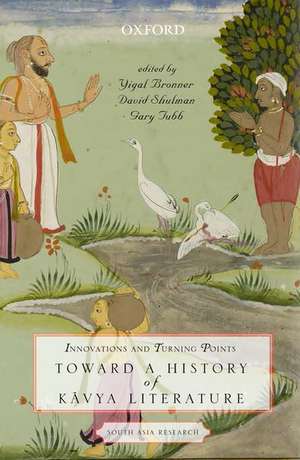
Innovations and Turning Points: Toward a History of Kāvya Literature: South Asia Research
Editat de Yigal Bronner, David Shulman, Gary Tubben Limba Engleză Hardback – 8 ian 2015
Din seria South Asia Research
- 32%
 Preț: 3995.32 lei
 - 33%
 Preț: 601.30 lei
 - 30%
 Preț: 544.81 lei
 - 32%
 Preț: 536.42 lei
 - 33%
 Preț: 559.21 lei
 - 31%
 Preț: 1063.59 lei
 - 31%
 Preț: 1034.88 lei
 - 33%
 Preț: 974.03 lei
 - 32%
 Preț: 1108.06 lei
 - 33%
 Preț: 966.26 lei
 - 31%
 Preț: 808.75 lei
 - 31%
 Preț: 795.85 lei
 - 31%
 Preț: 604.28 lei
 - 29%
 Preț: 536.30 lei
 - 30%
 Preț: 499.87 lei
 - 31%
 Preț: 742.99 lei
 - 31%
 Preț: 701.55 lei
 - 31%
 Preț: 1161.70 lei
 - 34%
 Preț: 789.34 lei
 - 33%
 Preț: 663.05 lei
 - 31%
 Preț: 573.26 lei
 - 30%
 Preț: 1379.05 lei
 - nou
 Preț: 470.26 lei
Preț: 414.07 lei
Puncte Express: 621
Carte disponibilă
Livrare economică 07-21 noiembrie
Livrare express 24-30 octombrie pentru 136.70 lei
Livrare prin curier în România Termenul estimat este afișat lângă disponibilitate.
Transport gratuit pentru acest produs Plată online sau ramburs, în funcție de opțiunile comenzii.
Retur gratuit în 14 zile Comandă securizată și suport în română.
Specificații
ISBN-13: 9780199453559
ISBN-10: 0199453551
Pagini: 816
Ilustrații: 2 b/w illustrations
Dimensiuni: 167 x 247 x 57 mm
Greutate: 1.36 kg
Editura: OUP INDIA
Colecția OUP India
Seria South Asia Research
Locul publicării:Delhi, India
ISBN-10: 0199453551
Pagini: 816
Ilustrații: 2 b/w illustrations
Dimensiuni: 167 x 247 x 57 mm
Greutate: 1.36 kg
Editura: OUP INDIA
Colecția OUP India
Seria South Asia Research
Locul publicării:Delhi, India
V-ar putea interesa
-
 52 Ways Of Looking At A PoemRuth Padel-20%Preț: 74.07 lei92.54 lei
 -
 A Life in LettersWilliam WordsworthPreț: 109.78 lei
 -
 Palgrave's Golden TreasuryFrancis Turner Palgrave-17%Preț: 84.14 lei101.43 lei
 -
 -24%Preț: 173.27 lei226.68 lei
 -
 Poetry of the Passion: Studies in Twelve Centuries of English VerseJ. A. W. Bennett-19%Preț: 350.69 lei435.31 lei
 -
 The Force of PoetryChristopher Ricks-28%Preț: 400.72 lei557.85 lei
 -
 Allusion to the PoetsChristopher Ricks-19%Preț: 367.22 lei454.79 lei
 -
 Srinatha: The Poet who Made Gods and KingsVelcheru Narayana Rao-16%Preț: 339.43 lei404.87 lei
 -
 Heinemann Poetry Bookshelf: Keats Selected Poems and LettersRobert GittingsPreț: 189.04 lei
 -
 The Literature of IrelandTerence BrownPreț: 275.92 lei
 -
 The Father of the PredicamentsHeather MchughPreț: 87.40 lei
 -
 Poetry: The Ultimate GuideRichard Bradford-14%Preț: 250.90 lei291.04 lei
 -
 Modernism: A SourcebookSteven Matthews-24%Preț: 259.51 lei342.66 lei
 -
 The Blue Rock CollectionForrest GanderPreț: 88.77 lei
 -
 Khirbet KhizehS. YizharPreț: 76.88 lei
Recenzii
One of the merits of many essays in the volume is that their authors carefully read the works they had chosen for study. This might seem to be an obvious prerequisite, and yet there are histories of...literature that do not fulfill this condition. The book is full of quotations both in the original language and in translation (though one might wish to encounter less mistakes in theSanskrit), accompanied by insightful and minute analyses. Lawrence McCrea's closing paragraph of his essay...contains an important methodological observation, which has been put into practice in some of the best essays in the volume: "It is essential that we attempt to make sense of each poem as a unique object in its own right, which, while it may in some cases be usefully elucidated through terms and categories drawn from either western or indigenous critical traditions, can never simply be uncritically reduced to them" (p. 140).
This collection of essays suggests an ambition to draw kavya literature into the orbit of world literature studies in a sensitive and substantive way. Teachers in the global classroom, one surmises, regularly experience the difficulty of presenting kavya to uninitiated students. This is partly due to the linguistic and cultural gulf that separates any literature from readers outside of that literature's culture. This is a problem for all literary traditions experienced in translation. For kavya, however, the hindrance mostly lies in the sense one gets that the k?vya universe in all its variety has not been adequately translated for the general reader. Also lacking seem to be adequate reading strategies that are both compelling and user-friendly. That complex problem remains even with the publication of this book. Without a doubt, however, this collection is a turning point in kavya scholarship.
the chief delight of this book lies not so much in the range and extent of the area covered, or in the scholarship on display, which is hugely impressive, but in the particular lines quoted or the detailed discussion of a passage that stay in the mind.
This collection of essays suggests an ambition to draw kavya literature into the orbit of world literature studies in a sensitive and substantive way. Teachers in the global classroom, one surmises, regularly experience the difficulty of presenting kavya to uninitiated students. This is partly due to the linguistic and cultural gulf that separates any literature from readers outside of that literature's culture. This is a problem for all literary traditions experienced in translation. For kavya, however, the hindrance mostly lies in the sense one gets that the k?vya universe in all its variety has not been adequately translated for the general reader. Also lacking seem to be adequate reading strategies that are both compelling and user-friendly. That complex problem remains even with the publication of this book. Without a doubt, however, this collection is a turning point in kavya scholarship.
the chief delight of this book lies not so much in the range and extent of the area covered, or in the scholarship on display, which is hugely impressive, but in the particular lines quoted or the detailed discussion of a passage that stay in the mind.
Notă biografică
Yigal Bronner is Associate Professor in the Department of Asian Studies, the Hebrew University of Jerusalem.David Shulman is Renee Lang Professor of Humanistic Studies at the Hebrew University.Gary Tubb is Chair and Professor, Department of South Asian Languages and Civilizations, Division of the Humanities, the University of Chicago.
Cuprins
- Acknowledgements
- Introduction: Yigal Bronner, David Shulman, Gary Tubb
- I. Kalidasa and Early Classicism
- 1. Waking Aja: David Shulman
- 2. Baking Uma: Gary Tubb
- 3. On Beginnings: Introductions and Prefaces in Kavya: Herman Tieken
- II. The Developing Mahakavya
- 4. Pace and Pattern in the Kiratarjuniya Peter Khoroche
- 5. The Conquest of Cool: Theology and Aesthetics in Magha's Sisupalavadha: Lawrence McCrea
- 6. Kavya with Bells On: Yamaka in the Sisupalavadha: Gary Tubb
- 7. A Constant Flow of Pilgrims: Kavya and the Early History of the Kakawin:Tom Hunter
- III. The Masters of Prose
- 8. The Nail-Mark That Lit the Bedroom: Biography of a Compound: Yigal Bronner
- 9. Bana's Death in the Kadambari: Herman Tieken
- 10. Persons Compounded and Confounded: A Reading of Bana's Kadambari: David Shulman
- 11. On Bana's Boldness: Gary Tubb
- IV. The Sons of Bana
- 12. Something New in the Air: Abhinanda's Ramacarita and Its Ancestry: Gary Tubb
- 13. "The Plays of Bhavabhuti": Gary Tubb
- 14. The Poetics of Perspective in Rajasekhara's Young Ramayana: Lawrence McCrea
- 15. Murari's Depths: David Shulman
- V. Poets of the New Millennium
- 16. The Poetics of Ambivalence: Imagining and Unimagining the Political in Bilhana's Vikramankadevacarita: Yigal Bronner
- 17. Putting the Polish on the Poet's Efforts: Reading the Karnasundari as a Reflection on Poetic Creativity: Phyllis Granoff
- 18. Shadows: Charles Malamoud
- 19. Indian Kavya Poetry on the Far Side of the Himalayas: Translation, Transmission, Adaptation, Originality: Dan Martin
- VI. Regional Kavyas
- 20. Sakalya Malla's Telangana Ramaya?a: The Udara-Raghava: David Shulman
- 21. The Classical Past in the Mughal Present: The Brajbhasha Riti Tradition: Allison Busch
- 22. Poetry and Play in Kavikarnapura's Play within the Play: Gary Tubb
- 23. Modernity in Sanskrit Viswanatha Satyanarayana's Amrta-sarmistam Velcheru Narayana Rao
- 24. A Distant Mirror: Innovation and Change in the East Javanese Kakawin; Tom Hunter
- 25. Notes on Contributors
- Index