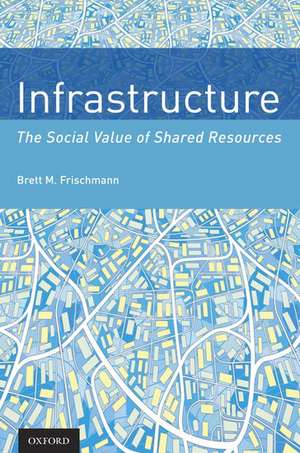
Infrastructure: The Social Value of Shared Resources
Autor Brett M. Frischmannen Limba Engleză Paperback – 17 ian 2013
Preț: 389.01 lei
Preț vechi: 497.02 lei
-22%
Puncte Express: 584
Carte tipărită la comandă
Livrare economică 31 iulie-05 august
Livrare prin curier în România Termenul estimat este afișat lângă disponibilitate.
Transport gratuit de la 400.00 lei Plată online sau ramburs, în funcție de opțiunile comenzii.
Retur gratuit în 14 zile Comandă securizată și suport în română.
Specificații
ISBN-13: 9780199975501
ISBN-10: 0199975507
Pagini: 436
Dimensiuni: 155 x 231 x 18 mm
Greutate: 0.5 kg
Editura: Oxford University Press
Colecția OUP USA
Locul publicării:New York, United States
ISBN-10: 0199975507
Pagini: 436
Dimensiuni: 155 x 231 x 18 mm
Greutate: 0.5 kg
Editura: Oxford University Press
Colecția OUP USA
Locul publicării:New York, United States
V-ar putea interesa
-
 Governing Knowledge CommonsBrett M. Frischmann-34%Preț: 405.45 lei611.28 lei
 -
 Construction Adjudication and Payments HandbookDominique Rawley QC-66%Preț: 476.03 lei1416.82 lei
 -
 Understanding the CDM 2007 RegulationsOwen V Griffiths-15%Preț: 483.92 lei569.31 lei
 -
 -4%Preț: 414.90 lei432.18 lei
 -
 Geographic Information ScienceGeorge Cho-9%Preț: 730.79 lei803.06 lei
 -
 Delay Analysis in Construction ContractsAnthony F. Caletka-19%Preț: 559.26 lei690.44 lei
 -
 The Jct 2011 Building Sub-ContractsPeter Barnes-8%Preț: 451.44 lei490.70 lei
 -
 Construction Contract LawJohn Adriaanse-19%Preț: 322.50 lei399.05 lei
 -
 Law Built EnvironmentDouglas WoodPreț: 416.93 lei
 -
 Dictionary of Construction TermsSimon Tolson-18%Preț: 1243.46 lei1516.40 lei
Recenzii
It is a rich book that neither ducks from challenging the disciplinary boundaries of economic theory nor from complex issues of spillover effects or hard-to-measure externalities. Frischmanns contribution includes the grand task of comparing and analysing the very much different types of infrastructurestransportations, telecommunications, environmental, intellectualin terms of managing commons.
Brett Frischmanns book is an important contribution to enhancing our understanding of the fundamental resources that shape our economic, social, and political opportunities. ... Most importantly, the books contribution lies in linking shared infrastructure resources we rely on daily, with a particular management regime that is capable of generating and maintaining the maximum social value within a community on nondiscriminatory terms.
Brett Frischmanns book is an important contribution to enhancing our understanding of the fundamental resources that shape our economic, social, and political opportunities. ... Most importantly, the books contribution lies in linking shared infrastructure resources we rely on daily, with a particular management regime that is capable of generating and maintaining the maximum social value within a community on nondiscriminatory terms.
Notă biografică
Brett M. Frischmann is Professor of Law at the Benjamin N. Cardozo School of Law, Yeshiva University, where he teaches intellectual property and internet law. After clerking for the Honorable Fred I. Parker of the U.S. Court of Appeals for the Second Circuit and practicing at Wilmer, Cutler & Pickering in Washington, DC, he joined the Loyola University, Chicago law faculty in 2002. He has held visiting appointments at Cornell, Fordham, and Syracuse. He is a co-author of one of the leading internet law casebooks entitled: Cyberlaw: Problems of Policy and Jurisprudence in the Information Age, 4th Edition, along with Patricia L. Bellia, Paul Schiff Berman, and David G. Post. Professor Frischmann has written articles for the Columbia Law Review, Cornell Law Review, University of Chicago Law Review, Review of Law and Economics, and many other leading journals.