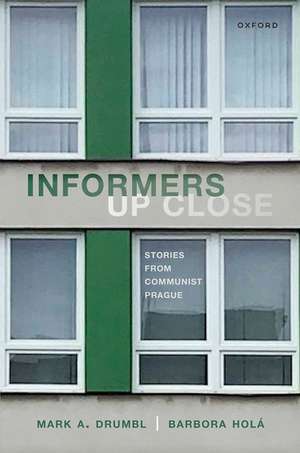
Informers Up Close: Stories from Communist Prague
Autor Mark A. Drumbl, Barbora Holáen Limba Engleză Hardback – 20 mai 2024
Preț: 616.41 lei
Preț vechi: 915.72 lei
-33%
Puncte Express: 925
Carte disponibilă
Livrare economică 12-18 noiembrie
Livrare prin curier în România Termenul estimat este afișat lângă disponibilitate.
Transport gratuit pentru acest produs Plată online sau ramburs, în funcție de opțiunile comenzii.
Retur gratuit în 14 zile Comandă securizată și suport în română.
Specificații
ISBN-13: 9780192855138
ISBN-10: 0192855131
Pagini: 272
Dimensiuni: 164 x 240 x 20 mm
Greutate: 0.6 kg
Editura: OUP OXFORD
Colecția OUP Oxford
Locul publicării:Oxford, United Kingdom
ISBN-10: 0192855131
Pagini: 272
Dimensiuni: 164 x 240 x 20 mm
Greutate: 0.6 kg
Editura: OUP OXFORD
Colecția OUP Oxford
Locul publicării:Oxford, United Kingdom
Recenzii
In Informers Up Close, Drumbl and Holá vividly humanize the castigated figure of the informer. This book is essential reading for scholars of transitional justice as it brilliantly opens up new pathways for the pursuit of reconciliation and rehabilitation.
Drumbl and Holá offer a deep understanding of the shifting emotions among informers, or 'victims who victimize', and their handlers. Informers Up Close treats this contentious subject with tenderness and humanity.
The stories of informers in this insightful book confirm their motives and emotions as manifold. Informing reflects the complexity of life in Communist Czechoslovakia.
Informers Up Close provides an intimate look into the motivations, loyalties, material incentives, and political rationales surrounding decisions to inform in Communist Czechoslovakia. Bringing informer files to life, this book humanizes informers while forcing us to consider the lingering damage wrought on societal trust.
Who are individuals who inform to authorities on their fellow citizens? Responsible citizens? Self-absorbed betrayers? Using Communist Czechoslovakia as a case study, the book provides a nuanced answer. It reveals informers as a diverse group of individuals driven by emotions such as fear, resentment, desire, and loyalty. The book is based on solid theoretical grounding in the area studies literature, and on thorough archival research. And while it delves into the situation in one country, it recalls time and again that informers are not specific to any region, political regime, or historical period, but are always here, always there, everywhere. So it is high time to learn more about them from a book which has been long overdue.
The very word 'informers' generates both unease and fascination, and reckoning with the legacy of informing is one of the most important and intricate tasks of societies emerging from authoritarianism or conflict. Drumbl and Holá make a major contribution to our understanding of both why people turn informers and how societies do and should address the consequences. Deftly combining intimate life stories with broader theoretical and historical analysis, Informers Up Close focuses on the Czech case and brings it to life with original and resourceful empirical analysis and compelling prose, as well as opening up significant questions and insights that will be applicable also in many other cases, and should be of interest to readers from a variety of fields.
By looking at collaborators with secret police, Drumbl and Holá fill a notable gap in the studies of transitional justice. Informers Up Close provides a fascinating qualitative study of dilemmas faced by ordinary and not so ordinary people in authoritarian regimes.
Mark Drumbl and Barbora Holá's new book 'Informers Up Close' is a beautifully written, riveting read and first-rate scholarship.
Informers Up Close is a cutting-edge and inspiring book that reimagines informers and fosters novel accountability measures for their past actions. Informers suffered resentment, they were ostracized, but transitional justice was too politicized to fairly consider the poignant reality of informing life. In light of the ubiquity of informing, this book offers a blueprint to reinvigorate transitional justice interventions in the future.
This meticulously researched and thought-provoking work is essential reading foranyone seeking to understand the complex interplay between power, control, andindividual agency in (pre-)authoritarian societies. Drumbl and Holá's compellinganalysis challenges readers to move beyond binary moral judgments, encouraging amore sophisticated engagement with the legacies of repression. By shedding light onthe intricate mechanisms of coercion, survival, and complicity, Informers Up Close notonly deepens our understanding of historical authoritarian regimes but also serves asa cautionary reflection on contemporary and future societies grappling with issues of political violence, social fragmentation, and moral ambiguities.
From a formal perspective, the book is masterful. It is well-structured, clearly written, and engaging. As a reader who appreciates clarity, I was particularly drawn to the succinct and informative introduction...[T]he stories presented in this book are both novel and deeply resonant.
Mark Drumbl and Barbora Holá have written an intriguing book - and a valuable one.
Informers Up Close provides insight into how law and society should speak to, with, and about informers. In addition, this is, simply, a beautifully written book. Academic jargon is replaced with attention to literary rhythm and flow, playful yet gracious and respectful of the stories retold and the people represented through them.
Drumbl and Holá are to be highly commended for this work. In its absorbing and detailed illumination of informing in Communist Czechoslovakia and the reasons why informers informed, this book has made an invaluable addition to the literature and to our understanding of a perennial practicethat is widely known but not always fully understood.
Mark Drumbl and Barbora Holá's Informers Up Close offers a micro-level, socio-legal analysis of the human cost of these processes, questioning the imperative of total transparency.
Drumbl and Holá offer a deep understanding of the shifting emotions among informers, or 'victims who victimize', and their handlers. Informers Up Close treats this contentious subject with tenderness and humanity.
The stories of informers in this insightful book confirm their motives and emotions as manifold. Informing reflects the complexity of life in Communist Czechoslovakia.
Informers Up Close provides an intimate look into the motivations, loyalties, material incentives, and political rationales surrounding decisions to inform in Communist Czechoslovakia. Bringing informer files to life, this book humanizes informers while forcing us to consider the lingering damage wrought on societal trust.
Who are individuals who inform to authorities on their fellow citizens? Responsible citizens? Self-absorbed betrayers? Using Communist Czechoslovakia as a case study, the book provides a nuanced answer. It reveals informers as a diverse group of individuals driven by emotions such as fear, resentment, desire, and loyalty. The book is based on solid theoretical grounding in the area studies literature, and on thorough archival research. And while it delves into the situation in one country, it recalls time and again that informers are not specific to any region, political regime, or historical period, but are always here, always there, everywhere. So it is high time to learn more about them from a book which has been long overdue.
The very word 'informers' generates both unease and fascination, and reckoning with the legacy of informing is one of the most important and intricate tasks of societies emerging from authoritarianism or conflict. Drumbl and Holá make a major contribution to our understanding of both why people turn informers and how societies do and should address the consequences. Deftly combining intimate life stories with broader theoretical and historical analysis, Informers Up Close focuses on the Czech case and brings it to life with original and resourceful empirical analysis and compelling prose, as well as opening up significant questions and insights that will be applicable also in many other cases, and should be of interest to readers from a variety of fields.
By looking at collaborators with secret police, Drumbl and Holá fill a notable gap in the studies of transitional justice. Informers Up Close provides a fascinating qualitative study of dilemmas faced by ordinary and not so ordinary people in authoritarian regimes.
Mark Drumbl and Barbora Holá's new book 'Informers Up Close' is a beautifully written, riveting read and first-rate scholarship.
Informers Up Close is a cutting-edge and inspiring book that reimagines informers and fosters novel accountability measures for their past actions. Informers suffered resentment, they were ostracized, but transitional justice was too politicized to fairly consider the poignant reality of informing life. In light of the ubiquity of informing, this book offers a blueprint to reinvigorate transitional justice interventions in the future.
This meticulously researched and thought-provoking work is essential reading foranyone seeking to understand the complex interplay between power, control, andindividual agency in (pre-)authoritarian societies. Drumbl and Holá's compellinganalysis challenges readers to move beyond binary moral judgments, encouraging amore sophisticated engagement with the legacies of repression. By shedding light onthe intricate mechanisms of coercion, survival, and complicity, Informers Up Close notonly deepens our understanding of historical authoritarian regimes but also serves asa cautionary reflection on contemporary and future societies grappling with issues of political violence, social fragmentation, and moral ambiguities.
From a formal perspective, the book is masterful. It is well-structured, clearly written, and engaging. As a reader who appreciates clarity, I was particularly drawn to the succinct and informative introduction...[T]he stories presented in this book are both novel and deeply resonant.
Mark Drumbl and Barbora Holá have written an intriguing book - and a valuable one.
Informers Up Close provides insight into how law and society should speak to, with, and about informers. In addition, this is, simply, a beautifully written book. Academic jargon is replaced with attention to literary rhythm and flow, playful yet gracious and respectful of the stories retold and the people represented through them.
Drumbl and Holá are to be highly commended for this work. In its absorbing and detailed illumination of informing in Communist Czechoslovakia and the reasons why informers informed, this book has made an invaluable addition to the literature and to our understanding of a perennial practicethat is widely known but not always fully understood.
Mark Drumbl and Barbora Holá's Informers Up Close offers a micro-level, socio-legal analysis of the human cost of these processes, questioning the imperative of total transparency.
Notă biografică
Mark A. Drumbl is the Class of 1975 Alumni Professor of Law and Director of the Transnational Law Institute at Washington & Lee University. He has been a Visiting Scholar at Oxford, Université de Paris, VU Amsterdam, University of Melbourne, and Queen's University Belfast. Along with editing anthologies, he authored Reimagining Child Soldiers in International Law and Policy (OUP) and Atrocity, Punishment, and International Law, both of which have been extensively reviewed and cited. His work has also been relied upon by courts. Drumbl has served as an expert witness in trial litigation, participated in treaty drafting, represented clients in genocide prosecutions and public inquiries, and consulted widely.Barbora Holá is Senior Researcher at the Netherlands Institute for the Study of Crime and Law Enforcement (NSCR) and Associate Professor at the Department of Criminal Law and Criminology at Vrije Universiteit Amsterdam. She has an interdisciplinary focus and studies international criminal justice, societal reconstruction after atrocities, and the aetiology of collective violence. Barbora has published extensively on these subjects and presented as an expert at international conferences and universities in Europe, Australia, Africa, and the Americas. Barbora co-edited The Perpetrators of International Crimes: Theories, Methods, and Evidence (OUP), and The Oxford Handbook on Atrocity Crimes (OUP).
Cuprins
- Preface and Acknowledgements
- Glossary of terms
- Acronyms
- Note about translations
- 1: Introduction
- 2: History of Communist Czechoslovakia and Its Secret Police
- 3: Reckoning with Informers and the Communist Past
- 4: Informer File-Stories
- 5: What Jumps Out: Informing as Intimacy and Emotions as Drivers
- 6: Transitional Takeaways
- 7: Informers Here, Informers There, Informers Everywhere