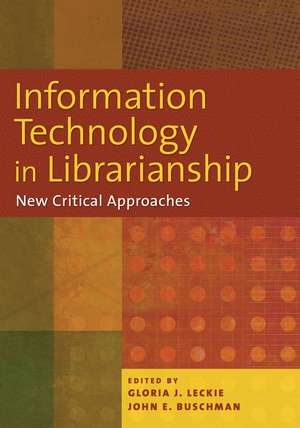
Information Technology in Librarianship: New Critical Approaches
Editat de Gloria J. Leckie, John E. Buschmanen Limba Engleză Paperback – 30 noi 2008
Preț: 346.66 lei
Preț vechi: 437.24 lei
-21%
Puncte Express: 520
Carte tipărită la comandă
Livrare economică 05-19 decembrie
Livrare prin curier în România Termenul estimat este afișat lângă disponibilitate.
Transport gratuit de la 400.00 lei Plată online sau ramburs, în funcție de opțiunile comenzii.
Retur gratuit în 14 zile Comandă securizată și suport în română.
Specificații
ISBN-13: 9781591586296
ISBN-10: 1591586291
Pagini: 304
Dimensiuni: 156 x 235 x 25 mm
Greutate: 0.48 kg
Editura: Bloomsbury Publishing
Colecția Libraries Unlimited
Locul publicării:New York, United States
ISBN-10: 1591586291
Pagini: 304
Dimensiuni: 156 x 235 x 25 mm
Greutate: 0.48 kg
Editura: Bloomsbury Publishing
Colecția Libraries Unlimited
Locul publicării:New York, United States
V-ar putea interesa
-
 Preț: 467.81 lei
 -
 RDA and Cartographic ResourcesPaige G. AndrewPreț: 442.19 lei
 -
 Diversity in Youth Literature: Opening Doors Through ReadingJamie Campbell NaidooPreț: 373.86 lei
 -
 Library Management 101: A Practical GuideDiane L. VelasquezPreț: 487.99 lei
 -
 Moys Classification and Thesaurus for Legal MaterialsElizabeth M. Moys-23%Preț: 2336.99 lei3035.06 lei
Cuprins
Introduction: Information Technologies and Libraries--Why Do We Need New Critical Approaches
Part One: Foundations
Chapter 1: Critical Theory of Technology: An Overview
Chapter 2: Surveillance and Technology: Contexts and Distinctions
Chapter 3: Cycles of Net Struggle, Lines of Net Flight
Chapter 4: A Quick Digital Fix? Changing Schools, Changing Literacies, Persistent Inequalities: A Critical, Contextual Analysis
Chapter 5: Theorizing the Impact of IT on Library-State Relations
Part Two: Applications
Chapter 6: The Prospects for an Information Science: The Current Absence of a Critical Perspecitive
Chapter 7: Librarianship and the Labor Process: Aspects of the Rationalization, Restructuring, and Intensification of Intellectual Work
Chapter 8: "Their Little Bit of Ground Slowly Squashed into Nothing": Technology, Gender and the Vanishing Librarian
Chapter 9: Children and Information Technology
Chapter 10: Open Source Software & Libraries
Chapter 11: Technologies of Social Regulation: An Examination of Library OPACs and Web Portals
Chapter 12: Libraries, Archives and Digital Preservation: A Critical Overview
Conclusion: Just How Critical Should Librarianship Be of Technology?
Index
About the Editors and Contributors
Part One: Foundations
Chapter 1: Critical Theory of Technology: An Overview
Chapter 2: Surveillance and Technology: Contexts and Distinctions
Chapter 3: Cycles of Net Struggle, Lines of Net Flight
Chapter 4: A Quick Digital Fix? Changing Schools, Changing Literacies, Persistent Inequalities: A Critical, Contextual Analysis
Chapter 5: Theorizing the Impact of IT on Library-State Relations
Part Two: Applications
Chapter 6: The Prospects for an Information Science: The Current Absence of a Critical Perspecitive
Chapter 7: Librarianship and the Labor Process: Aspects of the Rationalization, Restructuring, and Intensification of Intellectual Work
Chapter 8: "Their Little Bit of Ground Slowly Squashed into Nothing": Technology, Gender and the Vanishing Librarian
Chapter 9: Children and Information Technology
Chapter 10: Open Source Software & Libraries
Chapter 11: Technologies of Social Regulation: An Examination of Library OPACs and Web Portals
Chapter 12: Libraries, Archives and Digital Preservation: A Critical Overview
Conclusion: Just How Critical Should Librarianship Be of Technology?
Index
About the Editors and Contributors
Recenzii
.The new edition, subtitled New Critical Approaches, examines six types of critiques, among them feminist technology analysis and technological utopia, in a series of chapters by prominent scholars. Required reading for anyone interested in critical theory relating to technology.
Because this volume focuses on the issues and implications connected to technology, it will be accessible and useful for readers who are already familiar with critical discussions of technology as well as readers who are new to the conversation. . . . Because of the complexities and interconnections for each of the chapters, the volume as a whole is stronger than any of its individual parts. The individual sections and chapters, however, are also of considerable merit albeit on the more local level addressed in each. Any of the components, especially if supplemented by the introduction and conclusion, would be excellent reading for both students and professionals.
In this second edition of the 1993 classic, the authors present an insightful and thought-provoking sequel on information technology in librarianship from a critical perspective. . . it is in Part II that the practical application of information technology will be of interest to most readers.
.will interest librarians, as well as those in government, industry, research, and education.
Although it may appear that this book is aimed at academics and researchers in the field of information and library science, as well as practising librarians, anyone with an interest in the impact of technologies on society should find a number of relevant chapters and passages in this volume. An example is Chapter 9 about children and information technology that should be of interest to parents and teachers.
Because this volume focuses on the issues and implications connected to technology, it will be accessible and useful for readers who are already familiar with critical discussions of technology as well as readers who are new to the conversation. . . . Because of the complexities and interconnections for each of the chapters, the volume as a whole is stronger than any of its individual parts. The individual sections and chapters, however, are also of considerable merit albeit on the more local level addressed in each. Any of the components, especially if supplemented by the introduction and conclusion, would be excellent reading for both students and professionals.
In this second edition of the 1993 classic, the authors present an insightful and thought-provoking sequel on information technology in librarianship from a critical perspective. . . it is in Part II that the practical application of information technology will be of interest to most readers.
.will interest librarians, as well as those in government, industry, research, and education.
Although it may appear that this book is aimed at academics and researchers in the field of information and library science, as well as practising librarians, anyone with an interest in the impact of technologies on society should find a number of relevant chapters and passages in this volume. An example is Chapter 9 about children and information technology that should be of interest to parents and teachers.