Cantitate/Preț
Produs

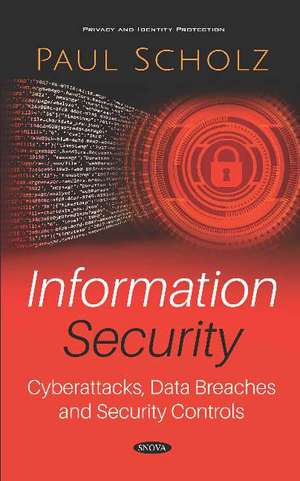
Information Security: Cyberattacks, Data Breaches and Security Controls

Autor Paul Scholz
en Limba Engleză Hardback – 30 iul 2019

Spre deosebire de documentația tehnică standard sau ghidurile de bune practici generale, volumul Information Security oferă o perspectivă critică bazată pe audituri reale și studii de caz din sectorul public american. Recomandăm această lucrare pentru abordarea sa pragmatică, ce transformă incidentele de securitate majore — precum breșele de la OPM sau vulnerabilitățile IRS — în lecții structurate despre controlul accesului și protecția datelor sensibile. Descoperim aici o analiză riguroasă a modului în care agențiile federale implementează strategiile de apărare cibernetică, oferind indicatori clari de performanță și deficiențe de control care pot fi extrapolați în orice infrastructură critică.

Structura volumului urmărește o progresie logică: de la cerințele legislative de partajare a informațiilor despre amenințări, la riscurile complexe ale lanțului de aprovizionare și până la evaluarea tehnică a sistemelor de detectare a intruziunilor. Reținem capitolele dedicate CDC și IRS, unde autorul Paul Scholz pune sub lupă acțiunile corective necesare pentru remedierea deficiențelor de program. Complementar volumului Information Security Across Federal Agencies, care se concentrează pe politicile generale de securitate, această lucrare merge în profunzime pe zona de implementare a recomandărilor tehnice și obligațiile legale ale companiilor private. Totodată, față de Data Breaches of Personally Identifiable Information at Federal Agencies, care analizează impactul asupra cetățeanului, textul de față se focusează pe controalele tehnice și administrative necesare prevenției.

Deși Paul Scholz are o bibliografie diversă, incluzând studii de inginerie precum Examplary Failure Modes and Effects Analysis (FMEA) of a Flashlight, prezenta lucrare păstrează rigoarea analizei de risc (FMEA), aplicând-o însă la o scară mult mai vastă: securitatea națională și integritatea datelor electronice în contextul amenințărilor cibernetice moderne.

Citește tot Restrânge

Preț: 123398 lei

Preț vechi: 178209 lei
-31%

Puncte Express: 1851

Carte disponibilă

Livrare economică 12-26 iunie


Specificații

ISBN-13: 9781536158809
ISBN-10: 1536158801
Pagini: 325
Greutate: 0.57 kg
Editura: Nova Science Publishers Inc
Colecția Nova Science Publishers Inc
Locul publicării:United States

De ce să citești această carte

Recomandăm această carte profesioniștilor din securitate cibernetică și administratorilor de sisteme care doresc să înțeleagă mecanismele de audit și control într-un mediu cu mize ridicate. Cititorul câștigă acces la o analiză detaliată a eșecurilor de securitate reale și a pașilor concreți pentru remediere, fiind un instrument esențial pentru cei care gestionează infrastructuri IT complexe sau date cu caracter personal la scară largă.


Descriere

Federal agencies and our nation's critical infrastructures, such as communications and financial services, are dependent on information technology systems and electronic data to carry out operations and to process, maintain, and report essential information. Yet, cyber-based intrusions and attacks on federal and nonfederal systems have become not only more numerous and diverse, but also more damaging and disruptive as discussed in chapter 1. The IRS has a demanding responsibility to collect taxes, process tax returns, and enforce the nation's tax laws. It relies extensively on computerized systems to support its financial and mission-related operations and on information security controls to protect the sensitive financial and taxpayer information that reside on those systems. As part of its audit of IRS's fiscal year 2017 and 2016 financial statements, GAO assessed whether controls over financial and tax processing systems were effective in ensuring the confidentiality, integrity, and availability of financial and sensitive taxpayer information as reported in chapter 2. Reliance on a global supply chain introduces multiple risks to federal information systems. Chapter 3 highlights information security risks associated with the supply chains used by federal agencies to procure IT systems. The Office of Personnel Management (OPM) collects and maintains personal data on millions of individuals, including data related to security clearance investigations. In June 2015, OPM reported that an intrusion into its systems had affected the personnel records of about 4.2 million current and former federal employees. Then, in July 2015, the agency reported that a separate but related incident had compromised its systems and the files related to background investigations for 21.5 million individuals. From February 2015 through August 2017, multiple reviews of OPM's information security were conducted. Four reports based on these reviews were issued. The reports contained 80 recommendations for improving the agency's security posture. Chapter 4 reviews relevant documents and artifacts reflecting OPM's actions and progress toward implementing the 80 recommendations contained in the four reports, and assessed the actions against the intent of the recommendations. CDC is responsible for detecting and responding to emerging health threats and controlling dangerous substances. In carrying out its mission, CDC relies on information technology systems to receive, process, and maintain sensitive data. Accordingly, effective information security controls are essential to ensure that the agency's systems and information are protected from misuse and modification. Chapter 5 reviews the extent to which CDC has taken corrective actions to address the previously identified security program and technical control deficiencies and related recommendations for improvement. Federal agencies are dependent on information systems to carry out operations. The risks to these systems are increasing as security threats evolve and become more sophisticated. To reduce the risk of a successful cyberattack, agencies can deploy intrusion detection and prevention capabilities on their networks and systems. Chapter 6 determined the reported effectiveness of agencies' implementation of the government's approach and strategy; the extent to which DHS and OMB have taken steps to facilitate the use of intrusion detection and prevention capabilities to secure federal systems; and the extent to which agencies reported implementing capabilities to detect and prevent intrusions. Recent large-scale data breaches of public and private entities have put hundreds of millions of people at risk of identity theft or other harm. Chapter 7 reviews issues related to consumers' options to address risks of harm from data breaches and examines information and expert views on the effectiveness of consumer options to address data breach risks. While Chapter 8 considers the answer to this question: what legal obligations do Internet companies have to prevent and respond to data breaches? Then discusses several factors Congress might consider when weighing future legislation.

Cuprins

  • Preface
    • Cybersecurity: Federal Agencies Met Legislative Requirements for Protecting Privacy When Sharing Threat Information
    • Information Security: IRS Needs to Rectify Control Deficiencies That Limit Its Effectiveness in Protecting Sensitive Financial and Taxpayer Data
    • Information Security: Supply Chain Risks Affecting Federal Agencies: Statement of Gregory C. Wilshusen
    • Information Security: OPM Has Implemented Many of GAOs 80 Recommendations, but Over One-Third Remain Open
    • Information Security: Significant Progress Made, but CDC Needs to Take Further Action to Resolve Control Deficiencies and Improve Its Program
    • Information Security: Agencies Need to Improve Implementation of Federal Approach to Securing Systems and Protecting against Intrusions
    • Data Breaches: Range of Consumer Risks Highlights Limitations of Identity Theft Services
    • What Legal Obligations do Internet Companies Have to Prevent and Respond to a Data Breach?
    • Index.
  •