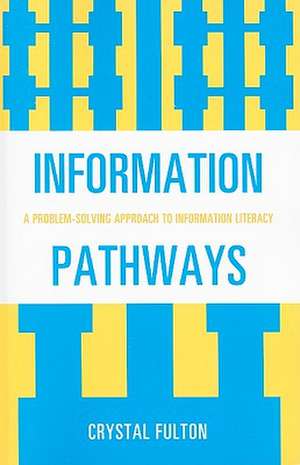
Information Pathways: A Problem-Solving Approach to Information Literacy
Autor Crystal Fultonen Limba Engleză Paperback – 23 mar 2010
.Build effective search strategies for solving information problems
.Evaluate and use information and information sources
.Apply information skills to the writing process
.Be at ease with numeric information
.Integrate information skills for smooth problem solving
.Maintain their new fluency with information
Organized into chapters that examine different ways in which information is structured, Information Pathways will help students develop and evaluate strategies for finding and adopting information.
Preț: 394.79 lei
Preț vechi: 549.52 lei
-28%
Puncte Express: 592
Carte tipărită la comandă
Livrare economică 07-21 noiembrie
Livrare prin curier în România Termenul estimat este afișat lângă disponibilitate.
Transport gratuit de la 400.00 lei Plată online sau ramburs, în funcție de opțiunile comenzii.
Retur gratuit în 14 zile Comandă securizată și suport în română.
Specificații
ISBN-13: 9780810874268
ISBN-10: 0810874261
Pagini: 145
Dimensiuni: 136 x 216 x 12 mm
Greutate: 0.21 kg
Ediția:2
Editura: Bloomsbury Publishing
Colecția Scarecrow Press
Locul publicării:New York, United States
ISBN-10: 0810874261
Pagini: 145
Dimensiuni: 136 x 216 x 12 mm
Greutate: 0.21 kg
Ediția:2
Editura: Bloomsbury Publishing
Colecția Scarecrow Press
Locul publicării:New York, United States
Recenzii
Fulton (Sch. of Information & Library Studies, Univ. Coll., Dublin) presents a straightforward guide to conducting research and becoming information literate. Encapsulating several library school courses...it's a good vehicle for explaining library research to novice library users in high school and college settings. Divided into 11 chapters, the book addresses factual information, how to research writing, numeric literacy, and other information-literacy topics. Each chapter starts with an introduction and specific learning objectives before moving on to manageable chunks of information. There are also quotes and diagrams throughout to emphasize the details. What makes Fulton's book effective is the inclusion of exercises-this moves the content from theory to practice. A useful tool for semester-long info lit courses or as a quick reference for students already familiar with the basics of research.
A reader-friendly layout including key concepts, quick tips, margin quotes, and numerous headings and subheads.
Information Pathways is designed to assist every reader in improving their own level of information literacy. This phrase, information literacy, means developing and evaluating strategies for finding and adopting information. Each chapter covers a different group of resources, such as chapter 3, "Finding Factual Information," and chapter 4, "Selecting and Navigating Electronic Information Systems." The entries explain how this group is structured or organized. Each chapter has quick tips and explanations contrasting two different approaches to finding or negotiating your way to your desired answer. Each chapter offers a few exercises to improve your skills at the end of the chapter. Unlike bibliographic instruction classes, this resource does not cover specific titles and explain their benefits to find answers in a specific field of inquiry. It provides a much broader discussion of how to use competitive resources efficiently to retrieve information....This title is highly recommended for academic libraries teaching courses in bibliographic instruction and information literacy.
A reader-friendly layout including key concepts, quick tips, margin quotes, and numerous headings and subheads.
Information Pathways is designed to assist every reader in improving their own level of information literacy. This phrase, information literacy, means developing and evaluating strategies for finding and adopting information. Each chapter covers a different group of resources, such as chapter 3, "Finding Factual Information," and chapter 4, "Selecting and Navigating Electronic Information Systems." The entries explain how this group is structured or organized. Each chapter has quick tips and explanations contrasting two different approaches to finding or negotiating your way to your desired answer. Each chapter offers a few exercises to improve your skills at the end of the chapter. Unlike bibliographic instruction classes, this resource does not cover specific titles and explain their benefits to find answers in a specific field of inquiry. It provides a much broader discussion of how to use competitive resources efficiently to retrieve information....This title is highly recommended for academic libraries teaching courses in bibliographic instruction and information literacy.