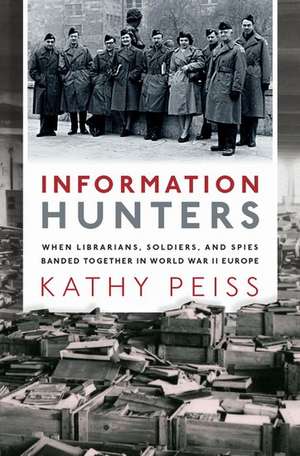
Information Hunters: When Librarians, Soldiers, and Spies Banded Together in World War II Europe
Autor Kathy Peissen Limba Engleză Hardback – 12 mar 2020
Preț: 254.53 lei
Preț vechi: 289.70 lei
-12%
Puncte Express: 382
Carte tipărită la comandă
Livrare economică 27 noiembrie-08 decembrie
Livrare express 23-29 octombrie pentru 74.05 lei
Livrare prin curier în România Termenul estimat este afișat lângă disponibilitate.
Transport gratuit de la 400.00 lei Plată online sau ramburs, în funcție de opțiunile comenzii.
Retur gratuit în 14 zile Comandă securizată și suport în română.
Specificații
ISBN-13: 9780190944612
ISBN-10: 0190944617
Pagini: 296
Ilustrații: 25 hts
Dimensiuni: 163 x 236 x 23 mm
Greutate: 0.54 kg
Editura: Oxford University Press
Colecția OUP USA
Locul publicării:New York, United States
ISBN-10: 0190944617
Pagini: 296
Ilustrații: 25 hts
Dimensiuni: 163 x 236 x 23 mm
Greutate: 0.54 kg
Editura: Oxford University Press
Colecția OUP USA
Locul publicării:New York, United States
Recenzii
In Information Hunters Kathy Peiss documents how information gathering was central to the U.S. victory in Europe—and how ‘collecting’ also came to mean, after the conflict ended, keeping information away from certain populations....Information hunting changed the course of the war, Peiss convincingly argues, and ‘made an imprint on the postwar world of books and information.’...In a time when we suffer from an overload of dematerialized information, Peiss's book is a valuable reminder of how different the world was when that information was scarce and existed only in vulnerable, physical form.
In her fascinating new book on information gathering and intelligence during WW II, Peiss spotlights the contributions of the American scholarly community. Her study—impressively researched and engagingly written—explores the ways in which librarians, archivists, and academics traveled throughout Europe to collect information relevant to the war effort....Peiss's narrative traces the work of these scholars from the procurement of open source materials at the beginning of the war through the collection of enemy documents in its closing stages to the thorny questions surrounding mass acquisitions in postwar Germany....In illuminating the link between information science and intelligence gathering, as well as the importance of foreign holdings in libraries as a symbol of American power, Peiss demonstrates that the academic community and military enjoyed a mutually beneficial relationship.
The book is carefully researched, written with care and skill, and provides an additional warning about the horrors of wartime.
Excellent and engaging....[Peiss's] analysis is smart, insightful, and compelling....Thanks to Peiss's informative and original book, we now know...why and how so many war-era German books and documents ended up in American research libraries....The information hunters...contributed to the development of information science,...helped tighten the relations between government, the military, and research university and libraries...and shaped the postwar intelligence activities and tactics of the National Security Agency and the CIA.
In astonishing detail, Peiss's study chronicles the multi-pronged efforts of American librarians, archivists, scholars, and military and intelligence personnel who activated a mass acquisitions programme that resulted in some two million foreign books and periodicals, thousands of microfilm reels, and 160,000 volumes looted from European Jewry by the Nazis and their collaborators, which found their way to repositories in the United States.
A marvelous new book about spy craft and the book world....I beg the creatives out there to read...and write a dramatic miniseries about bookish spies during the Second World War.
Illuminating the growing global power of the United States in the realms of intelligence and cultural heritage, Peiss tells the story of the men and women who went to Europe to collect and protect books and information and in doing so enriches the debates over the use of data in times of both war and peace.
This well-written and astutely researched book makes the wartime work of librarians engaging and engrossing. Those fascinated by intelligence missions or keen on the history of library science will appreciate this excellent read.
Information Hunters is Kathy Peiss's wonderfully surprising history of a little-known, World War II intelligence effort to gather newspapers, magazines, books, and every other kind of printed information about business, science, and ordinary life in Germany and occupied Europe. Working mainly through cities in neutral countries — Lisbon, Stockholm, Bern, and the like — agents quietly arranged to gather bundles, then truckloads, finally ship- and train-loads of books and paper for analysts to study. It's a beautiful piece of scholarship that reveals the war in a new light - as a struggle for knowledge and truth.
This fascinating book tells the story of the American librarians who set out on vast collecting missions amidst the destruction of World War II Europe. Cultural historian Kathy Peiss deftly reconstructs their work here, showing how librarians shaped the war and, in turn, how the war re-shaped libraries and librarianship. Beautifully told, this surprising story provides a valuable new perspective on the historical connection between war and the production of knowledge.
Kathy Peiss uncovers fascinating episodes in the history of information: the World War II entanglement of bibliography and spycraft as well as the postwar dilemmas of denazifying German culture while also dealing with cultural heritage collections that the Nazis left orphaned in their double project of confiscation and genocide. With its lucid attention to 'open source' intelligence gathering, incipient 'archive-consciousness,' and the anxieties of American influence on the world, this is history that is at once powerful and timely.
Kathy Peiss's Information Hunters tells the fascinating and important story of the American archivists and librarians who, during World War II, helped rescue, preserve, and repatriate huge numbers of books, newspapers, and manuscripts looted by the Nazis or otherwise hidden from sight. Their principal objectives were to confiscate and, in many cases, destroy Nazi materials and to locate and return or redistribute looted Jewish books. Many books wound up in American libraries and archives, greatly boosting their size and prestige, and helping to develop the field of information science.
Through savvy research Kathy Peiss has uncovered the enormous historical, ethical, and personal stakes of Americans' overseas efforts to collect-or destroy-the printed word during World War II. Her vivid account follows teams of scholars who scoured Europe's bookstores, battered cities, castles, and caves in search of material that bore witness to the continent's cultural heritage as well as its lies, secrets, and crimes. Pulling a book off the shelf of an American research library will never be the same after reading Information Hunters.
In her fascinating new book on information gathering and intelligence during WW II, Peiss spotlights the contributions of the American scholarly community. Her study—impressively researched and engagingly written—explores the ways in which librarians, archivists, and academics traveled throughout Europe to collect information relevant to the war effort....Peiss's narrative traces the work of these scholars from the procurement of open source materials at the beginning of the war through the collection of enemy documents in its closing stages to the thorny questions surrounding mass acquisitions in postwar Germany....In illuminating the link between information science and intelligence gathering, as well as the importance of foreign holdings in libraries as a symbol of American power, Peiss demonstrates that the academic community and military enjoyed a mutually beneficial relationship.
The book is carefully researched, written with care and skill, and provides an additional warning about the horrors of wartime.
Excellent and engaging....[Peiss's] analysis is smart, insightful, and compelling....Thanks to Peiss's informative and original book, we now know...why and how so many war-era German books and documents ended up in American research libraries....The information hunters...contributed to the development of information science,...helped tighten the relations between government, the military, and research university and libraries...and shaped the postwar intelligence activities and tactics of the National Security Agency and the CIA.
In astonishing detail, Peiss's study chronicles the multi-pronged efforts of American librarians, archivists, scholars, and military and intelligence personnel who activated a mass acquisitions programme that resulted in some two million foreign books and periodicals, thousands of microfilm reels, and 160,000 volumes looted from European Jewry by the Nazis and their collaborators, which found their way to repositories in the United States.
A marvelous new book about spy craft and the book world....I beg the creatives out there to read...and write a dramatic miniseries about bookish spies during the Second World War.
Illuminating the growing global power of the United States in the realms of intelligence and cultural heritage, Peiss tells the story of the men and women who went to Europe to collect and protect books and information and in doing so enriches the debates over the use of data in times of both war and peace.
This well-written and astutely researched book makes the wartime work of librarians engaging and engrossing. Those fascinated by intelligence missions or keen on the history of library science will appreciate this excellent read.
Information Hunters is Kathy Peiss's wonderfully surprising history of a little-known, World War II intelligence effort to gather newspapers, magazines, books, and every other kind of printed information about business, science, and ordinary life in Germany and occupied Europe. Working mainly through cities in neutral countries — Lisbon, Stockholm, Bern, and the like — agents quietly arranged to gather bundles, then truckloads, finally ship- and train-loads of books and paper for analysts to study. It's a beautiful piece of scholarship that reveals the war in a new light - as a struggle for knowledge and truth.
This fascinating book tells the story of the American librarians who set out on vast collecting missions amidst the destruction of World War II Europe. Cultural historian Kathy Peiss deftly reconstructs their work here, showing how librarians shaped the war and, in turn, how the war re-shaped libraries and librarianship. Beautifully told, this surprising story provides a valuable new perspective on the historical connection between war and the production of knowledge.
Kathy Peiss uncovers fascinating episodes in the history of information: the World War II entanglement of bibliography and spycraft as well as the postwar dilemmas of denazifying German culture while also dealing with cultural heritage collections that the Nazis left orphaned in their double project of confiscation and genocide. With its lucid attention to 'open source' intelligence gathering, incipient 'archive-consciousness,' and the anxieties of American influence on the world, this is history that is at once powerful and timely.
Kathy Peiss's Information Hunters tells the fascinating and important story of the American archivists and librarians who, during World War II, helped rescue, preserve, and repatriate huge numbers of books, newspapers, and manuscripts looted by the Nazis or otherwise hidden from sight. Their principal objectives were to confiscate and, in many cases, destroy Nazi materials and to locate and return or redistribute looted Jewish books. Many books wound up in American libraries and archives, greatly boosting their size and prestige, and helping to develop the field of information science.
Through savvy research Kathy Peiss has uncovered the enormous historical, ethical, and personal stakes of Americans' overseas efforts to collect-or destroy-the printed word during World War II. Her vivid account follows teams of scholars who scoured Europe's bookstores, battered cities, castles, and caves in search of material that bore witness to the continent's cultural heritage as well as its lies, secrets, and crimes. Pulling a book off the shelf of an American research library will never be the same after reading Information Hunters.
Notă biografică
Kathy Peiss is the Roy F. and Jeannette P. Nichols Professor of American History at the University of Pennsylvania. She is the author of Cheap Amusements: Working Women and Leisure in Turn-of-the-Century New York, Hope in a Jar: The Making of America's Beauty Culture, and Zoot Suit: The Enigmatic Career of an Extreme Style. A Fellow of the Society of American Historians, she has served as a consultant to museums, archives, documentary films, and public history projects.