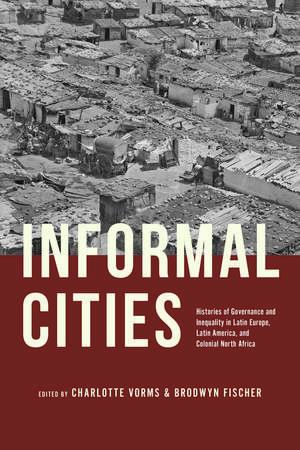
Informal Cities: Histories of Governance and Inequality in Latin Europe, Latin America, and Colonial North Africa
Editat de Prof. Charlotte Vorms Ph.D, Brodwyn Fischeren Limba Engleză Paperback – 4 sep 2025
Over a quarter of the world’s urban population lives in informal settlements. While informality as a concept has been widely debated, we still know very little about the phenomenon’s urban history or how that history has shaped the evolution of world cities. Spotlighting the historical processes that have created and sustained urban informality for more than a century, editors Charlotte Vorms and Brodwyn Fischer and this volume’s contributors reveal informality as an intrinsic feature of urbanity, shaping not only cities across the globe but also deeper processes of state formation, socioeconomic stratification, and political struggle.
The volume brings together case studies spanning more than a hundred years, drawn from Latin America (Brazil, Chile, Venezuela, and Mexico), Northern Africa (Morocco and Algeria), and Latin Europe (France, Spain, and Italy). Together, they show that informality is neither a contemporary crisis nor a predicament unique to the Global South. Topics include the origins of informal settlements and their relationship with law and institutional power; grassroots efforts to legitimize shantytown communities; mass social movements for rights to the city; the role that shantytown removal campaigns played in populist politics, fascism, and colonialism; and the ways that informality perpetuated racial and ethnic inequalities. Informal Cities is an indispensable guide to the complex and fraught terrain of urban informality in its many historical guises.
Preț: 232.78 lei
Puncte Express: 349
Preț estimativ în valută:
41.21€ • 47.95$ • 35.74£
41.21€ • 47.95$ • 35.74£
Carte disponibilă
Livrare economică 07-21 februarie
Livrare express 24-30 ianuarie pentru 26.57 lei
Preluare comenzi: 021 569.72.76
Specificații
ISBN-13: 9780226836010
ISBN-10: 0226836010
Pagini: 384
Ilustrații: 14 halftones
Dimensiuni: 152 x 229 x 25 mm
Greutate: 0.4 kg
Ediția:First Edition
Editura: University of Chicago Press
Colecția University of Chicago Press
ISBN-10: 0226836010
Pagini: 384
Ilustrații: 14 halftones
Dimensiuni: 152 x 229 x 25 mm
Greutate: 0.4 kg
Ediția:First Edition
Editura: University of Chicago Press
Colecția University of Chicago Press
Notă biografică
Charlotte Vorms is associate professor of history at the Paris 1 Panthéon-Sorbonne University where she is also a member of the Center for the Social History of Contemporary Worlds. She is the author or coeditor of several books, including La forja del extrarradio and What’s in a Name?Brodwyn Fischer is professor of Latin American history at the University of Chicago, where she also directs the Global Studies Program. She is the author or coeditor of several books, including A Poverty of Rights and Cities from Scratch.
Cuprins
Introduction: Informal Urbanism as History
Brodwyn Fischer and Charlotte Vorms
Part I: Law, Governance, and the Invention of Informality
1. Four Regimes of Informality: Legal Practices and Revolutionary Politics in Twentieth-Century Mexico City
Antonio Azuela and Emilio de Antuñano
2. From Insalubrious Housing to Unauthorized Neighborhoods: The Conceptualization of Urban Informality in Italy, 1880s–1960s
Francesco Bartolini
3. A Century of Governing with Informal Urbanization in Madrid, 1860s–1960s
Charlotte Vorms
Part II: Urban Informality and Political Struggle
4. “The Order Came from Above”: The Political and Ideological Foundations of Fascism’s Struggle against the Baracche in Rome
Luciano Villani
5. Carioca Favelas and the Catholic Church after World War II: The Case of the Fundação Leão XIII’s Interventions in Praia do Pinto
Rafael Soares Gonçalves
6. Democratizing the Republic by Instituting the Informal: Barrio Irregularity in Caracas and Venezuelan Democratization, 1941–1964
Serge Ollivier
7. The Invention of the Toma: Informality and Mobilization in Santiago de Chile, 1945–1957
Emanuel Giannotti and Boris Cofré Schmeisser
Part III: Race and Colonial Domination
8. Informality, Racialized Governance, and the Cidade Negra in Modern Brazil
Brodwyn Fischer
9. Bidonvilles in France: A New Term for an Old Phenomenon?
Françoise de Barros
10. Urban Risk? Constructing Shantytowns as a Problem of Colonial Governance in Algiers and Casablanca, 1919–1962
Jim House
Notes
Index
Brodwyn Fischer and Charlotte Vorms
Part I: Law, Governance, and the Invention of Informality
1. Four Regimes of Informality: Legal Practices and Revolutionary Politics in Twentieth-Century Mexico City
Antonio Azuela and Emilio de Antuñano
2. From Insalubrious Housing to Unauthorized Neighborhoods: The Conceptualization of Urban Informality in Italy, 1880s–1960s
Francesco Bartolini
3. A Century of Governing with Informal Urbanization in Madrid, 1860s–1960s
Charlotte Vorms
Part II: Urban Informality and Political Struggle
4. “The Order Came from Above”: The Political and Ideological Foundations of Fascism’s Struggle against the Baracche in Rome
Luciano Villani
5. Carioca Favelas and the Catholic Church after World War II: The Case of the Fundação Leão XIII’s Interventions in Praia do Pinto
Rafael Soares Gonçalves
6. Democratizing the Republic by Instituting the Informal: Barrio Irregularity in Caracas and Venezuelan Democratization, 1941–1964
Serge Ollivier
7. The Invention of the Toma: Informality and Mobilization in Santiago de Chile, 1945–1957
Emanuel Giannotti and Boris Cofré Schmeisser
Part III: Race and Colonial Domination
8. Informality, Racialized Governance, and the Cidade Negra in Modern Brazil
Brodwyn Fischer
9. Bidonvilles in France: A New Term for an Old Phenomenon?
Françoise de Barros
10. Urban Risk? Constructing Shantytowns as a Problem of Colonial Governance in Algiers and Casablanca, 1919–1962
Jim House
Notes
Index
Recenzii
“This outstanding collection is intellectually rigorous and empirically rich. Thanks to the spatial and temporal breadth of the contributions, as well as the clear analytic focus of the collective inquiry, it is tightly organized on key themes without being narrow—a rare example of success for both global historical research and edited collections. It is a major contribution—an utterly novel demonstration of the historical nature and modernity of informality.”